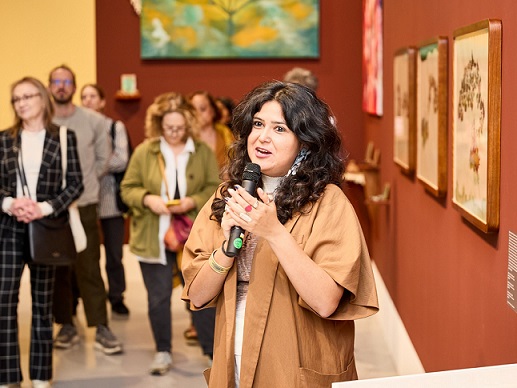
The Land Sings Back emerges as a stunning, intricate exhibit that ‘reimagines our relationship to our breathing planet through the work of thirteen artists with ancestries across South Asia, Africa and the Caribbean. It encourages connection with indigenous wisdom, which is reciprocal rather than extractive in terms of land’. The brilliant collective show is curated by Natasha Ginwala, the artistic director of Colomboscope: a Sri-Lanka based contemporary arts platform which aims to "constantly listen with a network of organisations of different scales across South-Asia, many artistic collectives and partnership with the UAE. The organisation is a responsive project, open to the developments of Sri-Lanka over the last decade as it undergoes various political and economic challenges. They think about the slow nationalism that has led to numerous years of war, and how to invoke new forms of relationality that are going to strengthen the island’s engagement with the region and the world today. Colomboscope is not a typical brick & mortar space, and so a specific program does not need to be followed: they are interested in manifesting festivals that are plural and regionally resonant.’ This ethos is certainly evident in The Land Sings Back as an artistic collaboration with the Drawing Room, in Bermondsey, South London, which features different indigenous and diasporic artists who uniquely engage the interconnectivity of neo-colonial existence, cultural mythology and the wider healing force of the natural world: ‘reception for the show has been extraordinary,’ Natasha shared with us: ‘it is deeply committed to culture that is rooted within lived context– it is about the shared experiences of the global majority where solidarity spills over. Many people have been writing to say that they feel there are rare ways in which their histories are being seen."
***
The gallery becomes a meditative luminous space that invites one to explore sensitive relationships with the ancestral land while reconsidering our own abstracted connection to the fundamental earth. Indeed, the walls reflect soil, expanding and stretching out as if into a liminal, almost spiritual, plane. The participating artists include Lado Bai, Shiraz Bayjoo, Lavkant Chaudhary, Jasmine Nilani Joseph, Manjot Kaur, Otobong Nkanga, Rupaneethan Pakkiyarajah, Joydeb Roaja, Anupam Roy, Anushka Rustomji, Pamela Phatsimo Sunstrum, Arulraj Ulaganathan and Charmaine Watkiss. To delve into but a few of their jointly radiant works: Manjot Kaur’s, Custodians of the Grasslands, 2025, seems to evoke the giant curving form of a peafowl peacock feather as she ‘conjures femme hybrid identities in which bird, animal and flora become mythopoetic tableaux’. The artist consciously bases these on endangered species – for example the blackbuck, native to India’s grasslands – ‘signalling the human follies and technocratic governance that perpetuate planetary exhaustion’ to quote Natasha’s critical essay on the show. In another piece, Otobong Nkanga’s Subsidence, 2025, tactile, organic blue pods appear to be highlighted as a potent source of restorative energy. Shiraz Bayjoo’s precious collection of beautiful natural artefacts such as coconuts, volcanic rock and seashells, and drawings, Botanical Shrines, 2024, , ‘redirect the gaze away from plant hunters, imperial administrators and antiquated travelogues.’ Rupaneethan Pakkiyarajah’s colourful works, evocative of fruit and organisms as well as the marine cycle that sustains them, include playing-card format drawings, ‘reflecting on how humans have evolved within the same waters, astral dust and minerals as the ecosystems they inhabit and often disrupt.’ As you walk in, Anupum Roy’s large-scale activist art hangs confrontationally; from his series, Time is Sloshing (2024), it ‘chronicles protest against anti-people policymaking and urban demolitions. He also documents environmental movements in rural Bengal opposing the proposed Deocha-Pachami coal mine, ongoing land grabs and dam projects impacting fragile ecologies in north-eastern India.’
However, the beauty of The Land Sings Back is at once held in its paradoxically large scope: the amplification of the celebration of nuance of the immense natural world and its reformative relationship with the individual subject. The ideas of social legacy, ecofeminism and documentative yet intimate stories converge into one lifting overarching truth: that of the counteractive endurance of the sanctity of our planet. Natasha’s own work: "does connect to questions of ecology from the point of view of spatial and environmental justice." She added that she has “been working with indigenous artists over the years from various contexts that are focussed on principles of guardianship and sovereignty that exist in pre-national and pre-colonial frameworks – artists engaged in conveying their own kinships and larger civilisational histories. It is about the connections that are not just between people and earth but also relating to other species which presents a different approach and aesthetic.' There is an all-encompassing ambient empathy that contributes to the highly "sensorial" quality of the show and makes concrete the idea that it is possible to movingly reclaim our relationship to the earth, not only pushing back against the complex corrosive division of current geopolitics, but perhaps also recovering humanity and elevating the direction of an ailing world. Natasha is also the co-curator of Sharjah Biennial 16 and one of Frieze's Five Curators to Watch in 2025. The Land Sings Backs runs until 14th December.
What defines a well-curated show for you?
I have never done an exhibit that was medium-specific, such as drawing, and I try to bring forth why this selection of artists and their practice extend the logic of drawing in relation to environmental aesthetics. I have known some of the creators for years, for example Joydeb Roaja ,who is an indigenous artist who does incredible drawing which is intuitive yet expansive and creates chronicles of communities who are living through and passing on those legacies so that drawing becomes a space of record, especially as the native land has been militarised and under threat for a long time. I have been waiting for the right platform to work with him.
How would you say The Land Sings Back engages with the world of contemporary art?
I have worked with several of the artists before and am interested in how we can shape longer conversations and deepen the understanding and recognition of their contexts – The Land Sings Back is a vibrant tapestry of social, historical and political relation and we have not just thrown together works on the walls. Also, we are dealing with artists from very different generations. We are not functioning in the set-up of a conventional gallery and have freedom to explore. It is refreshing that a lot of the work is being shown in this kind of exhibition; we have built unique case studies which are not just drawings.
Another element which was interesting is the cosmic imagery used to explore the idea of connection to the land – could you share your thoughts?
What we are dealing with in terms of aesthetics and social histories, on the one hand, is drawing on the long impact of imperial ways of marking the earth and colonisation of its resources. The artists draw on the long histories of the plantations as well as the land. The botanical garden is a site of movement from traditional practices of agriculture to the mapping of colonial plantation which produces sugar, coffee and tea; we look at the ways in which the land shifts and how it is cared for – the balance of what is put into the soil and removed from it. The artists are constantly wrestling with these histories which are continuing. We still have plantations, and they are still sites of exploitative labour, and yet these are our realities: how do we study in way that is not only from a space of loss or damage but also perspectives of revitalisation and understanding the role of these communities labouring in an everyday sense. This includes songs, stories and remembering their place of origin: Roaja Arulraj Ulaganathan commemorates women, showing them arriving as bonded labour from India to Sri-Lanka. A lot of my shows do pursue a multisensory experiential aspect, but at the same time deliver certain kinds of stories and histories that have been oppressed or sidelined, and yet appear in ways that artists personalise, talking from a communal perspective – not just as a theme but often connected to work in Sri Lanka.
W: https://drawingroom.org.uk/the-land-sings-back/