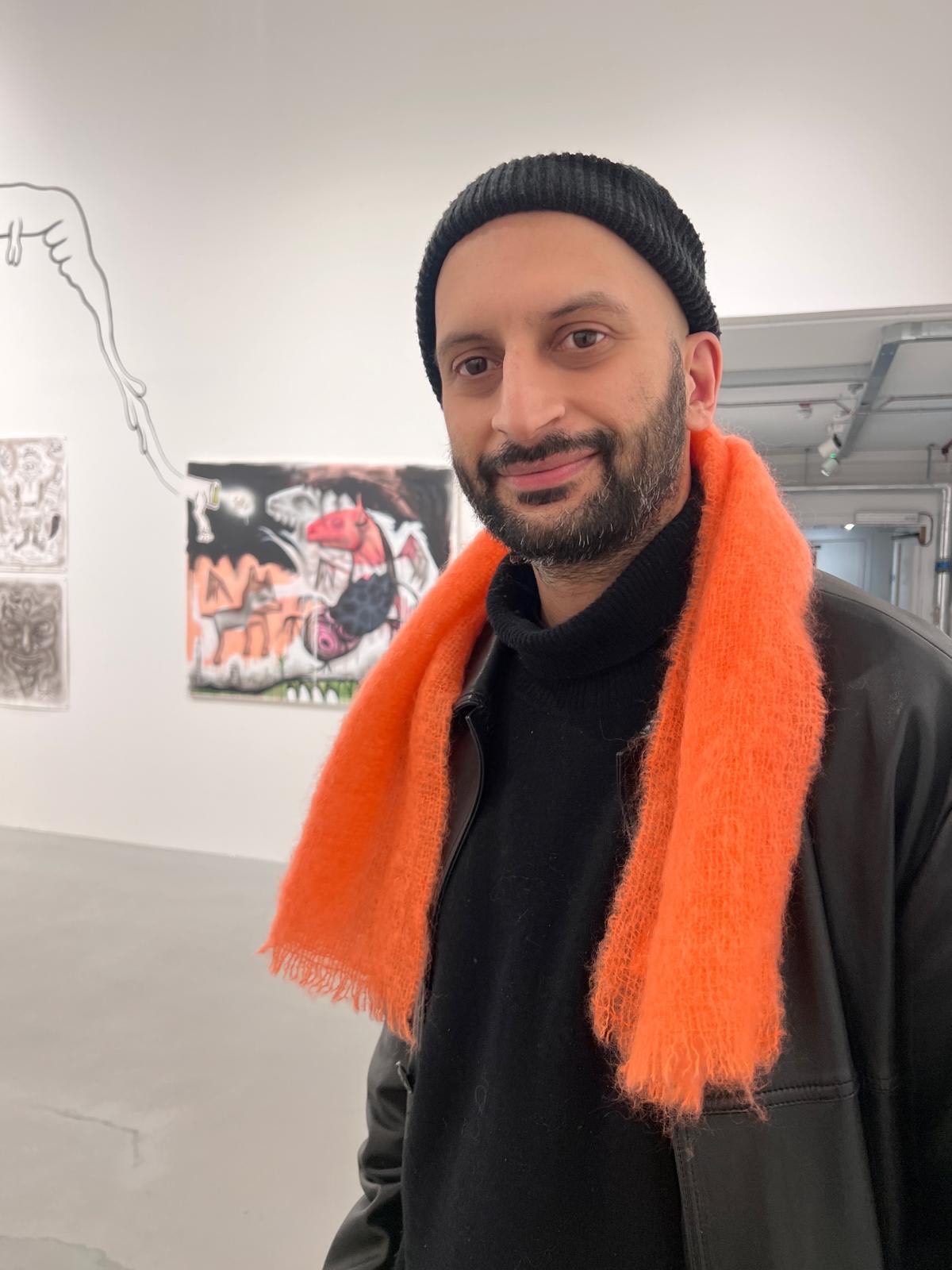
Hardeep’s latest illustrative show, Inner World, appears as a psychedelic post-colonial epic which explores the crisis of contemporary identity, persisting power politics and racial violence through a well-constructed and interestingly effective fictive lens. It is the artist’s first solo show in London as he gradually breaks into the international artworld, having exhibited at London’s Frieze Fair, Triennial at New Museum in New York and been nominated for the Film London Jarman Award in 2018. His new commentative display aptly takes place in the spacious venue of Drawing Room, in Bermondsey, where Hardeep’s signature surreal graphics grind brazenly across its huge white walls. The artwork relays an abstract parodic version of British imperialism, mass migration and eventually integration which is literally delineated by one huge latitudinal mark that Hardeep describes as intentionally “animated, mutating and organic as a way to suggest a degree of coherence across the different smaller works.” Much is also communicated through the artist’s playfully mystic creative touch which involves “airbrushing, canvassing, and painting using Indian ink and dip pen.” One piece is entitled, Equalities, Diversity and Implosion, and depicts a brooding blue, smoky nebulous face that seems to be dissolving into a human phantom as a jeering crowd of culturally stereotyped hands point damningly towards it. This could reflect the adverse emotionally deteriorative impact upon one’s essential self when it is forced to conform to a constrictive nationalistic dictate which robs a person of true living depth.
***
Indeed, another piece seems to show the haunting legacy of racist history hanging over its assimilated subject hollering the phrase, ‘I have some urgent colouring to do’, as if it were one of J.K Rowling’s soul-sucking poltergeists. The deep psychic pain of struggling to claim a pure social stake in the time of globalisation as people of colour is shown as enduring long after the accomplishment of geographic sovereignty. Even if the obvious physical markers of oppression are gone, the desire to be fully authentically seen still rages: a recurring motif in Hardeep’s work is Sepoy Man, a fictive character inspired by the history of Sikh soldiers, who were sent to fight on behalf of the British Empire, and seems to symbolise the subjugated state of modern British-Asian identity where even that diasporic nomenclature can be seen to have a eugenic connotation – Sepoy Man is shown appearing at one point in the exhibit battling the external colonial prescription, in the form of hands, that ongoingly attempts to erase his indigenous and developing self to controllingly dominate his spirit. He seems to be skewered in a militaristic face-off with that ironically alien part of his brain or guts or both. Exposing viscerally such mental subjugation, Hardeep then portrays the discordant process of reckoning with an imposed imperial identity as if it is an explosive psychosis. Indeed, the perception of individual consciousness as ailing is often a literary reflection of the sickness of the world: “I wanted to mix fantasy with real life,” the artist commented, “to create a jarring feel. I wanted to evoke representations of magic and spells and thought of Gandalf’s elaborate smoke rings specifically for some of the work. I had created parts of the exhibit before Trump’s announcement about removing the practice of EDI. I don’t want to pin it down, but there are digestive processes depicted to a degree: imagery of gaseous biology building up as well as the rituality of incense and smoke – this is perhaps a comment or suggestion of what the terms equality, diversity and inclusion really mean as when someone is included there is still paradoxically a degree of exclusion. There are strange principles underlying: who is this all really for?” At the core, Hardeep seems to reveal the absurdity of obsessively attempting to construct social identity altogether.
Especially when it is so superficially rooted in materialistic incentives of conquest, territory and acquisition driven by an antiquated West. This idea is certainly skilfully reinforced in the evocation of fantastical narratives of war such as Lord of the Rings and Game of Thrones which show such medieval thinking prevailing in modern times. Indeed, prior work of Hardeep’s pinpoints the neo-colonial multinational influence that endemically directs today’s racial politics such as in his lyrical short film, BAME of Thrones, which states ‘my soldiers work for Maybelline…’. However, the kaleidoscopic kingdom Hardeep builds is ultimately expansive – even transcendent in its ability to present perspective which is a comic catharsis of the myopia simultaneously being lampooned. Here, Hardeep’s intricate setting of the landscape of a varied pop-cultural videogame is a recovery of personal subjectivity contemporarily – even more so as this medium, together with tv shows, is a type of public authority that intimately speaks to him: “videogames are associated with being a child and at home with my parents – that mode of consumption existed and developed throughout my life and it feels quite important to my understanding of the world. I didn’t really read that much fiction when I was younger but there were certain games that were very well written and had great stories. For me, game worlds also conjured the Brechtian notion of the fourth wall via their empowering interactive features. When you do think about what’s going on with these games, they challenge quick cursory readings of subjectivities. There is further the idea that obstacles are set out equally for each player. The set-up of a virtual plane does not necessarily mirror barriers in the real world. You can escape and engage constructively within either world but game worlds are structured in the same way for every player.” The ability to now autonomously connect to diverse conceptual surroundings can provide hope for an energised complete self. Indeed, Hardeep’s cosmopolitan humour, which subversively appropriates the narrow-minded grand narrative of the past to potently mock it, is tangible in-yer-face proof. There is opportunity for creating strong “cultural interdependence” which elevates as opposed to the ethnically invasive and reactionary divisions by way of the dominant political doctrine:
“My work is mostly charged with dialectical conflict– the energy within the work is a build-up of tension and part of expressing that might mean presenting contradictory perspectives on a single plane or rapping lyrics in videos that have double meanings. If I do draw a beturbaned and bearded Sikh soldier then I am conscious that this will be understood as a racial subject which reflects my desire to have racial pride but without being a victim of subjugation. I try to enjoy myself and that’s what you see in the visual material: pleasure in a modern cultural context versus that confrontation with the burden of the past.” Finally, Hardeep’s illustrations evolve beyond the baseness of simplistic identity politics to underscore the greater significance of being existentially socially free.
You use surrealist free-associative techniques to construct the Pintooverse that forms your fantastical narrative content: what are some of these?
There is an attempt to understand what it may have been like for my parent’s generation to come to the UK, but is also built on my own observations and speculation. A lot of the pieces are self-portraits and expanded versions of this, and are drawn from my general individual interests: the surreal element would be the fact that ideas are not necessarily lined up in a straight-forward manner. There is content that is inexplicable to a degree. When you are using drawing tools and ink pens, your body and arms find a way to work where habits are formed and outcomes that occur which aren’t easy to explain. I also use ideas from day dreams whilst on the train or when I’m drifting off – using simple rhyme structures in my writing to generate associations is another technique.
You grew up in Birmingham and now live in Glasgow: did you face a lot of racism in these areas or has this been confined to just moments such as Black Metal gigs?
A lot when I was younger actually – but that incident at the concert happened 15 years ago now. Since then I think it is less visible. The direct manifestations of racism in everyday scenarios don’t exist as much, arguably, but it doesn’t mean the latent ones aren’t present – I perversely, and sardonically, suggest in my work, through my stereotyped caricatures, that I find explicit displays of racism more confirming in a way, as the underlying ones are becoming more invisible and are arguably more horrifying because they are hidden. Another example is having artists as figureheads for diverse programming at the expense of looking deeply at those respective cultural histories. The idea of diversity is still coming from an establishment but it’s not necessarily neutral.
I: @Hardeep_Pandhal
W: https://drawingroom.org.uk/exhibition/hardeep-pandhal-inner-world/
"I wanted to evoke representations of magic and spells"