An artist to watch is Bina Shah. Her multidisciplinary abstract work has been critically acclaimed and recognised through prestigious accolades including Winner of the 2019 Woolwich Contemporary Print Fair Prize, awarded at the National Original Print Exhibition at the Bankside Galleries, and shortlisted for the Boodle Hatfield Printmaking Prize 2020. Bina’s rich life experience and diverse cultural background has been a formative influence: “I spent much of my childhood in Nairobi, Kenya, where my father ran a horticulture business. Much of my younger years were spent outdoors surrounded by nature. This has stayed with me.”
Moving to the UK with its drastically contrasting cityscape further developed her awareness and appreciation of the multiplicity of textures, sensations and hues of her environment: “Emigrating as a child, we arrived from the heat of Africa to an urban metropolis in the middle of Winter.” Bina reflects that this dramatic change opened her to new experiences and the possibilities of adaptation: “Like many others of my generation, I had to adapt quickly to this new and alien environment. This sense of adaptation has been a constant throughout my career. I spend a lot of time experimenting before committing to a body of work.”
She began her formal artistic training within the more precise, representative field of illustration. On completing a four-year course with foundation studies at Harrow School of Art, she was one of the first Indian women in the UK to graduate as an illustrator. And in her final year she was the first person in the history of the Art School to be selected for both national and international exhibitions in the same year. She went on to receive a series of high-profile commissions including illustrating for Vogue, Illustrated London News (1842-2003), Time Out, Cosmopolitan and other well-known magazines. Notably, she was commissioned by Anita Roddick to illustrate the first ‘The Body Shop’ book after designing a range for the iconic Roger La Borde’s greeting cards company. She subsequently went on to illustrate Karen Blixen’s ‘Out of Africa’ book alongside David Shepherd. The book was published in conjunction with the release of the Sydney Pollack’s multiple Academy Award winning film.
She shared the insights into her organic journey: “The opportunity to take inspiration from and celebrate the indigenous designs and colours of African tribal art, in the context of a western film, and working alongside a classical western artist and renowned book publishers Schuckburgh Reynolds, was a wonderful experience. Every time I look back to this book it evokes memories of my childhood.” Following a break from full-time illustration to raise her two young children, Bina continued to apply her creative talents in a more commercial context, designing packaging and marketing materials for produce for major supermarkets and wholesalers. This gave her both creative and commercial experience and enhanced her spatial awareness skills which she feels has been helpful in her work as an illustrator and abstract artist. She resists a demarcation between business acumen and the imagination, with her own experiences representing the equal value of both:
“Creativity and imagination should be considered a superior skill, in the same way as good accounting. Technology is disrupting the world of work and we are seeing an increasing automation of certain manual processes. Certain things cannot be automated however and as a result, we are seeing increasing value being placed on people who can think independently and creatively. The most successful logos are based on creative branding e.g., Coca Cola, Apple, Rolls Royce, McDonald’s etc.” In fact, at the age of 10 Bina designed a logo for her father’s company; KHE and the trademark flying flamingo logo for air flown produce from Kenya that is internationally considered to be one of the leading brand names in the industry. Thus, the realms of a corporate business and creativity are one and the same. In this vein, she also made sure her two young children were exposed to all aspects of creativity, encouraging them to keep a little sketch book to journal their travels by drawing and writing. She strongly believes that children have a natural intuitiveness and ability to respond to their surroundings and are uninhibited to express their emotions, something that should always be encouraged; but it is often sadly lost through lack of encouragement and formal education that mainly focuses on the three R’s. Hence, she taught after-school art classes at a preparatory school to encourage these skills and finds children’s drawings inspiring as they have a certain primal purity and spontaneity about them. Bina’s contemporary work radiates a raw energy that makes it markedly unique. It is as much a statement of individual authority as it is a sentimental ode to growth.
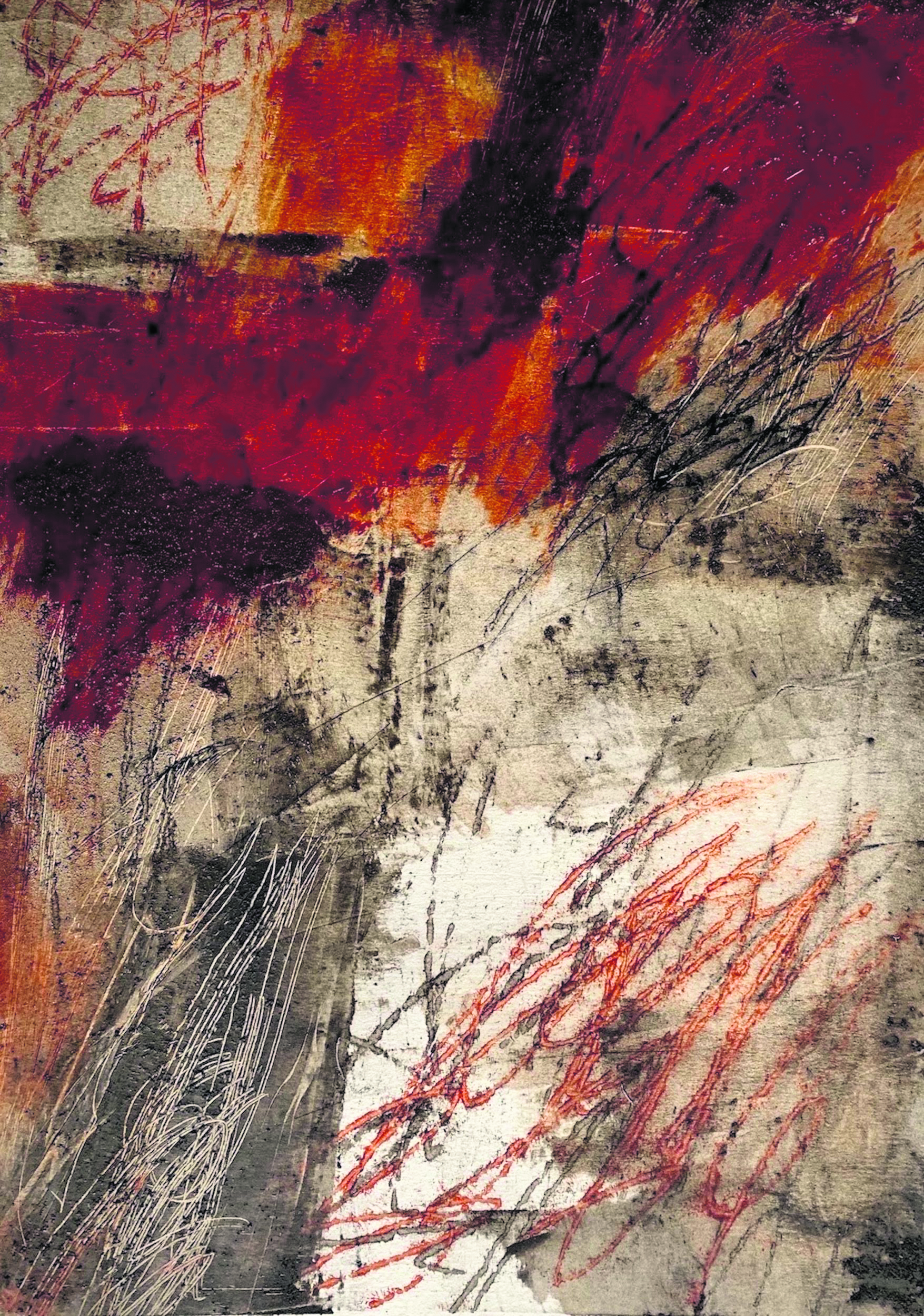
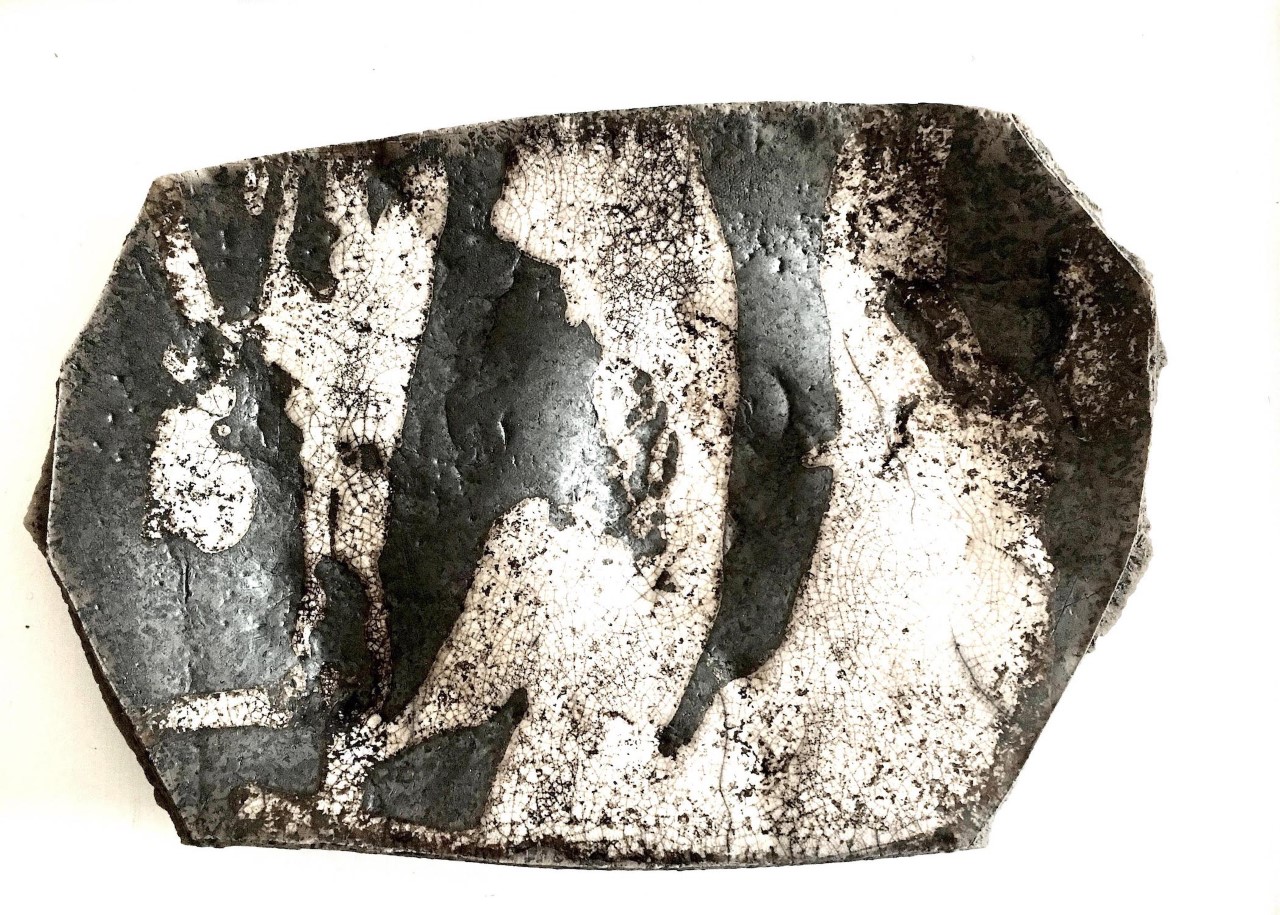
Here, a timely return to the sensory is also evident in Bina’s recent work as she chooses to add earth and natural pigments in her work: “I’ve always enjoyed the hands-on aspect to my work. I remember as a child growing up in Africa and playing with that rich, red, indigenous sienna coloured mud and making objects. Hence, I view my practise as about ‘making objects’ rather than a surface and the multi-layered two - dimensional work blurs the boundaries between painting, drawing, printmaking and ceramics to form something entirely new. She would not necessarily characterise herself as “green” artist, her practise implies a profound respect for the environment. “I consciously try and avoid the use of plastics and chemically-produced pigments where possible, replacing them with natural alternatives. Often using homemade soya milk to bind the natural pigments as well as using gum Arabic, tempera, glair and other natural binders. Harnessing natural materials from nature draws us closer to our primal roots; it can be beneficial to our art and our environment whilst making us more conscious to act responsibly.”
***
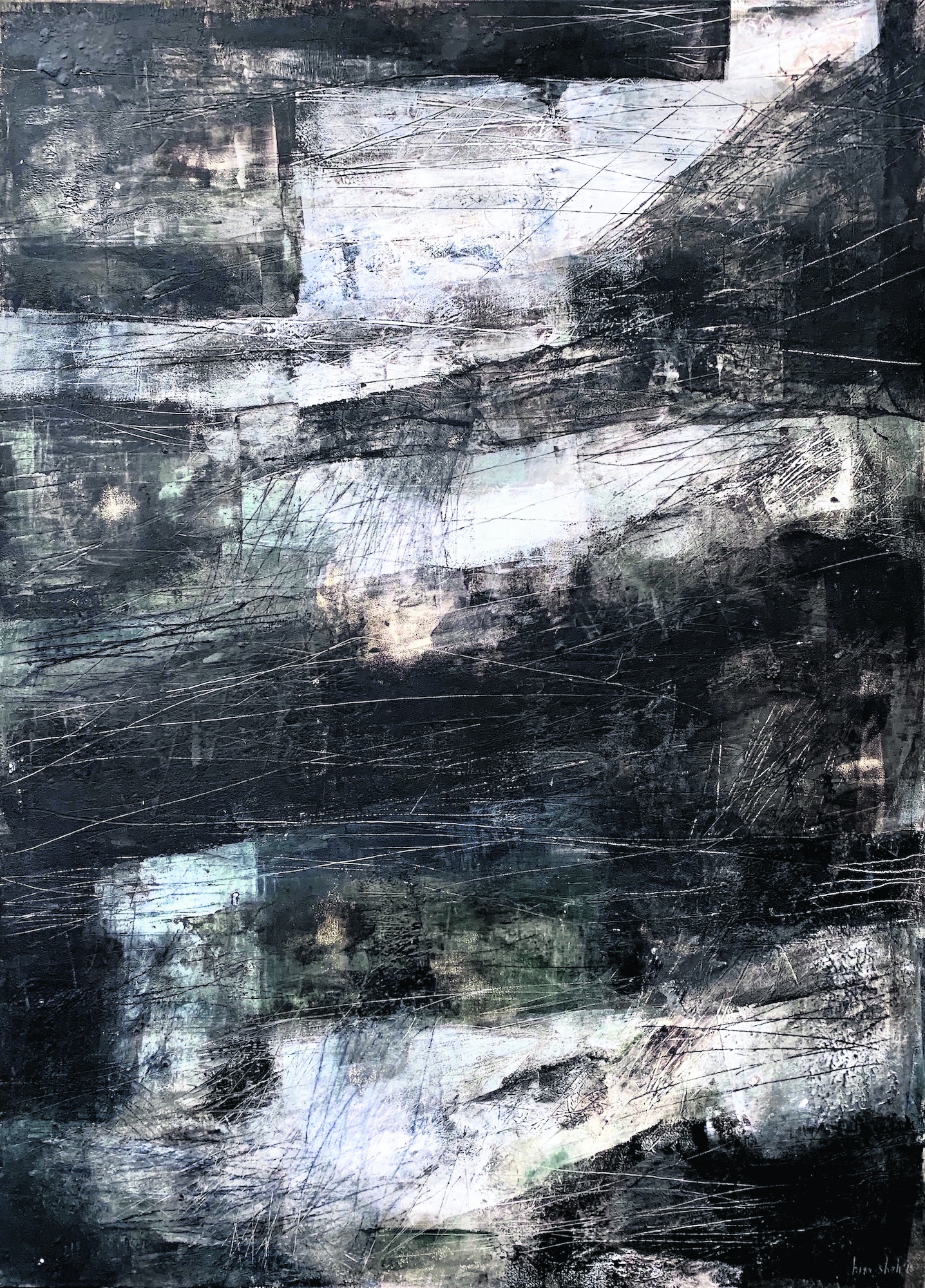
Bina returned to the field of fine art through printmaking which she felt freed her from the constraints of the limited scale of illustration. As part of this journey, she had to unlearn and relearn methods traditionally learnt at art school. Her work has gravitated more towards abstraction and is known for her novel use of materials and techniques rich complex surfaces specialised with use of oil, cold wax and earth pigments; mediums that enable her to express the subtle nuances of her environment: “Being an abstract artist and an illustrator aren’t all that dissimilar in some ways. Illustration is all about creating a visual narrative from text and it involves a mental process of abstraction. Abstraction is about enabling the viewer the opportunity to create their own narrative.”
Whilst Bina’s practice is studio-based, and categorises herself as an abstract landscape artist in the broadest sense, as the landscape clearly functions as potent sources for her inspiration, she rarely refers to her photographs or sketches, as she relies more on a feeling or an experience which seems to serve best to lodge that sensation in her mind to create her work: “It was spending time on the West Coast of Ireland that really accelerated my journey into abstraction. The environment there, with the crashing waves of the Atlantic and the ever-changing light is something which I felt simply could not be captured through the tradition of making on-site sketches as a basis for finished works. I began to experiment with unconventional techniques and materials to try and capture the sense of place. Choosing processes and organic materials that are hard to completely control offers scope for the imperfect and accidental and provides a sensation of discovery. The use of indigenous materials and earth pigments to create colour and texture allowed me to create a direct connection to the land.”
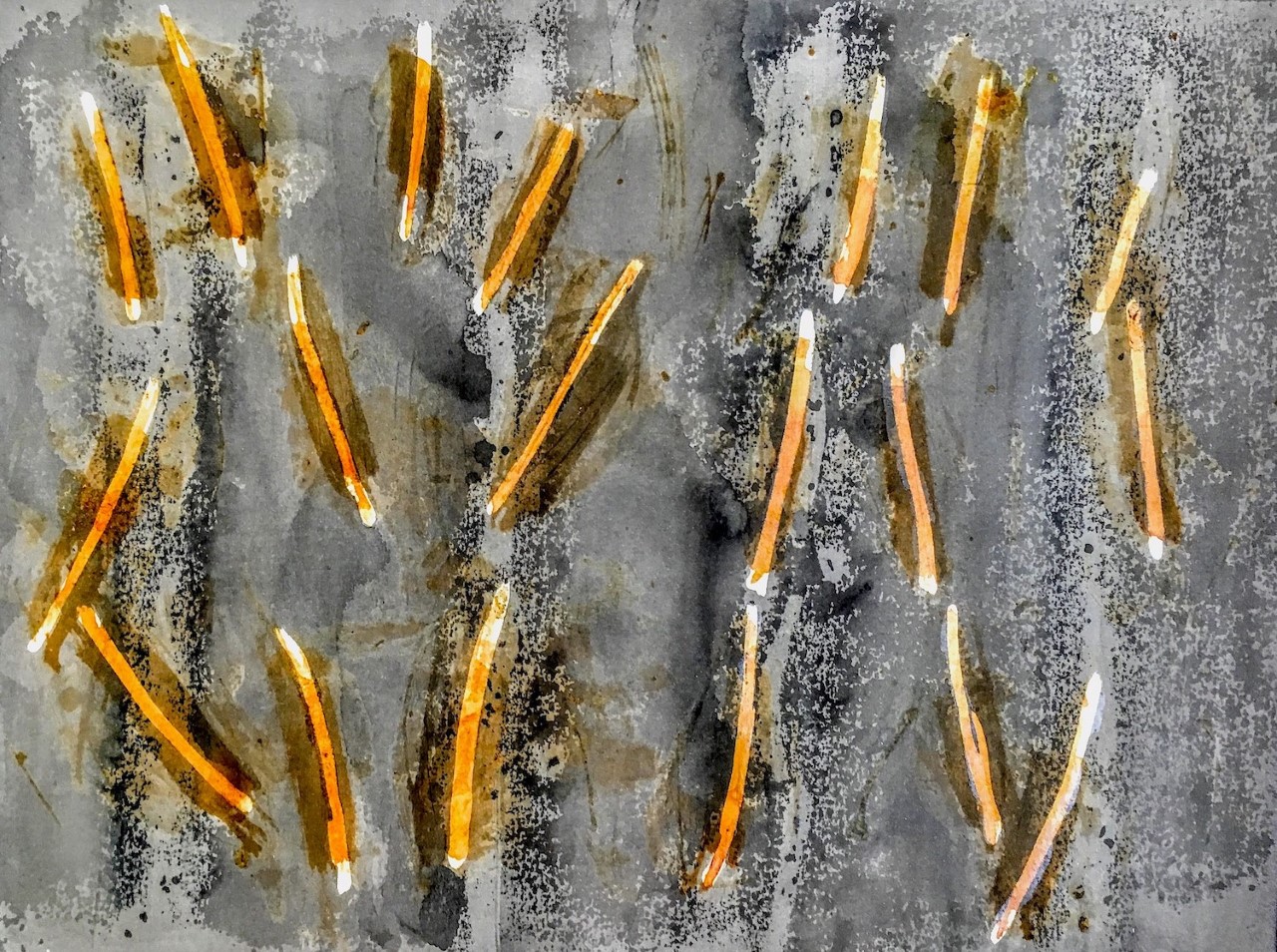
Her work is a marked departure from the more literal world of drawing and classic representative art. Indeed, Bina’s artwork has an individual energy that challenges traditional classification altogether: “Negative space gives the freedom to draw what is wanted and not what is already there. This is why I really believe in the spontaneous honesty of an artist’s sketches - there is a beauty in the impulsivity”. Bina’s work is sometimes seen as monochromatic and dark. However, her choice of colours is often seen as bold or tentative. The challenge is always to keep them alive and autonomous – stop them becoming predictable or formulaic. The layers of colours are revealed only when the eyes “settle”. And that requires a state of skilled “unknowing”: “The lines and marks are not for reading or explaining – they are entities in a dialogue with the surface and colour. Through a process of layering, building, etching, abrasion and deconstruction, incorporating indigenous materials, an image is created, echoing memories of a place, provoking emotion and challenging the perception of the viewer to find their own definition and narrative. It is a subtler exploration of emotion. The thoughts that are evoked aren’t so glaring or in your face.”
Bina’s draws inspiration from a range of artists from the past to the present day. She is a keen advocate of South Asian women thriving in the Arts: “At art school we only ever learned about male artists, and never studied major successful female artists. Living in London gave me the opportunity to see, first-hand, works of leading women creatives such as Zaha Hadid, Lubiana Himid, Rachael Whiteread, Rebecca Salter, Nancy Spero and Agnes Martin. Female artists like Louise Bourgeois, Ani Albers and Tracy Emin, most of whose work have both the elements of art and crafts - incorporating what was then seen as the female attributes of sewing and stitching into their mainstream work - was exciting and inspirational. It was challenging to be a female Asian artist of my generation. There weren’t many of us around and the value of creativity wasn’t necessarily understood or encouraged by our communities. I was lucky to have parents who, although not pretending to understand everything that I did, supported my career choice. Now that South Asian communities are well established and have thrived in the UK, it is pleasing to see young Asian women choosing, and being supported to choose, creative career paths and being celebrated for doing so”
As well as local pigments, she also embraces local artistic traditions: “I’m interested in traditional techniques such as hand dying and the natural staining qualities of spices and natural plant material. Unfortunately, the dying industry is fading away in many countries like India and Africa due to economic and climatic changes. I like the idea of preserving these ancient traditional skills, even on a small scale, and hope that I can play a small part in championing and preserving these techniques.”
When asked if traditional training is as important in making good art, Bina’s response was that it was two-fold: “You do need the basic practical training that develops hand-eye co-ordination. Those techniques help to engrain a relationship with your creativity. However, it’s important to remember that we naturally draw before we write: it is an emotional expression of how you are feeling. That first mark on the page has a precious primal quality. You must trust your instinct. It’s a balance of both.” This resonates with the Henry Moore quote that “Art is the expression of the imagination not the reproduction of reality”.
Bina’s painting 'Winter Storm on Bracken Fields XII' (see image) has been selected for The Royal Institute of Painters in Watercolours 209th Exhibition and is on view at:
Mall Galleries,
The Mall, London SW1
20 – 29 May, 11am - 4pm |
|
For all enquires please email:
[email protected]I: https://www.instagram.com/bina5hah/
To view more of Bina’s work please visit:
W: https://www.binashah.co.uk/