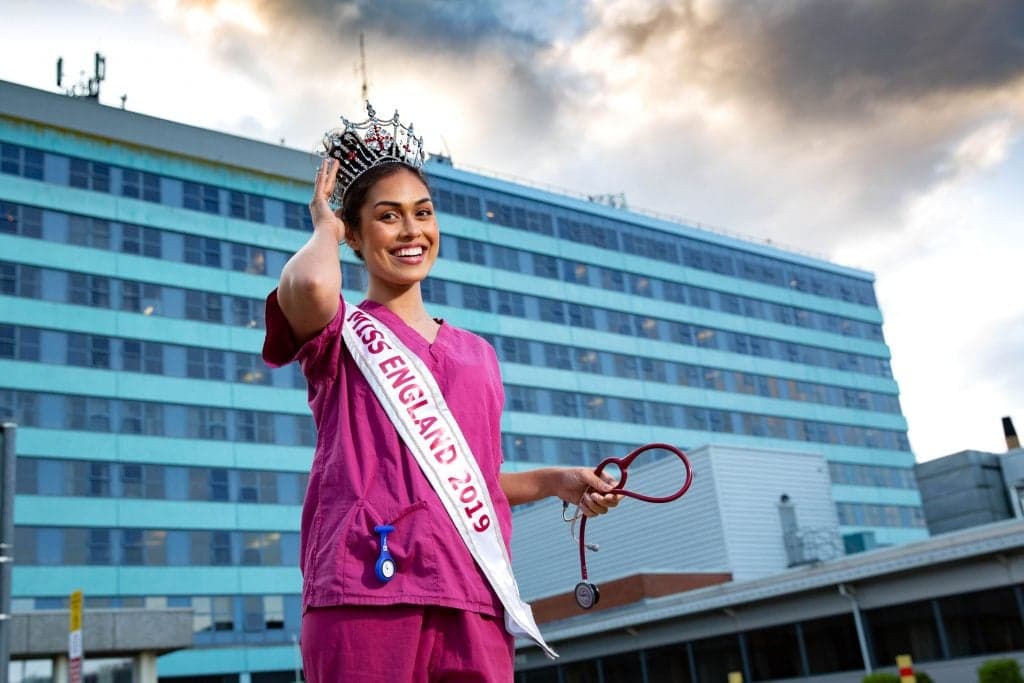
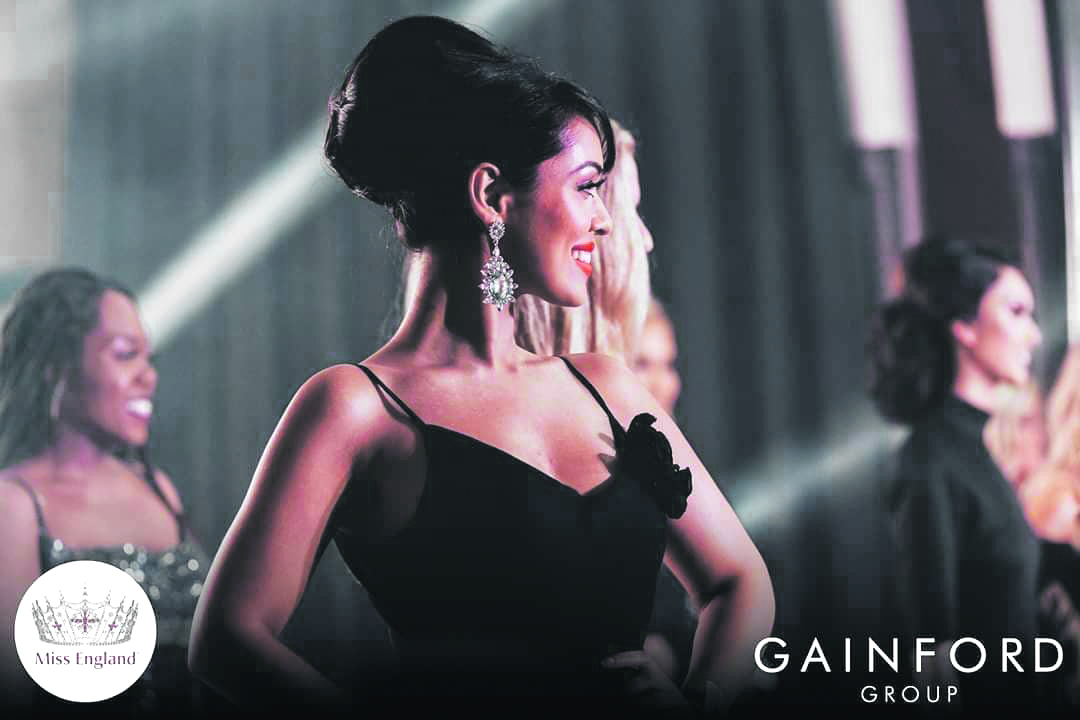
23-year-old Bhasha made international headlines when she won the title of Miss England, this August, just hours before starting her new day job as a junior doctor. Currently practising at Pilgrims Hospital in Boston, Lincolnshire, the intelligent beauty told Asian Voice: “Growing up, I was a complete boffin. I chose to study to medicine because it allowed me to combine my love of academia with other natural passions such as socialising and connecting with lots of different people.” A legendary beauty competition, setting its winners on the sole path to becoming Miss World, Miss England received somewhat of a record number of applicants, 21,000, this year, under its newly established ethos of promoting career women over the archetypal image of the flirty front-page model. “Actually, I really enjoyed the Miss Beautiful Hair round,” the forthcoming Bhasha stated, “because it allowed me to try something different!” Also, an aficionado of the performing arts from a young age, she continued: “I got to dabble in different hairstyles, and be creative in a novel, hands-on way. It wasn’t just about the curling tongs. I like playing with hair design such as hair doughnuts, and let my imagination run free.”
***
Some of the other rounds included in the nationwide competition are: General Knowledge, which consists of twenty standard questions and an extra tie-breaker; Beach Beauty, which requires contestants to submit a photograph of themselves in swimwear upholding a healthy body image; and the Ethical Fashion round, which asks the participants to create eco-friendly outfit that then looks good on the catwalk. “I really enjoyed that latter round,” Bhasha commented, “as well as another separate heat: raising awareness for the pageant’s own charity, Beauty with a Purpose, helping underprivileged children across the world.” However, here, Bhasha made sure to emphasise the importance of maintaining a strong spirit, even over robust workmanship: “success, for me, came with accepting my shortcomings, and still holding my own. It is important, especially for young women, to understand that they don’t need to tick every box. I took each moment as it came in the competition. I wasn’t the best at everything, but I always did my best with an open mind. You need to keep your composure, learning to gather yourself when you slip. It can be an anxious environment, and you’ve got to learn to give yourself a break.”
Indeed, Bhasha’s comment and the inclusive mood of the modernised beauty pageant epitomise the fresh and revolutionary zeitgeist of our recent decade. At a time of increasingly coveted ‘no make-up selfies’, dynamic ideas of femininity, and soulfulness being forwarded as much as material assets, the very concept of beauty is being paradoxically redefined: once equated with achieving precise perfection, what is now truly attractive is letting loose your uncontainable, authentic self. As a corollary to this, Bhasha was asked on the progress reflected in vibrantly representing post-colonial England as an outspoken South-Asian, to which she aptly replied: “the modern change goes beyond the victory of the Indian subcontinent. It speaks for those of every culture around the world, and more pertinently yet, for a lot young people who’ve lost faith in national politics.” For, of course, the issue of radiance, as is being discussed, is far from superficial, going further than skin colour to the deepest corner of the inner world: personal empowerment. “I want to be a symbol for owning your individual territory, and starting change on a micro-scale. I demonstrate that brown-skinned girls, and women of other traditional backgrounds, can transcend gender barriers to do more than just stay at home or work – they can truly realise ambition.”
This is a feeling journey, almost existential and bigger than any vocation as Bhasha went on to explain: “Just surviving is not the human purpose. We need to re-establish the why of what we wanted as children growing up. So many youngsters can lose sight of their dreams – what drove them to study a particular subject at university, what made them choose a particular job afterwards. They are also told that they need a so-called ‘reality check’, pushed to settle into a one-track way of life. This can be crushing. I’ve felt the corrosive effect myself. Studying for a medical degree is a long and arduous process.” Applying for Miss England then was Bhasha’s way of keeping her communicative, playful dimension alive. “I’ve always had so many different sides to me – I’ve wanted to be a writer, an orator, an analyst, a spiritualist! I don’t think I could live without honouring the entire picture that I am.” Bhasha also talked about the special value of actualising oneself fully, harking back to her own limitations by contrast in nascent years: “I grew up in a poor immigrant family. We had shared housing, and no access to the internet. It was hard so I had to fight to honour my wants. I'd escape to public libraries to read books to celebrate who I was. When you are deprived of a crucial part of yourself, you’ll never feel good enough because that's not who you really are. I didn't let any force undercut me.”
And so, standing both empathetically and glamorous, as a social influencer and a clear-headed professional, Bhasha turns the conventional notion of ultimate womanhood on its pretty head. Organically expressing herself, she she shows that 2019 welcomes self-love as the striking self-image. No longer based on flimsy external validation, women can now focus on what is best for them. Furthermore, the shiny cult of celebrity which is socially extended from this becomes an uplifting resource accessible to all, with emotional well-being firmly at the core: “Just because someone is a winner does not mean you are a loser. I would have happily carried on doing what I loved had I not won the title. Life should be an ongoing reward: the rest is a bonus”: much like Bhasha’s glittering crown! Beauty then emerges a virtue that truly liberates. With the understanding that self-worth should be deep steadily spreading, physical additions to appearance can simply enhance one's happiness: hopefully involving less and less manipulation as more value is placed on the natural and private self.
Do you plan to use your title to raise awareness about medical concerns?
My Beauty with a Purpose project with Miss England was tied to raising awareness around Diabetes. However, I am doing health education more generally for ethnic minority groups, especially enlightening children on the dangers of obesity and diabetes, which can be interrelated. I want my focus to be on prevention. I don’t think it’s enough just to treat people once they have developed the condition. In fact, Boston, where I work has been reported to be England’s fattest city! I spend a while fixing issues that have gone too far down the line. I think knowledge shouldn’t just be restricted to doctors. We should give the power over health to people to manage too.
In the future, I'd love to become a GP. I'm a good listener, and communication and wanting to care for people at their most vulnerable is important in medicine too.
Do you have a comment on work/life balance?
It’s alright to be ambitious, but remember to feed your heart too – the ego isn’t everything. Give yourself necessary time away from social media, which sometimes gets too superficial. It’s not healthy to be more anxious or more excited a lot of the time – find peace just sitting being you.
T: @BhashaM
________________________________________