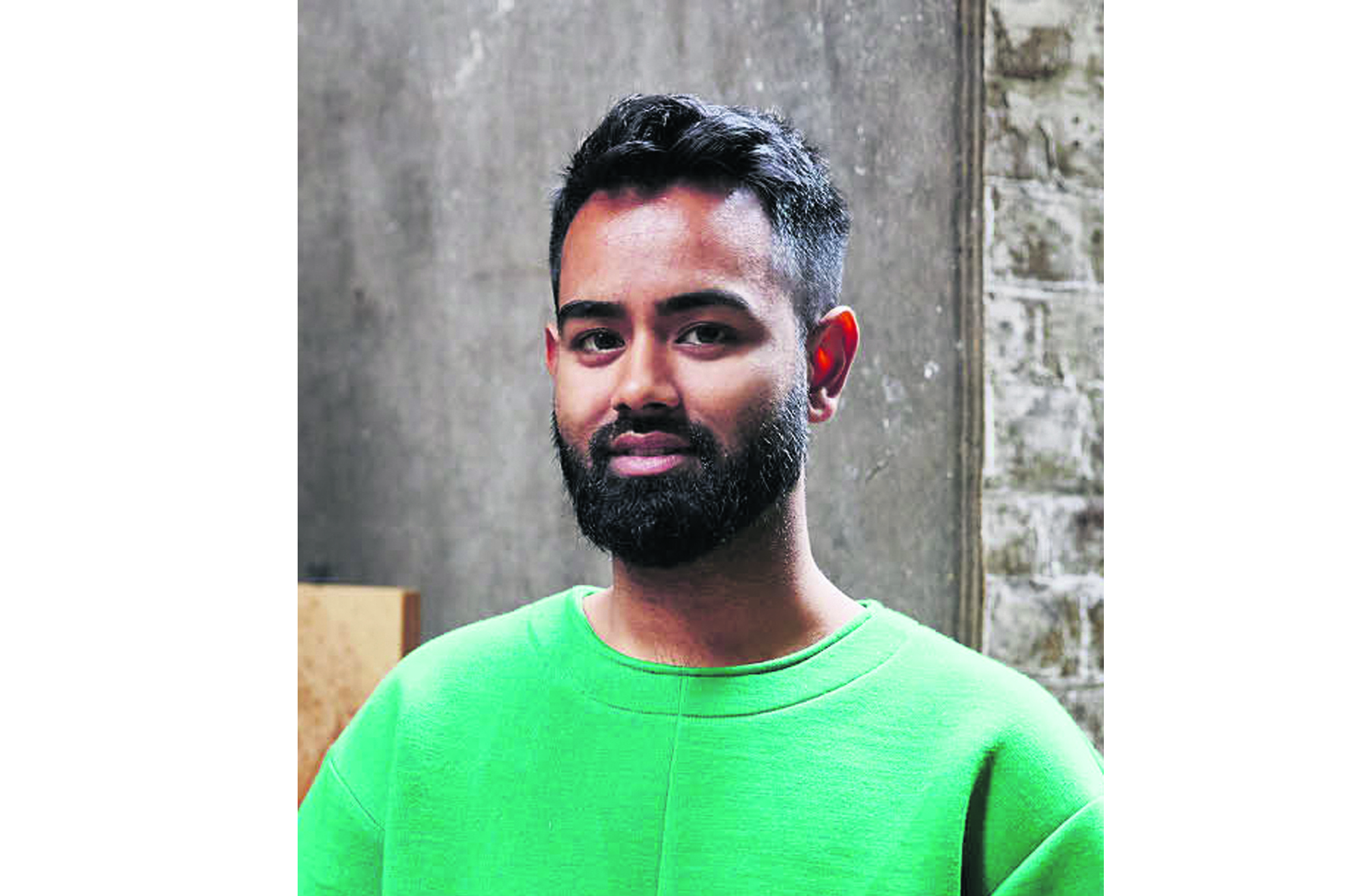
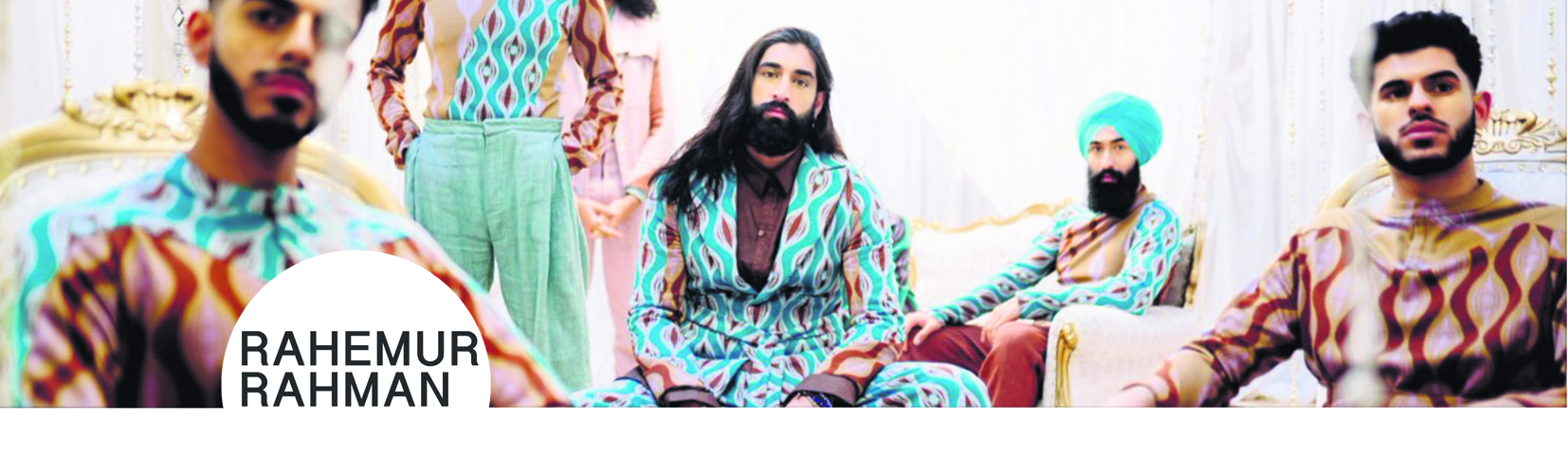
You can tell Rahemur is the creator of playful and punchy post-modern designs. He is explicitly humorous and serious about his bright, eye-catching collections at the same time. Currently boasting a 2020 spring collection in none other than Vogue magazine, the young British-Bangladeshi designer recently launched his brand at the prestigious Somerset House at the start of 2019. Having the grand opening at a particularly arty venue is also fitting since Rahemur’s work is as deep as it is striking. His use of contrasting pastel colours, Eastern and Western styles, and traditional elliptical shapes radiate the underlying emotive motivation of reconciled modern identity.
The designer creates clothing chiefly for men, embracing South Asian femininity with a nuanced Bangladeshi spin, or should we boldly say, sashay. “Men have curves too,” Rahman commented, “we’re just used to attributing this to women. I love to use the lines of my clothing to soften the otherwise masculine cuts on traditional designs. Tailoring can be very sharp on men – boxing them into their figures. I love to open out my fashion. Additionally, men’s waists can be very dainty in comparison to their hips and shoulders.” Indeed, Rahemur’s diverse range of male models perfectly embodies the expressive spectrum of male personalities sewn into the fabric of his high fashion pieces. “I base a lot of the items on my own wardrobe which consists of both women’s and men’s wear – a feel an affinity with both personas.” As well as utterly breaking the mould of gender, Rahemur also pleasingly subverts the subjective expectation of minority culture through his idiosyncratic contemporary style.
***
“My brand was put together during a very turbulent family time,” he told us. “I was inspired by old family photographs, which led to wider exploration of my South Asian heritage. I basically relearned what it was to be Bangladeshi.” The sparky designer decided it was important to return to his home country as part of his research into textiles at the time. “I was 28 years old when I finally visited Bangladesh!” Rahemur has since collaborated with Bangladeshi fair-trade organisation, Aranya, to provide authentic and well-paid labour for his fashions. This meant working with independent artisans in East Bengal to really honour the value of their handicrafts. “Such trade established South Asia in the eyes of the West. The British wanted the subcontinent’s incredible skills, spices and fabrics, and it’s sad to think we’ve lost that colourful partnership somewhat.”
Many of Rahemur’s designs then also contain the block hues of old industrial Bangladesh, reviving the beautiful aspect of a history gone. Indeed, his whimsical clothing wonders are at once confrontational. “That part of the world is full of such a mish mash of influences,” he continued. “It’s weird, but so original and fascinating.” Rahemur talks not only about the urban Bengal Delta and rural Sylhet Division communities that constitute Bangladesh, nor just the many religions and local cultures that are India, Pakistan and Bangladesh altogether, but also the imitable legacy of the Diaspora now spread across the globe. “South Asians are inherently a myriad of different reference points. When you look at Caucasian people you know exactly what generation, country and era they are from. When I look at pictures of my family, I see Nineties chip shops with Eighties haircuts, puffer jackets worn with saris and Nike trainers! I love that.”
Rahemur speaks to a young multicultural movement that is reconstituting itself, redressing the painful narrative of a once marginalised space as they occupy a more equal millennial standing. “It’s amazing – people are actively reclaiming their backgrounds. You go online and see more confidence. It’s not the norm to self-critique or parody your differences anymore. Youth today are proud of where they’re from.” This celebration of ethnic oddity manifests in the uncanny poignancy that also emanates from the designer’s brand. What might have once been considered garish or too ‘out there’ can be flaunted in the open. It’s the landmark closing of a generational circle as reflected through the central shape in the artistic line up of Rahemur’s fashion spread in Vogue.
This holistic acceptance is further reflected in the fundamental vision of Rahemur’s couture, who does not usually design single garments. “I enjoy putting together the whole attire from head to toe. I always see the full products.” This might be a loose pale pink wrap-coat worn over matching pleated trousers. Or simple patterned robes that look as if they are stately yet accessible. Some pieces even evoke pop cultural ideas of boyhood such as the Karate Kid while retaining a South Asian street lens. It’s that heritage of bizarre miscellanea being passionately continued. Here, Rahemur touched on another important affirmative part of his work: changing the perception of minority tradition as lowly or somehow eternally impoverished. “The V&A have such a brilliant archive of South Asian textiles – outlines, prints and colours - over the centuries that show the high value in the tradition. They cover the time before, during and after Indian partition. A lot of my initial concept comes from having witnessed this rich, amazing exhibit. Everyone should see it.”
The post-colonial pride pulsing, there is also an expansive international sensibility to Rahemur’s pieces. “It seems wrong that people from such a wide variety of vibrant backgrounds can’t even afford to go back to their homes to visit. Coming from a working class immigrant family, my mother has not been back to Bangladesh to this day.” Economically as well as socially boosting representation then, Rahemur’s fashion ultimately lands politically. He aptly concluded: “my advice to anyone who wants to make a strong creative statement is to be sure of their story. Don’t talk about identity just for the sake of it. What’s the purpose? Don’t just make noise.” A rare blend of direct yet discerning, Rahemur not only draws attention to the merit of sovereign culture, but also its freeing philosophy: a set of exciting guidelines that are always subject to change. Much like the designer’s approach to his trade, the measurements refreshingly vary from one body shape to the next: “Rules of thumb are not rigid.”
What grabs you most about fashion?
The moment you fall in love with a garment – it’s such a personal, instant connection.
What personally inspired you to go into fashion?
It was always there in my unconscious. South Asian culture is so full of vivid clothing and meaning. However, I did not turn to fashion professionally until after I completed my university degree. I certainly felt pressured to go into a traditional masculine discipline such as architecture or graphic design.
Finally, do you have any more advice for those wanting to launch their own brand?
Take your time, and do what you can to your best ability. Also, research what you do choose to do. That’s so important. It helps you tighten the message you are giving to the world too.
W: [https://www.rahemurrahman.com<%20https:/www.rahemurrahman.com%0d]https://www.rahemurrahman.com<%20https:/www.rahemurrahman.com%0d>
T: @RahemurRahman<https://twitter.com/RahemurRahman>