Karun is part of that generational zeitgeist defined by a celebratory timelessness: not necessarily in terms of classic style, but more fundamentally through a new, elevated way of life. As the young artist himself commented: “Art is the most accurate marker of culture, even over the narrated history”. A rising oil painter, Karun’s bright, often pixelated prints frequently depict a central graphic with an infinite vintage feel. This radiantly reflects a time where the advent of technology has allowed people to share strong personal influences with one another like never before. Older people across the world can access younger culture, while youth are similarly able to rediscover the inspirations of recent decades. In short, it is a pulsing era of modern nostalgia.For Karun, who consummately uses Instagram to both promote and motivate his professional art – “a diehard fan of the #art tag” - this is specifically realised through his unique negotiation of cultural identity: “I’ve never felt quite at home in either India or the UK, but have always felt the sentimental pull towards my country of origin.” Indeed, elephants are a recurring national symbol in Karun’s artwork: “this trademark was not intentional rather an organic expression of my South Asian background. In fact, I try not to consciously create an artistic identity as this can lead you to become someone you’re not.” Rather Karun lets the surrounding world equably speak to him, letting the product be. “This is what allows you to be a contemporary presence, and not just ‘another British-Asian artist.”
***
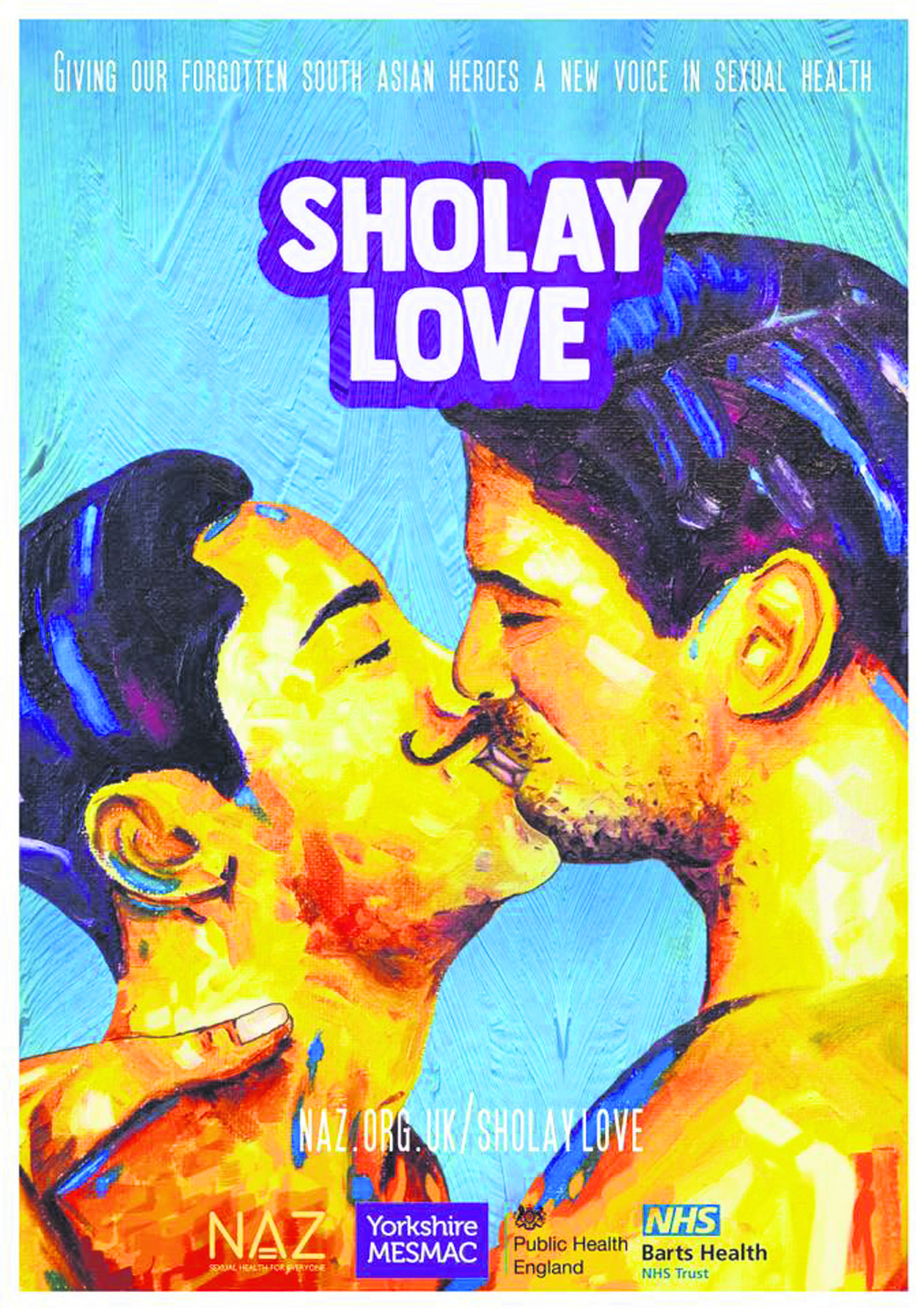
This is epitomised by one of Karun’s outstanding professional highlights: formulating the artwork for the "Sholay Love" which was a campaign for the London-based charity, Naz, raising awareness around testing for HIV within the gay British-Asian, or ‘Gaysian’, community. “This has been my biggest socio-political achievement to date.” Due to the unfortunate, enduring stigma on the alternative lifestyle, especially within the Diaspora community, the doubly marginalised social group are statistically less likely to get tested. Karun “created a Bollywood-style poster to celebrate the intimacy between gay Asian men.” One of Karun’s pieces in the series shows two Asian men kissing (pictured), boldly breaking the taboo. “The campaign actually led to more people getting tested too: I felt a lot of pride being a British-Asian driving this positive community change. British-Asians are coming to lead social innovation in so many different ways.”
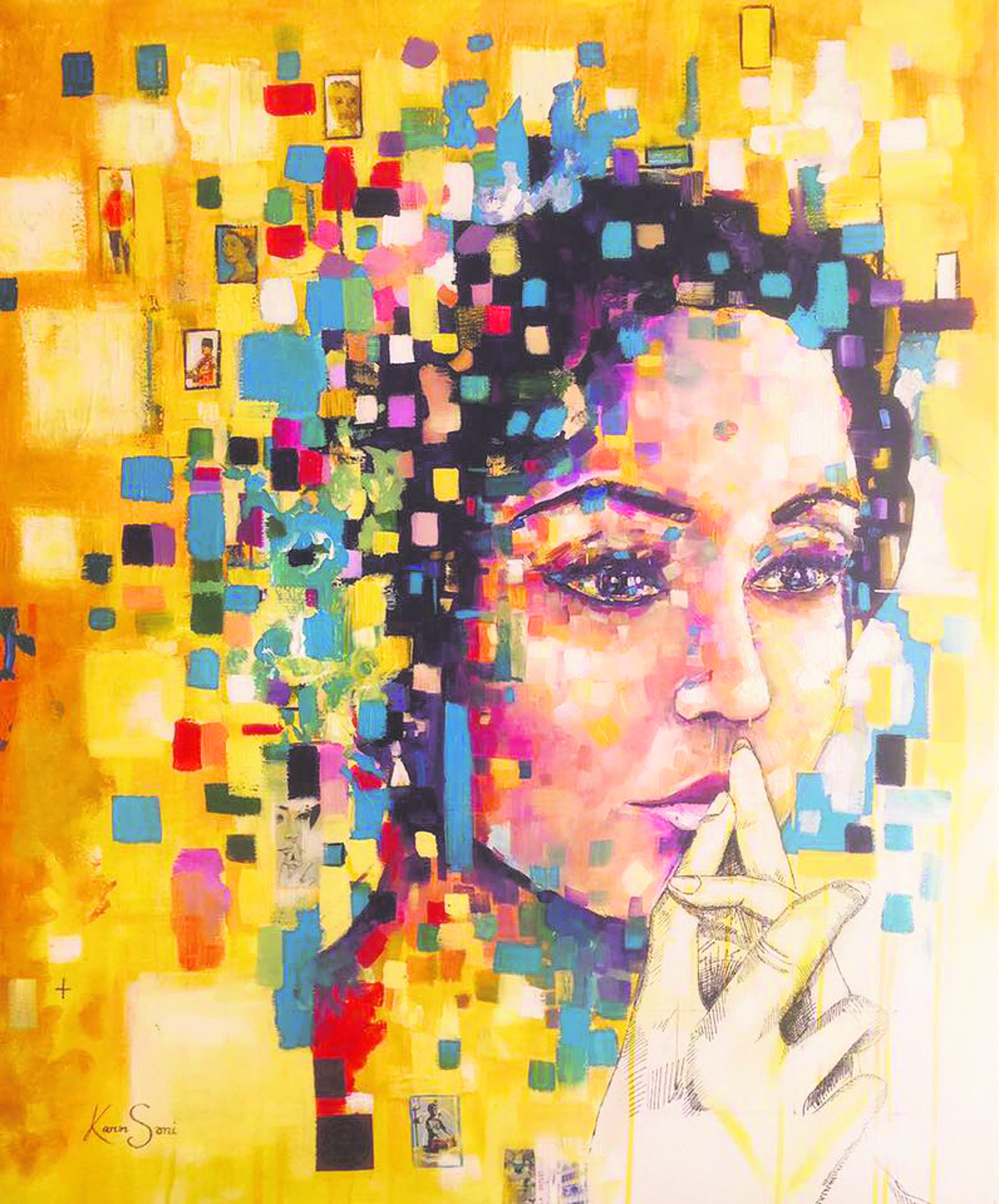
Karun states that his main painterly technique is ‘Pointillism’, though he “continues to expand, painting simply but definitively on canvasses too.” Here, interestingly, Karun has been fascinated by his grandmother’s archetypal record collection, which has emotively shaped his work: “the inspiration rippled out over a period of roughly two or three years, and I still do study into it. The artwork on her vinyls is so hauntingly beautiful. Though I am looking at an early period of analogue, the visuals are so colourful and creative, and layered too. The music is from the Sixties, the time of classic Bollywood, so the record covers were designed by hand. There was no digital assistance. The effect is a stunning simplicity. This persists in my craft. I have actually created a piece paying homage to this. It’s a replica of one of the album’s images: a lady deep in thought (pictured). Listening to the music has impacted the style of the piece too. The final image is restless - broken up and later reconfigured. ”
This appears as if musical notes which have been accentuated before “dissolving again into the background. I found myself tearing up the image and putting it back together again, using chaotic, heavy brush strokes. At one point the picture was too abstract, while it became too precise at another. The key, ultimately, was not rushing through the uncertainty.” Indeed, Karun, tellingly, identifies ambiguity as an equally prevalent theme in his work: “without wanting to psycho-analyse myself too much, I do find that my subconscious tends to drive the brush. I have drawn infinite paths – streets, walkways or rivers that trail off into nowhere. This is the part of me that embraces uncertainty, and wants to enjoy the ride.” Materialised in the signature jarring vibrance of his work then, what has stayed with Karun has not been so much a cultural affinity with a traditional past as a fascination with the “alien mystery,” as he put it, of an individual who he recognises as a multi-dimensional being: “No matter how much I investigate, there will always be a piece I’ll never know – it’s strange, but not altogether bad.”
This motivation is also evident in the inscrutable aesthetic of his idiosyncratic work which boasts a multicoloured allure. It profoundly extends, too, to the artist’s measured view of the existential landscape. Karun acknowledges the legacy of imperialism as part of a bigger world story: “I’ve returned to India pretty much every year since I was seventeen, experiencing its many vivid sights and sounds. Educationally, I’m at once aware of the incredibly adverse impact of the British Raj. It’s bizarre to think that after years of the motherland being exploited for economic gain and racial superiority, Indians have then ended up back in the UK, establishing their strength from here. It’s bittersweet.”
Especially engaged in his personal outlook then, Karun powerfully demonstrates the condition of a generation who are not only at the cusp of a daunting transitional period, but are defiantly responding to it too. If prior waves of vocal youth, from the Fifties to the Nineties, and even the Noughties, have been characterised by depression or anxiety, this is surely a display of a budding Generation Hope. “I’m really not one for subtlety,” Karun aptly concluded. “My work revolves around the colour wheel and must leave a striking impression. Also, trying to extremely control what I’m doing is limiting – there must always be an element of fun along with a pristine work ethic. They must work together, or you lose yourself.”
You have a degree in Graphic Design from Leeds University. Yet, you’ve chosen a highly classical mode of painting: oil.
Oil painting is certainly sophisticated. It’s not as easy as water colours etc. Actually, my mum, who’s a huge fan, accidentally bought me my first set of paints. She just knew I enjoyed painting, and didn’t notice the particulars. As a child, I was sat there trying to mix oil and water! But the difficulty is equally rewarding – the paints are malleable. You really start to explore and experiment – you can’t layer random colours on top of each other. If you can master them, the reward is great.
What keeps you inspired?
Honestly, movement and financial motivation. I love to travel, and am driven by selling my art – it is possible to be profitable and creative!
Finally, who have been big influences on you?
Hundreds of artists. However, if I had to narrow it down: Jean-Michel Basquiat: his work combines African influence with an urban edge. I could relate to his subjective struggle which he worked through with bright expression too, such as graffiti art. He teamed up with pop artist, Andy Warhol.
I: @dotty.art