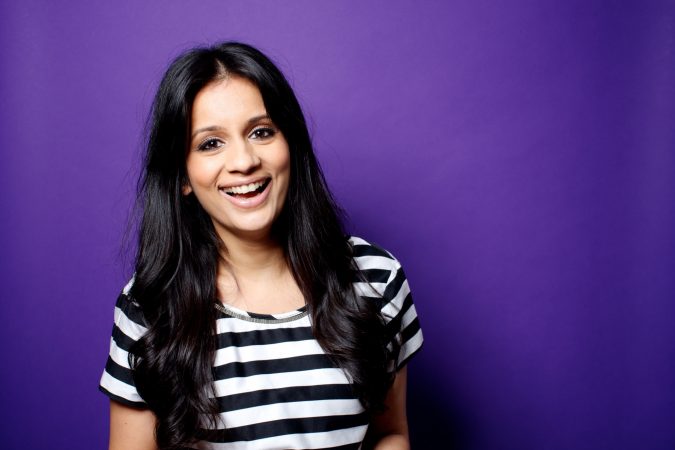
There is an alluring quality about Sonali, and it’s not just limited to her radiant, good looks. As the current host of BBC’s Escape to the Country – a much loved property programme which introduces prospective couples to their dream homes across rural England – her presenting style is subtle yet very sincere. Breaking the mould of the traditional female presenter, Sonali does not just represent British Asians but appears her forthright, petite, and warmly welcoming self: “I certainly enjoy chatting,” she told us. “Whether it’s about new homes, sports, or international issues, I really want to discover the particulars of people’s stories, and delve into their worlds. The storytelling drives me. I’ve possessed this innate inquisitiveness since I was a little girl to the point where my parents would even ask: “Sonali, why are you asking?” Indeed, Sonali is go-to lady for the BBC’s coverage of trending household pieces: the Queen’s 90th birthday, the Royal Wedding, Wimbledon, the London Marathon and the 2011 Cricket World Cup to name but a few.
***
This pure – if insatiable - curiosity is mandatory to good broad-casting; a talent often obscured by playing the passive or overtly bubbly woman. On the topic Sonali specifically commented: “more than being Asian, the professional roles that are advertised as being available to women really should be expanded: from television to within Asian families themselves. There is a tendency to - for example - assume that women can only do the cooking and boys are only capable of the more physically demanding work: we’ve got princesses and heroes. I’ve two children - a son and daughter - and I always make sure to expose them to the same wealth of ideas and influences. We don’t like to admit it but we are affected by what we see around us as a society: from whom we see representing us on television to the binary gender colours of pink and blue splashed throughout big maternity stores.” As well as being an Ambassador for the British Asian and Prince’s Trust, Sonali became part of the Crimewatch team in 2015, carrying on the show’s reputation for strong presenting. She was also part of the BAFTA award-winning show, Newsround, for five exciting years in which she filmed special international reports, including the Beijing Olympics and a documentary called “Growing up in a Warzone”, where she spoke with conflict-mired children in the region of Afghanistan. The latter actually won her a 2011 AIB (international broadcasting award). But as prestigious as Sonali’s career is, she initially followed a very instinctive and humble path: “growing up, I was never really surrounded by journalism or the sort of commentative career I wanted, but I sought it out. My parents were actually in the medical profession, and what I would do is go round the wards and take music requests to play on the Hospital Radio Station after school! Later, I began thinking, ‘why shouldn’t I make this into a career?’ I later threw myself into a journalism course at Nottingham Trent University from where my hard work and passion swiftly moved into the BBC. I’ve been there, for the most part, ever since.” Approaching life as an organic extension of her profession, Sonali exudes the power of self-belief and confidence over what’s socially prescribed and pretence.
What’s your favourite part of being on the BBC's Escape to the Country?
Looking at lovely properties for a living; it’s really the same reason people watch the show. I’m able to explore and immerse myself in idyllic parts of the beautiful countryside.
Was it a requirement to have prior experience in property development before Escape to the Country, or was it more important to be a good communicator?
Actually, I do possess a GCSE in Design and Technology which incorporated the building of my own family home when I was growing up! But really property has been a national obsession for decades, and we primarily draw on that. Escape to the Country can be really relaxing for that reason. It comes on at 3pm in the afternoon and can be very addictive viewing for the pure aesthetic pleasure! People just love watching it. I’ll be following the live feed on Twitter and everyone has an opinion. We are actually on the 19th series, which we’ll begin shooting in Derbyshire tomorrow!
What would your ideal property be?
I’m not sure just one could do it! But I do have one envisioned in my head: the colours, the details of the kitchen etc. I think I imagine it the same way a lot of people might be passionately planning for their wedding.
You produce shows too: how are the presenting skills combined on Escape to the Country; what have been some of your most memorable conceptual projects in the past?
We have a fantastic team of researchers in-house so it’s very much a team effort. The first interaction with the team is very much through the researcher who talks to the couple and determines their exact specifications. As well as being a good TV show, we genuinely want to help people find good homes. We actually have a re-visit series –I Escaped to the Country – because we so enjoy seeing people after they’ve settled in. It’s about more than just moving house; it’s an area, a lifestyle change perhaps.
In terms of my own work, I was very proud of the documentary I did on children growing up in a war zone in Afghanistan. At Newsround, when going abroad, there were smaller teams and as a result I did get to be more hands-on. At Radio 5 Live, I also enjoyed talking to top businesses about how they were run which was revolutionary within the BBC. And on a separate note, when Businesses are successful in Britain, it really is a blessing for everyone.
Do Asian families do enough to encourage professional diversity?
I think so. I was never discouraged, and if I was it was for a very specific pragmatism. Actually, ironically, my mother told me to be careful of choosing a career as a Paediatrician because of the frequent night shifts which might have interfered with raising a family. But that’s still very much the case with journalism and TV! All of these industries have become more traditional in society, and the Asian community generally accepts that. I had a working mum and was always encouraged to follow my dreams. We are progressing in the right direction, if not at an ideal pace.
More generally, I would add that we need to put more Asian people behind the scenes because that affects the sorts of stories we see, and helps people who don’t know our stories understand them. Class is another big issue; we need more stories from working class backgrounds, which of course ties in with minority communities again.
Finally what’s one misconception about TV presenting that simply isn’t true?
It certainly isn’t as glamorous as people might think!
W: //www.sonalishah.co.uk/