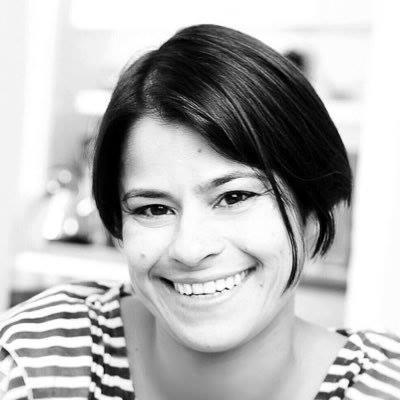
Raizada is a fast-rising writer and script developer, whose latest stage-play, Bitched, carries her trademark fieriness, physicality and shining satire. Short-listed for Theatre’s 503’s 5, and the producer of several award-winning short films, her first full-length drama, Black-i, produced by Kali Theatre, explored the unlikely relationship between Naz, a young man from London’s Bangladeshi community, and Rose, a girl from the “Mayfair moneyed elite.” The “work is always about those intersection points where expectation clashes with desire,” the candid creative told us. As well as of course the humour and an urban edge, current play Bitched also showcases her incredible ability to produce timeless, almost Shakespearean themes, whilst holding her writerly own. If Black-i is somewhat reminiscent of a modern, multicultural Romeo and Juliet, Bitched stands a contemporary, more hopeful Othello. This makes organic sense. Raizada said: “my father was brought up Hindu, hailing from Jabalpur, India, while my mother is Jewish. My brother also converted to Islam to marry his Bangladeshi wife so my family is one big melting pot - I feel English through and through!” The Bitched set centres around a simple white bed, while the plot gradually peels back the grand narratives of culture and class to reveal patriarchy as the unchanged foundation of society. The outspoken protagonist Ali, played by Shireen Farkhoy, also resembles Othello’s character imagination of Desdemona. Together with Farkhov’s buoyant and relatable performance, and the rest of the compact, yet highly talented cast – Rob (Darren Douglas), Suzanne (Viss Elliot Safavi), and Nirjay (Robert Mountford), the particulars of the story are then emphasised as clearly, jarringly, in the present. Talking on her work, Raizada said: “we see how, even in our generation of women, being domesticated and having children is expected and doing so completely disrupts one’s autonomy and status. This is shown through the emotional conflict of the main couple Rob and Ali’s pursuit of work, and the former’s assumption that his wife’s place is at home and the distress that this causes her. She is pressured one way, to give up on her dreams. We realise femininity and coming into motherhood really isn’t that different from the Fifties!”
***
Indeed, though claiming to really care about her ambitions and happiness, Ali’s aspiring artist partner, Rob, is ultimately full of sexist platitudes such as ‘my precious lady’ which finally escalate into the more violent slur ‘bitches’ when he feels he is losing socio-sexual control over the surrounding women. Furthermore, Rob and Ali’s interactions with a second, pretentious upper-class couple, gallery owners, Suzanne and Nirijay, makes the male verbal smokescreen politically pervasive. The scene where Suzanne talks directly to Ali about children and what will be the irreversible compromising of her freedom mimics the intimate Emilia and Desdemona scene in Othello, where the former, a wiser female confidante, essentially says to the younger, less experienced woman: it doesn’t matter what background you’re from: ‘These Men! These Men!’ Though much has changed on the surface, the view that women are simply vessels for male appeasement and securing a family line is still sadly the norm. Though Suzanne has money, she cannot fully dedicate herself to the children because her husband deflects his portion of the responsibility, drinking and gambling and seemingly punishing her for the power. However, Bitched champions one significant refreshing departure from a tiring oppressive story. Both Raizada’s women are unapologetic and active about their anger – towards the men as well as with and amongst themselves. Sharp as knives, shouting back and swearing in spades, whilst the men are not only exposed but ridiculed for their incompetence and self-centredness– at one-point Nirjay comes in with a carrier bag as if he’s about to grocery shop for a baby – the play rails against the system. As Raizada pointed out: “this is especially relevant in light of the recent Harvey Weinstein scandal. We’re beginning to listen to women’s voices because their experience doesn’t get articulated or heard that much. If no one is heeding women’s perspectives, I’m definitely up for shouting. I’m definitely sick of being calm and diplomatic and one of the bonuses of being playwright is that you don’t have to be!” Thus, a play of uncanny pertinence and precision – including the interconnected concepts of unequal economic distribution, and an increased psychological burden on already struggling women – Bitched doesn’t just show us the core of women’s frustrations, but passionately rejects it. Accompanied by gentle electronic music, the last scene is one of subtle but definite rebellion. The show doesn’t so much ask ‘can women have it all?’ as, very refreshingly, ‘why are you making them ask in the first place?’
What inspired you to write this play?
This came from my own experience of becoming a mother. Though there was also extra stress for my husband, it was my life that completely altered; having to take on all the child related chores etc. It’s a blessing to have children but we don’t hear about the side of it that involves the nightmare of pushing for maternity leave and the disproportionate burden put on women.
What are the basic components of good writing?
Caring about it. You can have a piece of work that’s polished and slick but if it lacks energy, and doesn’t have that truth and urgency, there is no point.
There’s a poignant, cinematic bit in Bitched where there is this interweaving split scene. What is an interesting difference between cinema, TV and the theatre?
It’s the live aspect of theatre and the fact that the audience shares in it; when it’s at its best, it’s absolutely exhilarating – it’s like rock and roll!
You have been a script developer, for example on Emmerdale, and a CBeebies script has been nominated for a BAFTA. What do you look to do to improve scripts/stories?
I look out to see if the story is clear? Are we clear about what the characters want and where they’re going? How are they are changed? Also isolating those moments of transition and making sure this is well understood. You want to travel with the character.
What’s your favourite part of that job?
The writing! The power of words. I love how language can create emotions and stories and it’s a thrill to enhance the power.
Does your work always deal with shifting identity?
Yes, a future play of mine, Cracked Vase, is very much about current race and class politics, and in the same way Bitched deals with sexual politics at a time of change where society is not keeping up with our identities, this new piece seeks to overcome that too.
Finally, who are some of your artistic influences?
Mamet, Patrick Marber, Caryl Churchill, Gurpreet Bhatti and Phyllis Nagy.