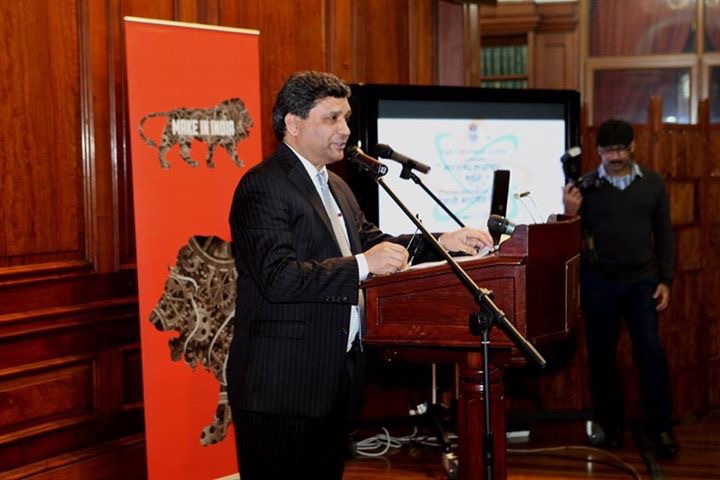
Shailesh Vara MP, Parliamentary Under Secretary of State at the Department for Work and Pensions and at the Ministry of Justice, said this is India’s century. There is no two ways about it that India will be a global force to reckon with. The only issue is when?
Mr Vara was speaking at a reception hosted by the Acting High Commissioner of India, Virander Paul, to celebrate the Pravasi Bhartiya Divas 2016 at India House on January 9.
Mr Vara, who was the chief guest, said, “We have to recognise that perhaps 30 years ago if I had spoken about Indian community I would have probably said Indians are in every corner of the world, I would probably have said in every corner of the world there is an Indian running a corner shop, but what I would say now is that in every corner of the world there is a corner shop, but there is probably an Indian who owns the warehouse that supplies the corner shop and there is probably an Indian manufacturer who supplies the warehouse that supplies the corner shop and there is probably an Indian financier who paid for the financing of the manufacturing organisation.”
He said in Britain there are people of Indian origin in all spheres – be it public service, business, professions, media, academia, arts, culture. They are in every field.
He said, “All data will show that the contribution made by Indian community in Britain to the exchequer by way of taxes exceeds the proportion that they have as part of the electorate. There are people who hold high office and positions in every sector. I am a minister in her Majesty’s Government and I am proud to be a minister. And I am Indian origin. And that is why when India progresses it concerns you, people like us, all of you, me to help her as she progresses on to the global stage.”
He added, “UK is our country. We have made this our home out of choice and we are 100% loyal to Britain. But we also have deep affection for the country of origin. And so it is for Indians throughout the world”
He said the Wembley extravaganza was an extraordinary event during Prime Minister Narendra Modi’s UK visit. He added that he and his colleagues, were actually taking notes on “how to win the next election” and “what we could learn” from Modi's historic speech. It was a rock star treatment for an Indian politician. Britain has not experienced this in the past. But what was also significant was there was follow-up in terms of trade, connections and contacts.
He gave credit to Mr Manoj Ladwa, India Inc. CEO, for the success of the Wembley event. Mr Vara said, “Manoj was the backbone of the event.”
On the occasion, Mr Ladwa said social media should not be seen as an alien thing. In fact, it is the “in thing”. The need is to recognise and capitalise on the power of social media.
“Today my 75-year-old mother has a Facebook account and the social media has opened a new window of opportunity to her to connect with her grandchildren, in particular, and the world outside. So social networking is no longer considered the domain of the young,” said Mr Ladwa.
“Whether it is Prime Minister Narendra Modi or David Cameron or President Barack Obama, all have Twitter accounts and are highly active. They have used social media to their advantage. They use social media to invite ideas or suggestions or as a weapon to broadcast their vision,” he said.
The reach of social media is beyond imagination. Today social media breaks the news before you read it in newspapers or watch it on TV, he added.
Mr Ladwa said the Indian overseas students should make use of the opportunity provided by the Overseas Indian Facilitation Centre to do internship with top Indian corporates. The internships are a window to gain experience about Indian work culture and an opportunity to connect with their roots in India.
Sanam Arora, President, National Indian Students Union (UK), in her presentation said India should leverage the experience and expertise of the highly skilled diaspora by enabling an environment that allows recruitment of highly qualified academics, business people and entrepreneurs who will use their expertise to expedite the mission to catch the Make in India and Skill in India initiatives promoting innovation and entrepreneurship and leading to the development of new technologies and high tech industries in India.
She said there is a need to introduce lateral thinking in schools and that’s possible only if teachers teach that way. Now that applies the best of both worlds approach. Members of the diaspora who are subject matter experts are the most ideal people to take on this task – with their Indian background and their western experience. Training delivered by these diaspora experts in specialised fields on the ground has a more targeted and demonstrable effect than short term training courses where typically trainees are sent abroad for a week or so to be trained. More often than not such courses are expensive, they are temporary in nature and are not self-sustained. In contrast, on the ground expertise deployed in a targeted fashion will be much more effective, cost-efficient, self-sustainable and practical, she added.
Amarjeet S Bhamra of Ayurvedic Bodywork Consortium said traditional medicines are India’s most ancient contribution to the world. He said, “The World Health Organisation itself says that 700 million people still rely on traditional medicines, but the European Union somehow thinks this is not good and they have now banned all ayurvedic medicines that come into UK.”
He urged to look at India as a potential possibility where people’s health care can be taken care of by some of the best ayurvedic doctors and traditional medicine doctors in India.
Lord Raj Loomba said India is building smart cities, increasing trade relations with most of the world, but India should also pay attention to stopping domestic violence, trafficking, raping and should provide security to women in India.
Bob Blackman MP said the relationship between India and the UK is becoming stronger than ever. Be it the field of trade, education or finance. India and the UK are united. The relationship between India and UK should be similar to the one between the UK and the US. He said Indian students are choosing the US for education and are not coming to the UK. That should change. They should come to the UK. “We should make UK the destination of choice for Indian students.”
He said the relationship between the two countries is so strong that Prime Minister David Cameron has visited India more than any other country during his premiership – the only exception being Belgium (Brussels) for obvious reasons. “If the European Union stops certain goods coming from India, that’s another good reason I would say why Britain might want to leave EU,” he said it in a lighter vein, much to the delight of the jam-packed audience at India House. He said we should make sure British Parliament listens to the voice of Indians and acts on behalf of the Indian population.
In praise of Modi at Wembley Stadium, he said, “Any man who can hold an audience of such magnitude in the bitter November cold for one-and-a-half hours, it is quite remarkable.” Modi had addressed over 60,000 people at Wembley Stadium on November 13, 2015.
Earlier, Acting High Commissioner of India, Virander Paul, said henceforth the “big” Pravasi Bhartiya Divas (PBD) event in India will be held once in two years, while it will normally be held in the Indian missions in various countries. January 9 was chosen as the day for PBD as it was on this day in 1915 that Mahatma Gandhi, the “greatest Pravasi”, returned home from South Africa to lead India’s freedom struggle. He said the webcast by External Affairs Minister Sushma Swaraj on the day was watched here. He gave a brief overview of what Sushma Swaraj said – like merging of the Indian overseas affairs ministry with the External Affairs Ministry and initiatives of Narendra Modi Government such as Make in India, Skill in India, Digital India and Aadhar card for overseas indians.