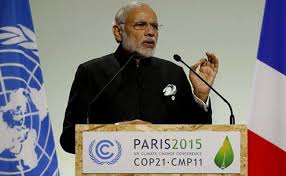
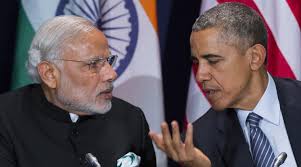
In his characteristic style, polite yet not mincing words, India's Prime Minister Narendra Modi said it in no uncertain terms that the onus of reducing carbon emissions is more on the developed countries than the developing ones, although India – not highly industrialised yet – will contribute its mite to make the world a less warmer place to live in.
Modi on Monday told rich nations which powered their way to prosperity on fossil fuels that it would be morally wrong if they shift the burden of cutting carbon emissions on developing countries like India.
“The principle of common but differentiated responsibilities should be the bedrock of our collective enterprise. Anything else would be morally wrong,” he wrote in the Opinion section of 'Financial Times' on November 30, 2015.
Modi's words of warning on warming came against the backdrop of a critical UN conference, known as COP21, aimed at agreeing a new global approach to climate change, the talks for which are being held in Paris. Negotiators from 195 countries will try to reach a deal within two weeks aimed at reducing global carbon emissions.
Modi, along with nearly 150 world leaders, was in the French capital to attend the opening of the climate summit with a central aim of the new agreement to keep global warming below 2C over pre-industrial temperatures.
The Indian Prime Minister asked the developed nations to fulfil their duty to shoulder the greater burden of the fight against climate change. Modi said: “Justice demands that, with what little carbon we can still safely burn, developing countries are allowed to grow. The lifestyles of a few must not crowd out opportunities for the many still on the first steps of the development ladder.”
Modi reiterated his plans to launch an alliance of 121 solar-rich nations in the tropics aimed at bringing affordable solar power to villages that are off the grid. “We expect the same from the world with respect to responding to climate change,” he said.
“Some say advanced countries powered their way to prosperity on fossil fuel when humanity was unaware of its impact. Since science has moved on and alternative energy sources are available, they argue that those just beginning their development journey bear no less responsibility than those who have reached the zenith of their progress. New awareness, however, should lead advanced countries to assume more responsibility. Just because technology exists does not mean it is affordable and accessible,” the PM said.
He said this meeting should recognise that some face a choice between lifestyles and technologies, while others stand between deprivation and hope.
He said India believes in taking a sustainable path to development. Sustainable development is development that meets the needs of the present without compromising the ability of future generations to meet their own needs.
Not shying away from India's responsibility to the uphill task, Modi said India is committed to the cause and will do her bit in right earnest. “We will play our part.” Modi said.
“India is also experiencing the impact of climate change caused by the industrial age of the developed world. We are concerned about our 7,500 km of coastline, more than 1,300 islands, the glaciers that sustain our civilisation and our millions of vulnerable farmers. We have pledged that, by 2030, we will reduce emissions intensity by at least 33% of 2005 levels, and 40% of installed power capacity will be from non-fossil fuel sources. We will have 175GW of renewables by 2022, and have imposed levels on coal and rationalised subsidies on petroleum products. Additional forest and tree cover will absorb at least 2.5bn worth of carbon dioxide. We will clean our rivers and create smart cities. We are replacing diesel with clean energy, and building 50 new metro railways,” he added.
He said the need for clean energy and healthy habitats should be worked out in a spirit of partnership. “India will work with governments, laboratories and industry to facilitate a natural transition to a clean energy era through affordable and accessible renewable energy,” Modi said.
The PM said the best political and technical measures will be ineffective unless “we review a lifestyle that overburdens our planet”.
“Our targets must seek to drive restraint in use of fossil fuel and moderation in our lifestyles,” the PM said.
With a reference to Mahatma Gandhi, the PM wrote in the UK's leading financial daily, “We look forward to Paris with the sense of duty that Mahatma Gandhi called us to assume: We should act as 'trustees' and use natural resources wisely as it is our moral responsibility to ensure that we bequeath to future generations a healthy planet. India will do its part for success in Paris.”
Modi spoke in English at the Paris Summit and his speech was well received by all and sundry. But he gave a hint of the rows to come as he used his speech to insist that rich nations must make the deepest cuts.
He said 300 million people in India lived in homes with no electricity. The rich nations should allow India enough room to grow. He said richer nations should not try to impose an end to the use of conventional energy such as coal, consumption of which is growing by 5% a year in India.
“It is not just a question of historical responsibility, they also have the most room to make the cuts and make the strongest impact. And climate justice demands that with the little carbon space we still have, developing countries have enough room to grow,” Modi said.
Many wealthy countries insist there can be no deal unless large emerging economies take on more responsibility for fighting climate change. The challenge for the Paris Summit is – equity between the developed and developing worlds.
Modi is not refusing to contribute to a deal. The Indian Prime Minister's point is that India's growing population cannot be denied the same path to development through the use the fossil fuels that today's rich countries pursued. So more of the burden to cut emissions must fall on those countries' shoulders, even at the cost of some of the prosperity their citizens enjoy at present.
Modi is right that India needs cheap power for its own growth, but not for ever. The need is to spur the world to forge the innovation necessary to make low carbon sources competitive with coal.
In this respect the commitment of $10bn to clean energy investment by a group of 20 wealthy nations should be only the first step.
India has promised to cut its emissions per unit of GDP by up to a third but, unlike China, has refused to set a date by which its emissions will peak then start to decline.
Modi offered to take part in stock-taking exercise of countries' emission pledges, which the UN said are insufficient to prevent catastrophic climate change.
What Paris Conference can do is – it can build an understanding of the opportunities that lie in carbon transition, as well as furnish the financial means needed to unlock technological change.
Mukesh Ambani, chairman of India's Reliance Industries, has also committed funds for clean power technology. Others supporting this cause include Bill Gates, the Microsoft co-founder, Facebook's Mark Zuckerberg and Virgin Group's Richard Branson, among others.
India is the world's fourth-largest carbon emitter after China, the US and the EU, and Modi's blunt affirmation of India's position on global warming is sure to set the tongues wagging in the days to come.
His assertion came days after US Secretary of State John Kerry said India could be a “challenge” at upcoming climate change talks in Paris beginning November 30 as it “has been more cautious, a little more restrained in its embrace of this new paradigm”.
Two weeks ago Kerry had expressed concern about India’s desire to burn more dirty coal for electricity, after New Delhi blocked efforts by the G20 countries to prepare for an ambitious climate accord in Turkey.
Responding to US’ concerns that India will be a “challenge” at the summit, India’s Environment Minister Prakash Javadekar said: “India cannot be bullied. You can’t bully India, the message is clear. Developed countries need to provide carbon space to developing countries.”
Calling Kerry’s comments unwarranted and unfair, Javadekar said the real challenge at Paris climate meet would be getting developed countries to offer more concessions.
Modi has promised cooperation, but still India is seen as an obstructionist or a challenge. India insists it has been misunderstood.
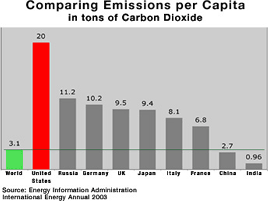
In 2012, its annual per capita carbon dioxide emissions were just 1.6 tonnes per person compared with 16.4 tonnes per person for the US and 7.1 tonnes per person for China. By 2030 its emissions will still amount to only about 5 tonnes per person per year.
India does not deny that its greenhouse gas emissions will increase dramatically in absolute terms – from 1.48bn tonnes of CO2 equivalent annually in 2005 to more than 7bn in 2030 – but says that is because of a growing population and the need to provide electricity to the 300m Indians who lack it today, and the requirement for new coal-fired power stations to supplement other sources of electricity. Half of India’s extra emissions are expected to come from coal.
What India is looking for at the Paris summit is that the climate deal should be just and equitable so that it gets the carbon space to develop as other countries did before it.
“Either we remain poor or you need to tell us a paradigm by which people can have better quality of life with lower energy use,” says Ajay Mathur, a veteran of climate talks and one of New Delhi’s negotiators in Paris.
As temperatures rise, India becomes more prone to droughts, floods, crop failures and cyclones. Scientists predict that average temperatures on the densely populated plains of north India will rise by between 2.9C and 5C by 2080.
So India probably has more at stake in the struggle against warming than any other large economy at the summit.
-----------------------
WHAT WORLD LEADERS SAID:
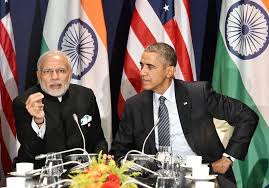
* US President Barack Obama has said the UN climate conference in Paris could be a “turning point” in global efforts to limit future temperature rises.
* “I came here personally to say the United States not only recognises the problem but is committed to do something about it,” said Obama.
* Russian President Vladimir Putin said, “We have demonstrated we can ensure economic development and take care of our environment at the same time.”
* Chinese President Xi Jinping told the conference he did not see the Paris talks as a turning point nor a “finish line, but a new starting point”.
* He said that climate change went beyond national borders and that it was “a shared mission for all mankind”, before reiterating China's pledge to start cutting its emissions from a peak in 2030.
* British Prime Minister David Cameron used his address to consider how future generations would respond to the idea that it was “too difficult” for this generation of politicians to reach an agreement in 2015.
“Our grandchildren would ask why it was so difficult. Instead of making excuses to our children and grandchildren, we should be taking action,” Cameron said.
* Prince Charles called for large-scale restoration of forests, warning the world would need much more forest “as all the horrors” of global warming started to bite. Protecting forests from being cut down is a key part of tackling climate change.
* World leaders attending a climate summit in Paris observed a minute's silence on Monday for the 130 people mowed down in a jihadist attack on the French capital on November 13.
* UN chief Ban Ki-moon thanked France for its “courageous” decision to host the 150 heads of state and government little more than two weeks after the deadly assault.
-------------------
***COPING WITH CLIMATE
*UN climate conference 30 Nov – 11 Dec 2015
*Leaders from 147 nations are addressing the meeting, known as COP21.
*Negotiators will try to reach a deal in 2 weeks aimed at reducing global carbon emissions and limiting global warming to 2C (3.6F).
*The UN has endorsed a goal of limiting global warming to no more than 2C over pre-industrial levels by the end of the century.
*But more than 100 poorer countries and low-lying, small-island states are calling for a tougher goal of 1.5C.
*Developing nations say industrialised countries should do more to cut emissions, having polluted for much longer.
*But rich countries insist that the burden must be shared to reach the 2C target.
*One of the few firm decisions from the 2009 UN climate conference in Copenhagen was a pledge from rich economies to provide $100 billion a year for poor countries from 2020 to develop technology and build infrastructure to cut emissions.
*Where that money will come from and how it will be distributed has yet to be agreed.
---------------------------
***QUOTE:
“Justice demands that carbon curbs should not limit poorer nations’ ability to grow”
Narendra Modi | PM, India
--------------------------
***ABC of SUMMIT
*What is COP21?
The 21st Conference of the Parties – COP21 – is a meeting of 195 countries in Paris hosted by the UN, aimed at agreeing an action plan to reduce carbon emissions.
*What are the specific goals?
The ultimate aim is to limit warming to 2C (3.6F) above pre-industrial levels, widely seen as a dangerous threshold. Since 1880, the average global temperature has already risen by almost 1C. About 0.6C of this has occurred in the past three decades.
*Why does this matter?
When the Earth warms about 2C above pre-industrialised times, scientists say there will be dangerous and unpredictable impacts on our climate system. And we are already half-way to that danger point.
*Climate Change: A change in global or regional climate patterns, in particular a change apparent from the mid to late 20th century onwards and attributed largely to the increased levels of atmospheric carbon dioxide produced by the use of fossil fuels.
*Greenhouse gas: A gas that contributes to the greenhouse effect by absorbing infrared radiation. Carbon dioxide and chlorofluorocarbons are examples of greenhouse gases.
*Greenhouse effect: A phenomenon in which the atmosphere of a planet traps radiation emitted by its sun, caused by gases such as carbon dioxide, water vapour, and methane that allow incoming sunlight to pass through but retain heat radiated back from the planet's surface.
*Naturally occurring greenhouse gases – carbon dioxide, methane, and nitrous oxide – normally trap some of the sun's heat, keeping the planet from freezing.
*Human activities, such as the burning of fossil fuels, are increasing greenhouse gas levels, leading to an enhanced greenhouse effect. The result is global warming and unprecedented rates of climate change.
-----------------------
*** EMISSION CHART
Country Year Annual per capita CO2
India 2012 1.6 tonnes per person
US 2012 16.4 tonnes per person
China 2012 7.1 tonnes per person
India 2030 5 tonnes per person
----------------------------
GREENHOUSE GAS EMISSIONS
Type Per cent
Carbon dioxide 57%
(Fossil fuel use)
Carbon dioxide 17%
(Deforestation,
decay of biomas etc.)
Methane 14%
Nirtous Oxide 8%
Carbon dioxide 3%
(other)
Fluorinated Gases 1%
--------------------------
***US greenhouse gas emissions compared to other nations:
*The US is by far the greatest emitter of greenhouse gases compared to other industrialized nations. The US comprises about 4% of the earth’s population, but emits about 25% of the total global greenhouse gases.
*When compared to 1.3 billion people of China, the 290 million people in the US emit over seven times as much, per person. Viewed in aggregate, the 290 million Americans emit 65% more carbon dioxide annually than the 1.3 billion Chinese do in total. And when compared to the 1.1 billion people of India, the 290 million Americans emit over 20 times as much, per person. Again, looked at in aggregate, the 290 million Americans emit 5.5 times the amount of carbon dioxide that the entire Indian nation of 1.1 billion people does in total.
The chart on the right shows that US carbon dioxide emissions, at over 20 tons per person annually, are over six times that of the global average (ignoring the US).