A-level results are in and for thousands of British Asian students, the numbers tell a story of ambition, achievement and some remarkable individual successes.
In England, 320,505 students received their results, with 835,950 A-levels awarded. Some 9.6% of entries secured an A*, while around 28.3% achieved an A or A*. Among 18-year-olds, 7,245 achieved an A in every subject they took, while 25 students secured A grades in five or more A-levels.
Beyond the headline figures lie the personal stories that give this year’s A-level results their real meaning. Across the British Asian community, students have celebrated extraordinary achievements, from a community-focused school recording its best-ever results, to young people overcoming significant adversity, and those emerging as the highest performers in their individual subjects.
Released on August 13, 2026, this year’s results marked a particularly strong performance nationally, with the proportion of top grades reaching its highest level outside the pandemic years. A record 262,820 18-year-olds secured university or college places, representing a 3% rise on the previous year.
But behind every grade is a story of determination, resilience and, often, sacrifice. These are the stories of students whose hard work has opened the door to their next chapter, of families who stood behind them through the pressures of sixth form, and of first-generation immigrant parents whose own sacrifices helped give their children opportunities they may not have had themselves.
Schools hail outstanding A-level results
For schools across the country, this year’s results offered plenty of reasons to celebrate.
From record-breaking performances and national subject honours to students choosing vocational routes designed to take them directly into the workplace, the achievements of British Asian pupils stood out among an impressive set of results.
At Avanti House Secondary School, a Hindu-faith school, students have delivered the strongest A-level performance in the school’s history, with a striking rise in top grades.
Almost 43% of all entries, 42.7%, were awarded A* or A, up from 31% last year. The proportion of A* grades also climbed, with 13.1% of entries securing the top grade. Overall, 69.3% of grades were A* to B, while 87.2% were A* to C.
The school’s average points score per pupil rose sharply to 124.62, compared with 107.5 in 2025.
The results have also opened a wide range of doors, with students heading to Oxbridge and Russell Group universities, while an increasing number have secured degree apprenticeships with leading organisations and global companies.
There was further cause for celebration at St Paul’s School, where the departing Year 13 cohort produced another outstanding set of results. A remarkable 60% of all grades were A*, while 91.5% were awarded A* or A. For the third consecutive year, more than three-quarters of the cohort achieved nothing below an A grade, with 77.4% of pupils, 164 out of 212 candidates, reaching that mark.
Ninety-nine pupils secured at least three A* grades, while 46 achieved four A*s.
Among the standout performers was Dev Ketan Patel, who was the highest performer in the country in Cambridge OCR’s A-level Further Mathematics A. Vyom Chamaria was also among the top performers nationally in A-level Mathematics.
The academic achievements translated into university opportunities, with 87% of pupils meeting their first-choice university offer in the UK and internationally, and 98% meeting either their first or insurance choice.
Success beyond traditional A-levels
For students taking alternative post-16 routes, Results Day offered its own moments of pride.
At Bradford College, T Level students achieved an impressive 96% pass rate, 3.4 percentage points above the national rate. The college’s Early Years and Health T Levels both recorded 100% pass rates, with 88% of Early Years students achieving a Merit or Distinction.
Among those celebrating was Umaiyah Waheed, who completed a T Level in Design and Development for Engineering and Manufacturing. She said the qualification appealed to her because of the opportunities it could create and praised her experience at the college.
Her next step is already mapped out: she plans to return to Bradford College to study an HNC in Manufacturing Engineering.
Fellow student Anita Olije, who completed a Business Administration and Management T Level, highlighted the value of visiting businesses and gaining practical experience during her course, including a placement at HMRC.
The resilience and sacrifice behind A-level success
For Aisha, receiving her A-level results was more than an academic milestone. It was another victory in a journey that began at Great Ormond Street Hospital when she was just five.
“I’m really happy with my results!” she said. “I’ve been at GOSH since I was five years old and I hope to one day come back as a doctor.”
Diagnosed with Crohn’s disease, Aisha spent long periods in hospital, often missing school and time with friends. Yet the disruption never defined her ambitions. She went on to become Assistant Head Girl, excelled in her A-levels and will begin medical school in September.
Inspired by the doctors and staff who cared for her, she hopes one day to return to GOSH — not as a patient, but as a doctor caring for others.
For first-generation immigrant parents Poonam Joshi and Viji Alles, the A-level success of their twins, Aryan and Shivan, carries a different but equally powerful story of perseverance, sacrifice and ambition.
The state-schooled twins achieved A, A and A grades, earning places at two of Britain’s most prestigious universities. Aryan will study Philosophy, Politics and Economics at Oxford, while Shivan is heading to the London School of Economics and Political Science (LSE) to study Politics and International Relations.
For Joshi, the achievement is “a generational” one.
She deliberately chose the state-school route for her sons after other Indian parents asked whether they would be sitting the 11+. At the time, she did not even know what it was. But once she understood the selective-school system, she decided her children would thrive elsewhere.
“If my kids have to excel, they will excel in a state school,” she wrote.
Rather than placing them among what she called a “sea of smart kids”, Joshi wanted her sons to grow alongside children with different abilities and backgrounds. She credits their school with giving them opportunities and recognition that helped them flourish.
Her message was simple: “If the children have their goals set, they will fly high, no matter what kind of wings they get.”
The moment was also deeply personal. “My father and my Grandfather would have been so proud today!” she wrote.
For Alles, who grew up in Sri Lanka, his sons’ destinations carry the weight of a journey that began with migration.
Reflecting on what it means to “up sticks and migrate”, he wrote about leaving behind the familiar to build a better life and, ultimately, give something back to the communities that nurture you.
As a child, he knew Oxford and LSE only through books, documentaries and stories of people who had gone on to shape the world. Now, his own sons are preparing to walk through their doors.
For Aisha, Aryan and Shivan, Results Day is not simply about where they are going next. It is a testament to how far they have already come. Theirs is a story of resilience in the face of illness, immigrant parents navigating unfamiliar systems, sacrifices made across generations, and young people refusing to let circumstances dictate how far they can go.
A mother’s perspective on Britain’s education divide in the wake of her son’s A-level success
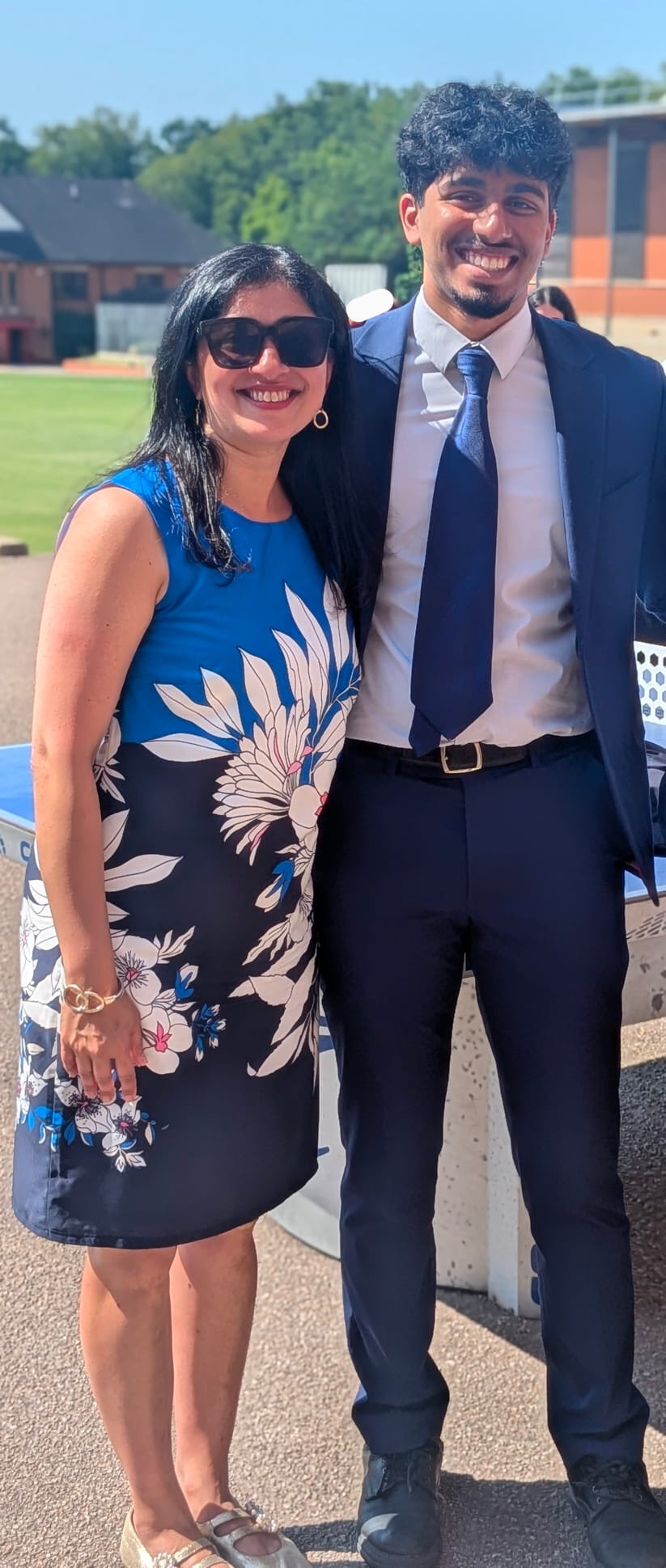
Like Poonam, for Rashmi Prabhakar, her son Vedant’s A-level success and place at a prestigious London university represents far more than a university offer. They mark a journey that began 25 years ago, when she and her family arrived in the UK as first-generation immigrants carrying little more than “hopes, aspirations and dreams” for the next generation.
“Seeing our child reach this milestone fills us with happiness and immense pride,” she says, describing Vedant’s achievement as the culmination not only of his hard work, resilience and ambition, but also of sacrifices made across generations.
Yet Rashmi’s pride comes with a nuanced understanding of the role privilege can play in educational success. Vedant attended a private school, while his younger sister Tanvi is currently at a state grammar school, giving Rashmi a rare opportunity to view the British education system from both sides.
The contrast, she says, is striking.
Vedant’s private education offered smaller classes, extensive extracurricular opportunities, repeated mock examinations, university guidance, enrichment programmes and access to networks. There were also experiences such as sports fixtures and ski trips that exposed pupils to different environments, social groups and opportunities.
Tanvi’s state-school experience has been different, but Rashmi is equally clear that there is no single route to achievement. Her daughter plays several sports through local clubs, for example, demonstrating that opportunities can also be created beyond the school environment.
“I do think attending a private school gave my son certain advantages,” Rashmi says. “I do not believe these opportunities should be exclusive to private education.”
For her, the bigger question is whether students from every background are given the support and confidence to fulfil their potential. State schools, she says, have talented teachers and students, but resources, guidance and access to opportunities can vary considerably.
“With the right support, mentoring, careers advice and extracurricular opportunities, students from state schools can achieve equally outstanding outcomes,” she says.
Her own experience of navigating the system has also been a learning curve. Arriving in Britain without having been through the UK education system herself, Rashmi had to understand applications, deadlines, university pathways and extracurricular opportunities largely from scratch. Extended family and friends helped, but much of the responsibility involved researching, learning and advocating for her children.
That experience has reinforced another belief: academic achievement does not happen in isolation. “Achievement is built through curiosity, perseverance and discipline, not simply privilege or opportunity,” Rashmi says.
As Vedant prepares to begin his next chapter, Rashmi sees his success and Tanvi’s very different educational journey as part of the same family story.
For a first-generation immigrant family, she says, reaching a leading university is about more than a name on an acceptance letter. It is about “dreaming big, creating possibilities” and giving the next generation the confidence to go further than those before them imagined possible.
“We are super proud of both our children,” she says.