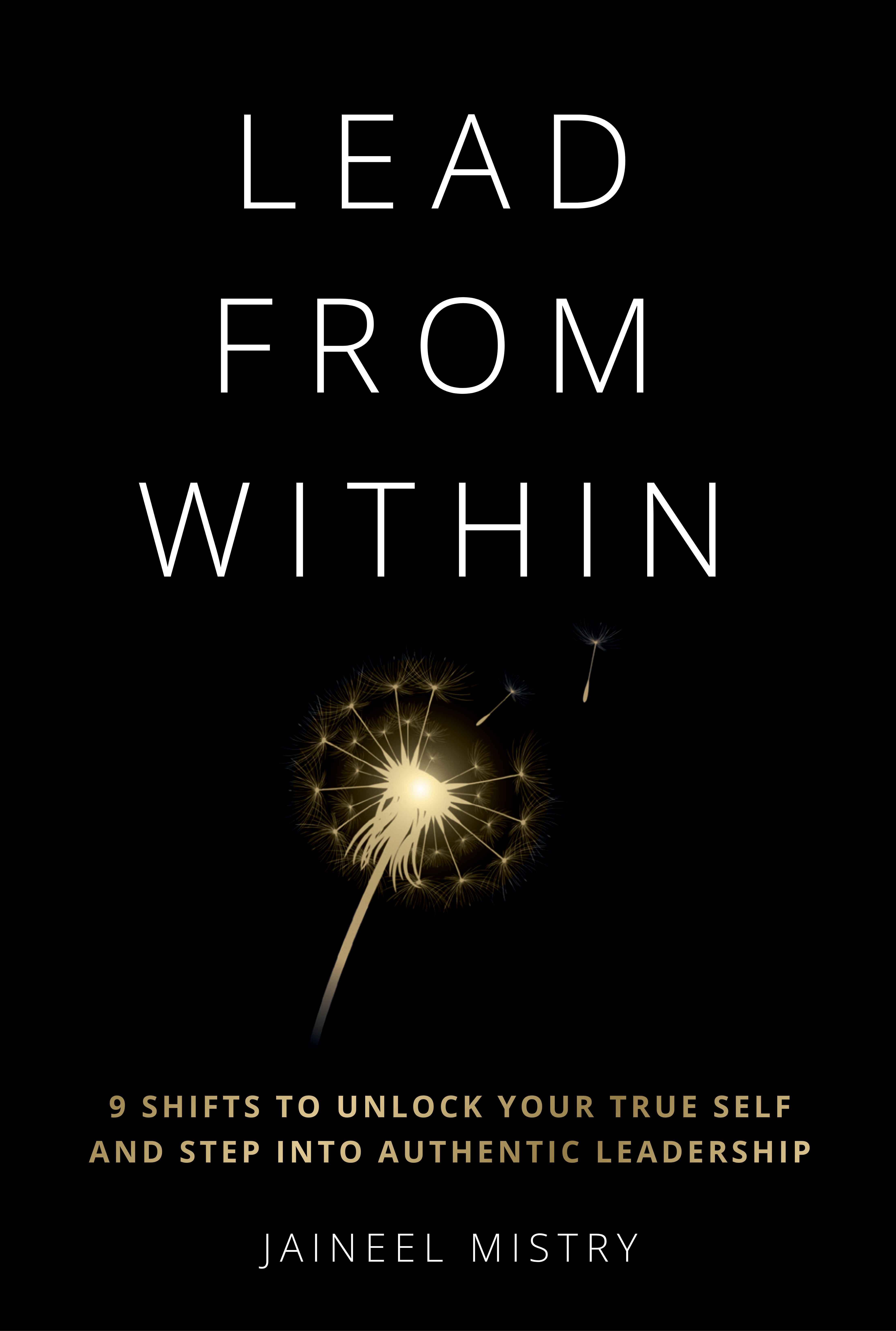

Jaineel Mistry is the founder of Thriving Scholar and author of ‘Lead From Within: 9 Shifts to Unlock Your True Self and Step Into Authentic Leadership’. A former pharmacist turned strategy consultant, he has more than a decade of leadership experience and has coached and trained over 500 executives, entrepreneurs and professionals around the world. His work draws on neuroscience, psychology and Eastern philosophy to help high achievers move beyond survival and lead from the inside out.
In an interview with Asian Voice, he discusses his book, leadership and finding purpose beyond conventional success.
1) Growing up in the UK as the son of Indian immigrants, how did your family’s experiences and expectations shape your understanding of success, security and ambition?
My grandparents and parents arrived with little and built everything through sacrifice, discipline and hard work. The message at home was clear. Stay safe, get good grades, secure a respectable job and never risk the stability they fought for.
It gave me resilience, discipline and a solid work ethic, which got me to the top 5% of my year at school. I got straight As at A-Level and qualified as a pharmacist. By every measure I’d been taught to use, I was “succeeding”.
But as I had climbed my “first mountain” of career success, I found myself in my mid-twenties in my dream career in management consulting. My mind said I had “made it”. But deep down it felt far from that. Surely there was more to my life than a “secure” job?
The safety I had achieved in my career, knowing I’d be okay, then allowed me to reflect on what success really meant for me. I recognise this is a privileged place to be, compared to what our parents faced. So I don’t resent any part of the journey.
That survival mindset helped me rise in corporate consulting and provide for my family. But I felt there was also more to explore. The people I looked up to in terms of success always had a sense of purpose and passion behind their work, which I didn’t have at the time, so I started to ask questions and look deeper.
2) Do you think children of immigrant families often feel an additional responsibility to fulfil their parents’ sacrifices, sometimes at the expense of their own aspirations and sense of identity?
Yes. When your parents have worked hard to give you the upbringing they have, success is collective as a family rather than individual. It becomes a debt you feel you owe. That creates a powerful drive, and it’s a real strength. But it can also mean you build a life for them and never ask what you actually want. When we don’t live in alignment with ourselves, then problems start to occur.
The risk is that you become a version of yourself designed to meet expectations and avoid disappointing anyone. I call it the Survival Self. It may be necessary for a season of our life, but I think if we continue to live that way, we will eventually reach a plateau across multiple areas of our lives: career, money, relationships and health.
I believe the way through this isn’t rejecting your parents’ sacrifice. It’s honouring it by becoming fully yourself. Because isn’t that the best thing you can do for your family? To discover your true nature, to embody your truth and to lead everyone around you toward the next success of your bloodline?
Just because our parents’ generation lived through real challenges and hardship, it doesn’t mean we need to carry the same patterns on to our children. I believe the best thing I can do for my whole family is to break inherited patterns, go beyond survival and enter a place of pure possibility and deliberately create the next season we can be proud of.
3) Through your coaching work with more than 500 professionals and leaders, what are the most common internal struggles you have encountered among people who appear successful from the outside?
Every battle we face is primarily an internal battle. Many people I work with have worked hard to get where they are today. Successful entrepreneurs, surgeons, executives, people leading their families. Everything may look right on the outside, and yet something is missing within them. They feel like they are on a plateau, and no matter how hard they work, nothing seems to get them through this survival mindset into one that is truly thriving regardless of the external circumstances.
They often find themselves getting in their own way with a lack of confidence, maybe conflicting belief systems, and a lot of overthinking, which stops them from achieving what they truly desire.
I see patterns in others which I certainly have found myself in:
1) Self-worth is tied to results, so net worth and self-worth become the same number.
2) A constant need to prove themselves.
3) Overthinking and worst-case spirals, even when the facts say they’re fine.
4) Loneliness with a lack of growth-minded people around them.
5) Guilt for feeling this way when they have so much to be grateful for.
It starts with updating our own internal software and the way we see ourselves and our world. I often explain it as giving ourselves a software update, just like we update apps on our phones. It takes consistent practice rather than a quick fix, but it’s absolutely possible.
4) Do you believe cultural expectations around stability, respectable careers and family responsibility can sometimes make it harder for people from immigrant backgrounds to pursue a path that feels authentic to them?
They can, though I’d put it carefully. Those values come from love and from real hardship. Stability meant safety for our parents’ generation, and that of course deserves respect.
The difficulty is that the path is often pre-chosen. Doctor, pharmacist, lawyer, accountant. When the route is mapped out so clearly, it becomes harder to ask whether it fits who you are. We live in a different world today, where technology allows us to explore other avenues and business/career options. We also have graduates coming out of university struggling to find a “respectable job”.
So I think we are now seeing that, in order to “survive” in today’s world, one must have an attitude of constant reinvention and adaptation.
My own route went from being a pharmacist to strategy consulting to executive coaching and running a business in leadership development. I had to become okay with people not understanding why I moved, and asking “what even is coaching?!”.
With AI reshaping how we work, that willingness to adapt matters even more. The security our parents wanted for us still matters. We just have to find it within ourselves first.
5) What would you say to young British Asians who feel caught between their families’ expectations and their own ambitions, particularly when those ambitions involve taking risks or pursuing unconventional careers?
First, you’re not betraying anyone by having your own dreams. You can hold deep respect for your family and still want something different.
Second, you don’t have to choose between security and aliveness overnight. I started Thriving Scholar as a blog and began coaching in 2018 while still working in consulting. I built the new path alongside the old one until it was ready to stand by itself.
Third, talk to your family out of curiosity rather than defence. Ask what they were really protecting. Usually it’s your safety and wellbeing. Once they feel that you’ve understood that, the conversation changes.
And ask yourself one question. If I had a year to live and knew I could not fail, what would I do? Your answer is worth taking seriously. Then take one small, sensible step towards it.
6) You describe your book Lead From Within as a personal retreat for readers. What do you hope someone is struggling with the question “Is this it?” will take away after reading it?
I hope they feel relief first. The emptiness they’ve been carrying isn’t a failure or ingratitude. It’s an invitation. For me, that feeling turned out to be the beginning of a whole new chapter.
I hope they also realise the answer isn’t out there. It’s not in the next promotion, the next business or the next goal. It’s within them, in a place that stays steady regardless of their bank balance, their title or what’s happening in the world.
The book is designed to be experienced rather than just read. It takes the reader through a journey of self-discovery, self-mastery and self-leadership. It has stories, reflection questions and practical exercises across nine shifts. I wanted it to feel like a private retreat with a guide who has walked this path with over 500 leaders.
If someone closes it feeling calmer, clearer and more honest with themselves, it’s done its job.
7) The book argues that people do not need to abandon their ambition to find greater fulfilment. How can they maintain their drive while moving away from the constant pressure to prove themselves?
By separating two things we usually mix together. Living is your inner experience of peace, joy and contentment. The game is your career, your goals and your achievements. The game is great fun. The trouble starts when you let how the game is going decide how you feel about yourself.
I’ve been driven since I was fourteen, and I’m still grateful for it. But I’d attached my worth to my results, and the highs stopped feeling joyful while the lows felt lower than ever.
When people hear “detach joy from the outcome”, they fear losing their drive. I argue it does the opposite. You lose the pressure, not the desire. You ask more boldly, take bigger risks, recover faster and enjoy the process.
Ambition from wholeness is purer than ambition from needing to prove yourself. You still play to win. You just stop needing to win in order to feel whole and complete within yourself.