The Indian diaspora rejoiced Prime Minister Narendra Modi's visit to the UK from 17 till 20th April 2018. He was in London to attend the 25th Commonwealth Heads of Government Meeting (CHOGM), signed many bilateral as well as visited the Queen, besides engaging with the Indian community.
Foreign Secretary Boris Johnson received Prime Minister Narendra Modi on 17th night when he landed at London's Heathrow airport. They had a brief meeting at the airport. The Prime Minister then reached St James' Hotel, at Buckingham Gate after midnight, where he was staying.
On Wednesday 18th morning at around 8am, supporters of Narendra Modi gathered outside 10 Downing Street with plaques and Indian flag, shouting slogans like 'Chak De India' and 'Har Har Modi'. Around 8.54 am Mr Modi arrived at 10 Downing Street and was greeted at the door by Mrs May saying, “hope you're well Mr Prime Minister.”
Outside Downing Street gates, around 100 people, mostly women, in orange, pink and green sarees with black blouses, men with white kurtas with orange jacket and Nehru caps shouted slogans supporting NaMo. Dhol played as women danced to the beats. Organisations like Indian Ladies UK, Uttarkhand Welfare Association, Friends of India Society International-UK, Indo-European Kashmir Forum, UK Dev Bhoomi Trust- West Midlands, Bihari Connect UK swayed the Indian flag as Mr Modi left 10 Downing Street for his future engagements. He waved at the gathered crowd, who cheered at the PM's convoy.
Near Central Hall and along Parliament square many supporters, as old as 70 years, danced and sang to patriotic songs, cheering for Modi, welcoming him. This included more than 2500 people from various localities including organisations such as Hindu Forum of Britain, Sardar Patel Memorial Society, BAPS South London, Anoopam Mission, Brent India Association.
Mr Modi then headed to the Exhibition on 5000 Years of Science and Innovation followed by a 'Living Bridge' themed Reception at the Science Museum - in presence of Prince Charles. The plaque for the Ayurvedic Centre of Excellence was inaugurated and they were joined by Amarjeet S Bhamra. A Memorandum of Understanding (MoU) was signed between the College of Medicine (UK) and the All Indian Institute of Ayurveda regarding establishment of this new centre of traditional Indian medicine and yoga- the first of its kind in the UK. An initiative of Prince Charles himself, the centre has been launched in London with hopes of future inclusion of Ayurvedic medicines in NHS and GP prescriptions and supported by the GMSP Foundation in the UK. Mainly a research centre in University of Westminster, it now will work towards building this trust in Ayurveda as real medicine and establish branches among several hospitals in the UK. Sir Venkatraman Ramakrishnan, President of the Royal Society, was present personally to escort Prince Charles and Mr Modi around.
GMSP foundation was set up by Ramesh and Pratibha Sachdev in 2006, to support vulnerable communities in India and the UK. Ramesh and Pratibha Sachdev said, “We see this very much as the beginning of a long-term project, linking India and the UK, to bring Indian traditional medicine to the UK healthcare system. We are very proud of our Indian culture, and are pleased to be supporting a project in the UK – a country which has given us great opportunity.”
Sonal Sachdev Patel, CEO of GMSP Foundation said, "We are strong believers in the benefits of yoga and traditional Indian medicine and are excited to see the strengthening ties between India and the UK. This initiative is the beginning of a long-term plan to make these tools available more widely on the NHS.”
This MoU will provide opportunity for both sides to collaborate on research, develop evidence-based guidelines for integrating Ayurvedic principles and practices with modern medicine. The MOU also provides opportunity to take up joint research programs, funding for which could be jointly shared by both sides.
The main base of the new centre will be the St Charles Centre for Health and Wellbeing in North Kensington, which already offers yoga on GP referral already and serves an ethnically diverse population. Initially, the centre will offer yoga, ayurvedic dietary advice and cookery demonstrations and massage. As well as referring patients directly, GPs will be able to provide access via social prescription.
The centre will also explore the provision of yoga and traditional medicine in other settings such as a GP surgery and at the University of Westminster.
Prof David Peters of University of Westminster said “Yoga is now part of everyday life for millions of people in the UK and scientific interest in meditation is at an all-time high. Colleagues in our Faculty of Science and Technology are already researching herbal medicines and evaluating social prescribing. We want to explore these approaches in different NHS settings and gather evidence for their wider use”.
In this system patients, protected by a sound regulatory environment and the support of the National Health Service, have access not just to conventional medical treatment but to proven complementary care and therapy.
After that NaMo went to the Basaveshwara statue where he laid flowers to the statue. Basaveshwara was a 12th century Indian philosopher (Lingayat) and a social reformer who believed to have pioneered the idea of democracy. People shouted Bharat Mata ki Jai and Hindustan Zindabad as he walked to the statue.
Dr Neeraj Patil, Former Mayor of the London Borough of Lambeth and one of the major proponent of the statue said, "We are delighted that Hon Prime Minister of India Shri Narendra Modi ji paid tribute to the pioneer of Worlds largest democracy 'Basaveshwara' in front of mother of all Parliaments, the Westminister Parliament."Modiji was anyway coming to UK for commonwealth conference and I requested him to pay tribute to Basaveshwara statue that was unveiled by him. "Coincidentally today is the 885th Birthday of Basaveshwara and he kindly agreed to come and pay respects."This was followed by his visit to Francis Crick Institute, where he had a tour of the Research Labs. At the India UK CEO Forum there was a showcase of India UK Collaboration in Science and Technology, where Mr Modi was accompanied by Prime Minister May. They discussed major break through on malaria and cancer research.
At 4 pm he had an audience with the Queen at Buckingham Palace, followed by an interaction with Indian community at the Centall Hall, Westminster. In ‘Bharat ki baat sabke Saath’ he was asked many questions about his policies, good governance and his indomitable spirit and energy.
This was followed by a dinner hosted by UK PM for Commonwealth leaders.
On 19th, Mr Modi attended the formal opening of the CHOGM summit where the Queen expressed her desire to have Prince Charles as her successor as the Commonwealth head.
This was followed by an official welcome by the UK Prime Minister and Commonwealth Secretary General.
He then attended two Executive sessions at Lancaster house, followed by a reception and dinner by Queen Elizabeth II.
In between executive sessions, he had 12 bilateral meetings, with heads of Antihua & Barbuda, South Africa, Uganda, Mauritius, Gambia, Trinidad and Tobago, Seychelles, Bangladesh, Australia, Cyprus, Fiji, St Lucia, Solomon islands and Jamaica.
Prime Minister Modi addressed the second plenary of the executive session, during which he reiterated India's focus on small island developing nations of the organisation and delivering "demand-driven, rather than donor-driven" assistance to the organisation's smaller member states.
An MEA spokesperson said, "The overall objective of the Prime Minister's participation at this CHOGM in 2018 signals our stepped up engagement with the Commonwealth. It conveys India's desire to see Commonwealth increase focus on developing country priorities."
On 20th, the Indian Prime Minister Narendra Modi joined other heads of government for the leaders' retreat at Windsor Castle, which concluded the CHOGM formally. The retreat marked an end to the week-long summit in Britain, which started on Monday with forums on the theme of business, women, youth and civil society. The formal executive session of the heads of government meeting, themed around "Towards a Common Future', concluded last evening.
The closed-door meetings comprised the informal segment of CHOGM, where the leaders met without any pre-set agenda and without the presence of their close aides.
At the retreat - unique to the Commonwealth - heads met privately to discuss collaboration on global and Commonwealth priorities. South African President Cyril Ramaphosa was absent from the group of 53 heads of government as he had to rush back to Cape Town after violent clashes broke out in the country.
At the end of the retreat today, leaders issued their joint communique and a leaders' statement.
Modi then flew out to Germany at the end of the retreat for a brief bilateral meeting with Chancellor Angela Merkel in Berlin before headed to India. The meeting was added to the PM's Europe schedule, which included Sweden and the UK, on the request of the German Chancellor, officials said.
Manchester’s Hero Cycles showcases ‘e-bikes’ to UK and Indian Prime Ministers
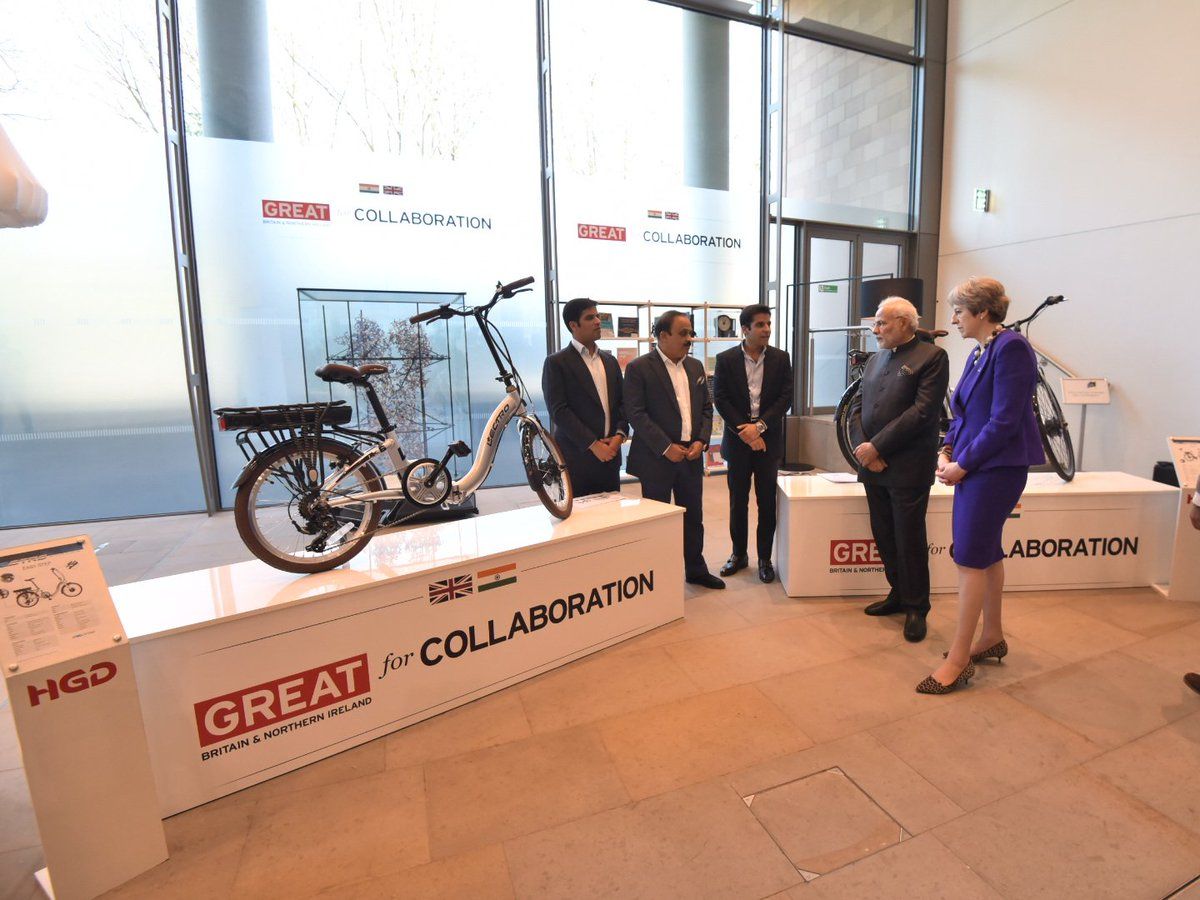
Manchester-based Indian-owned bike manufacturer Hero Cycles has presented its electric ‘e -bike’ range to the Indian and British Prime Ministers Narendra Modi and Theresa May during the Commonwealth Summit in London.
The Prime Ministers met with Hero’s chairman and managing director Pankaj Munjal during a visit to the Francis Crick Institute in London and were shown its Lectro bike range. Hero Cycles is the biggest bike manufacturer in the world by volume and became one of the most high profile Indian companies in the UK when it bought Manchester based bike company Avocet Sports in 2015.
In January 2017 Hero unveiled a new £2million ‘global design centre’ in Manchester near the National Velodrome, the home of British cycling. Manchester beat competition from Amsterdam, Copenhagen and Berlin to host the design centre.
Avocet Sports Limited’s CEO Sreeram Venkateswaran said Mr Munjal was able to explain to the Prime Ministers how Hero is fusing UK and Indian expertise.
“We were immensely proud to able to tell the Prime Ministers how Hero is in the vanguard of future UK India trade relations,” he said. “We have put the UK at the very centre of our growth ambitions by buying Avocet and investing in the new global design centre in Manchester. We believe the UK is the natural partner for Indian manufacturers where we can share knowledge and learning. Our Manchester design centre will lead innovation of our bike ranges which will then be built at our factories in India and around the world. This follows closely Mr Modi’s ‘Make in India’ campaign. Hero is following other Indian companies in investing in British companies with heritage brands Jaguar Land Rover and Royal Enfield. Avocet operated the Viking and Ryedale bike brands which we are keen to recalibrate for future generations starting with our new brand launch in May.”
Mr Venkateswaran said showcasing Hero’s Lectro electric bike was especially important.
“Hero is committed to using cycling as a force for good,” he said. “Our Lectro e-bikes range can help cut carbon emissions and take cars off the road. In addition, recent studies have shown the enormous health benefits of cycling improving fitness and immune systems particularly among older people.”
Hero Cycles will launch its eagerly anticipated new range of British designed bikes at a special ceremony at Old Trafford football ground on May 3.
Tim Newns CEO of Manchester inward investment agency Midas said: “India is a key market for Greater Manchester, which for the last two years has been running the campaign 'Make in India, Innovate in Manchester' and Hero Cycles’ creation of its Global Development Centre in Manchester epitomises the campaign’s aim,” he said. “The idea of the campaign is to support India’s “Make in India” policy, whilst leveraging the immense innovation strengths of Greater Manchester and the wider North, which can help drive growth for significant global Indian companies such as Hero. The city remains highly attractive to investors due to its world leading research specialisms and talented workforce, but also its connectivity to other global market places. The Lectro Bike is an exciting new product that will I am sure be a great global hit, but it will also help to move Manchester towards its goal of being a green city.”