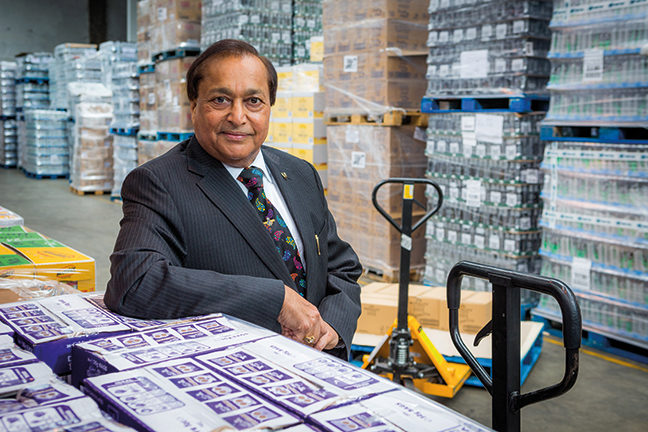
More than 40% of companies fear that Britain's vote to leave the European Union will damage their trading prospects. But shipping entrepreneur Dr Rami Ranger CBE believes that the concerns are misplaced, and Brexit will bring new opportunities for small businesses especially in Commonwealth countries and the Far East. In an article in The Times on Tuesday 4 October, he has discussed his 'path to success' and how 'slow and steady' he has built up his million worth business. Thirty years after he started a shipping company from his garden shed, Dr Ranger is still on a voyage of discovery. His business Sunmark made £200mn worth of sales to 130 countries last year. South America is the latest market in 68 year-old Dr Ranger's unrelenting mission to sell British branded products ranging from baked beans to deodorant cans.
His story is not unknown to the British Asians, growing up in the UK. Rami Ranger's father was an Indian freedom fighter, who was killed during the 1947 partition, two months before Rami was born. He and his 7 siblings were raised single-handedly by their mother, a teacher.
Necessity rather than desire led him into entrepreneurship. He was inspired by his mother's work ethics but wanted to channel his efforts into law rather than business. After graduating from University of Punjab, he convinced his mother to send him to Britain to continue his legal studies. But the UK failed to live up to his expecttaions. “It was a total cultural shock. I realised my perception of the UK was totally wrong. I’d seen English movies and I thought everything would be so easy here. But the government had changed the rules to say that overseas students had to be in the country for three years before he or she could qualify for grants.”
Looking at the soaring expenses for his education, he decided to earn some money before returning to India. This proved easier said than done, because everybody asked for experience. The first job he got was cleaning cars. The second was working as a cook for KFC, the fast food chain, in south London, earning 35p an hour.
He had two frustrating stints running convenience stores. “In those days Asians were buying corner shops, so I did the same. Those were difficult times because Asian immigrants were not treated as well as they are now.”
Fed up with the early starts, he sold the shops and got a job at Dixons, the electrical retailer, where he noticed a trend of people coming to the UK on holiday and buying televisions, videos and other electronics to take home. Excess baggage was expensive, so in 1987 he started Sea, Air and Land Forwarding to help them ship the products back from a shed with just £2 and a typewriter.
He says that he is not a risk-taker and his approach to building the company has been slow and steady. After ten years, the business was a success, turning over £10 million. By then he was being asked to ship other items aside from electrical goods and personal effects. In 1995 he started a second company, Sun Mark, which makes cheaper versions of the branded British products sold by fast-moving consumer goods giants.
He told the Times, “I took the model of Sainsbury’s and Tesco, who had their own versions of products they were selling more cheaply. But whereas these supermarkets do not give nice names to these products, calling them ‘value’ or ‘basic’, I decided to give nice names like Pure Heaven, English Breeze and Golden Country.” The approach worked. “My business just snowballed.”
The company has won numerous Queen’s awards for enterprise. Africa, the Middle East and Far East are proving his most lucrative markets and his big sellers include energy drinks and cooking oils. Dr Ranger’s strategy is to sell products that are overpriced in the target market, so customers save 30 to 40 per cent if they buy his brands.
He is now chairman of both businesses and the day-to-day operation is overseen by his son-in-law, who is chief executive. Mr Ranger says that the secret to his success is that he did not rush to prove himself.
Now that Sun Mark has scale on its side Mr Ranger is ready for a calculated gamble or two. “We are financially strong and able to fight the competition. We can sustain ourselves until the product is accepted.”
Speaking about Brexit, he added, “For the last 40 years we only looked at Europe and we were under the influence of the EU,” he says. “Its rules and regulations [meant] we couldn’t think for ourselves. We were told by the EU where to go, what to think and do.
“I’m very optimistic that Brexit will be a great thing for us. We will be able to forge relationships on our own terms.”
Ambarish Mitra: The tech-entrepreneur to change your world view
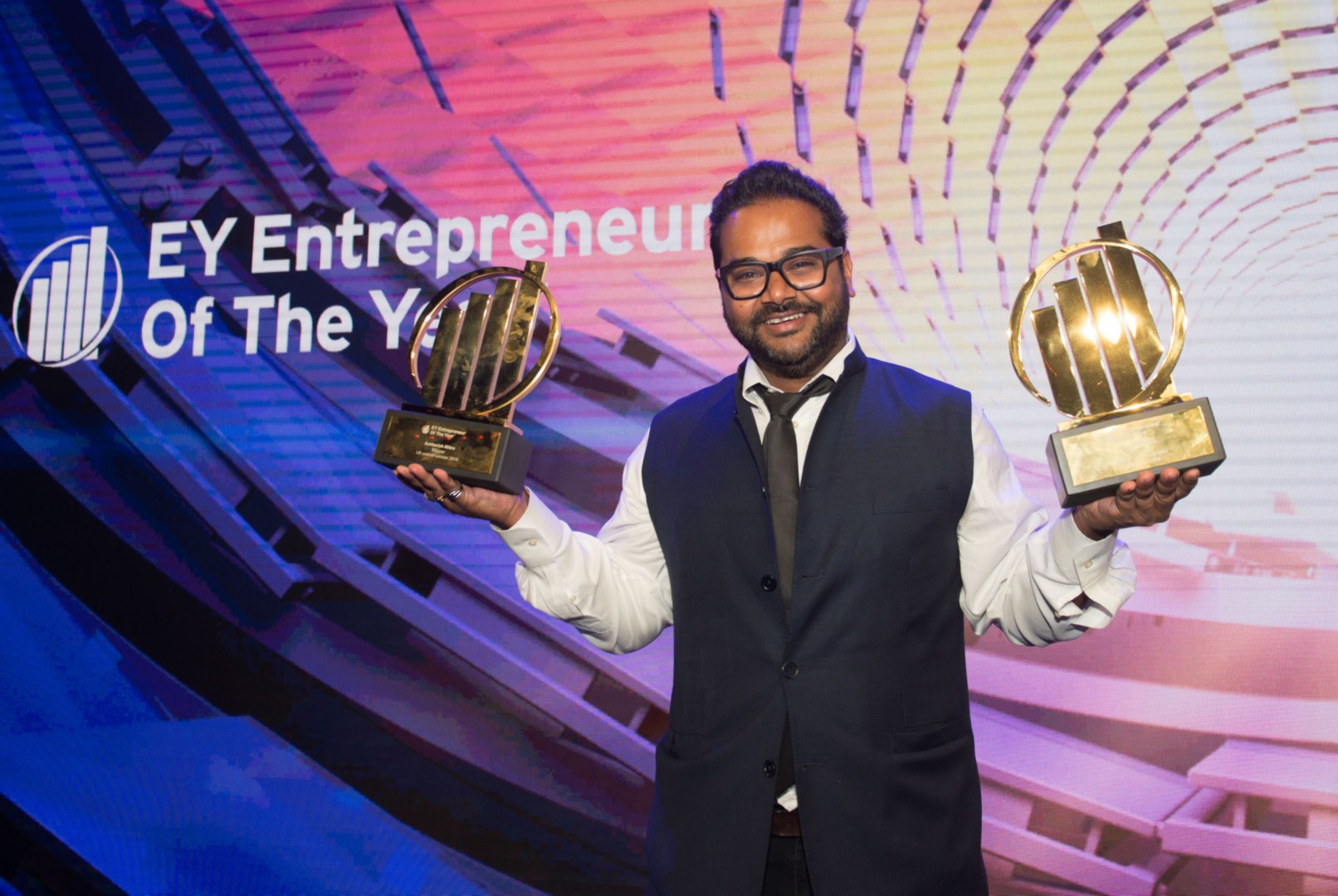
Ambarish Mitra's working life started two decades ago in a Delhi slum, after he ran away from his home as a teenager. Now he is building a technology business, set up in London in 2011, that has ambitions eventually to rival Facebook and Google. He is the Chief Executive and Co-Founder of Blippar, a tech company, growing rapidly, specialising in augmented reality, artificial intelligence and computer vision. He was named ‘EY Entrepreneur Of The Year UK 2016 overall winner’ at a ceremony in London on Monday night.
Blippar's free app turns a smartphone camera into a tool that scans, recognises and identifies everyday objects and brings up online information about them on the screen.
While working two jobs, as a door-to-door salesman by day and at a tea stall by night, Mitra won a nationwide business plan competition. The prize money funded the launch of his first business, Women Infoline, which gave free internet access to women earning below a certain wage.
At 21 Mitra sold the business and moved to the UK, where he started three business ventures over the next ten years. His ‘lightbulb moment’ happened in a pub, after sharing a joke with Blippar’s co-founder, Omar Tayeb, about the Queen coming to life out of a £20 note. A few days later a prototype was created and Blippar was born. The company now has twelve offices across the globe, including London, New York, San Francisco, Delhi and Singapore, with plans to expand.
Blippar harnesses image recognition, augmented reality and computer vision technology to bring the physical world to life through smart and wearable devices. Once they have downloaded the app, consumers can blipp (‘scan’) objects they are curious about and unlock content. The app has over 65 million users in 175 countries.
The judges described Mitra as “a man with big vision and a driving ambition, but also one that is matched by his social conscience, driven at least in part by his own early life experiences”.
Stuart Watson, UK Entrepreneur Of The Year Programme Leader said: “Ambarish wowed the judges with his technology and his entrepreneurial spirit. This is an entrepreneur with an unwavering determination to succeed, who sees each triumph and failure as feedback to help drive the business forward. They were also impressed by his personal journey from teenage runaway in New Delhi, to a CEO of a fast growth, high-tech multi-national, transforming interactions with consumers.”
Mitra has entered the awards programme three times in the last three years and will now go on to represent the UK at EY’s World Entrepreneur Of The Year in Monaco next June, competing with more than 50 other country winners for the global title.
An independent judging panel chaired by Rosemary Squire OBE, Founder Director and Deputy Chairman, Ambassador Theatre Group and EY Entrepreneur Of The Year UK 2014 overall winner, selected the winners from 40 UK finalists, who have combined revenue of £2.4bn and employ a workforce of over 16,000.