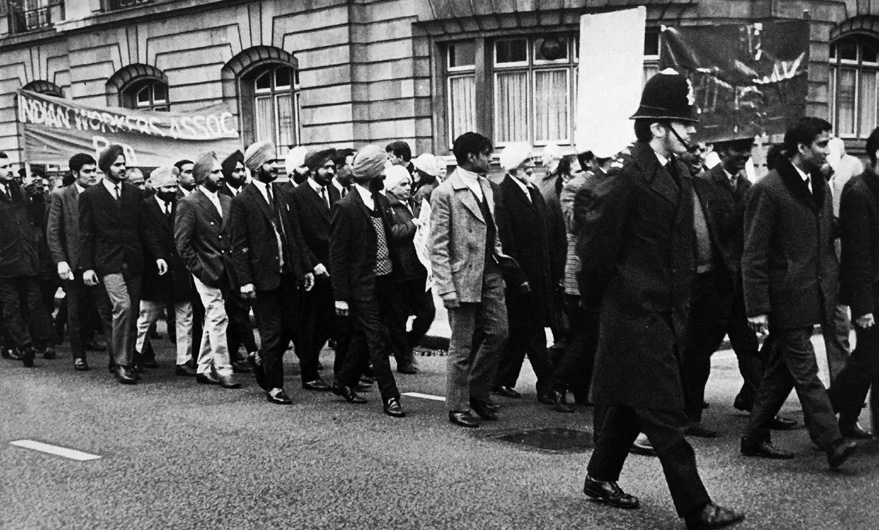
The history of Punjabi migration to the UK dates back to the colonial era when Punjab was a province of British India. During the nineteenth and early twentieth centuries, Punjabi migrants primarily occupied roles as domestic servants, seamen on British merchant ships, and individuals seeking professional qualifications such as civil servants or students.
Referred to as 'Little India,' Southall is situated in the far west of London, originally belonging to the region of Middlesex before London's expansion aimed at fostering economic growth. The name 'Little India' stems from the significant presence of South Asians within the district.
The substantial wave of Punjabi migration began in the 1950s due to labour shortages in the UK following the Second World War. The British administration actively encouraged recruitment from across the Commonwealth. The majority of these migrants were men from India and Pakistan. After a period of adjustment and acclimatization, they began to settle permanently and subsequently invited their friends, spouses, and children to join them. Many of these migrants found employment in the manufacturing, textile, and service sectors.
Gradually, Southall evolved into the largest South Asian community in London, solidifying its status as a vibrant hub of cultural diversity.
The R. Woolf Rubber Factory located in Southall, West London, holds a significant connection to the initial wave of immigrants from the Punjab region of India to Britain. During this time, the working conditions at the factory were exceedingly challenging, with Indian workers being subjected to strenuous labor while receiving lower wages compared to their white counterparts in similar positions.
With the rise of the Asian workforce, the alarming reality of exploiting migrant workers became more apparent and conspicuous. This led to a surge in calls for fundamental rights such as scheduled tea breaks, wage increments, an end to mandatory overtime, and improved working conditions. Asian workers initiated the process of organizing themselves, voicing collective demands, and actively participating in various strikes and demonstrations.
In November 1965, a significant event unfolded as approximately 600 Asian workers initiated a strike, demanding improved safety measures within the workplace. This strike persisted for a duration of seven weeks. During this time, while the management of the factory undermine the strike, they ultimately failed.
This strike served as a pivotal moment in the history of the Asian community in Southall and its aftermath marked a significant turning point, inspiring Asian workers to fight for their rights and assert their presence in the labor movement.
Five years later, in the 1970s, Southall became a site of civil unrest marked by acts of racism. In 1976, 18-year-old Gurdip Singh Chaggar fell victim to a racist attack carried out by infiltrating skinheads. While enjoying a night out with friends, Chaggar was fatally stabbed.
This incident ignited a powerful response from the youth in Southall, leading to the emergence of a significant anti-racism movement. Young people took to the streets to protest against Chaggar's murder. Although South Asian residents had already endured racial abuse, segregation, and violence, the realization that such abuse was resulting in actual deaths heightened tensions.
Following Chaggar's death, the Southall Youth Movement (SYM) was established. Their primary objective was to engage in direct action against politically motivated racist acts, particularly targeting immigration and the rise of the National Front. However, despite the community's stance, the police maintained that Chaggar's killing was not racially motivated. In response to the prevailing circumstances, the SYM occupied a building and transformed it into a safe haven for young people while teaching political history and celebrating their cultural music.
A few years later, the National Front made a decision to hold a public meeting at Southall Town Hall, with the intention of asserting their presence and agenda within the community. This announcement caused great distress, leading to widespread protests in the streets.
Southall’s Finest, an Instagram forum presenting regular insights on the town recalls that “ the protestors who held their ground, many of them being from India, were very familiar with the tactics of Gandhi, and sat down in the Broadway (Southall High Street) to protest peacefully.”
“However, the police who are supposed to help, protect and serve pulled up peaceful protestors, in some cases disrespecting their religion by pulling off their turbans.”
Another life lost during the protests was of Blair Peach, a New Zealand activist and teacher who had joined the National Front demonstration and was fatally beaten by police officers. Despite multiple witnesses to the incident, the police involved were not charged with any crime.
Following Peach's death, an inquest was conducted, revealing inconsistencies in the statements provided at the time. The community responded with a demonstration and in retaliation, the police arrested and charged 342 individuals on the day of Peach's death.
However, the SYM and other advocacy groups formed committees to defend those who were arrested and faced criminal charges and worked towards the acquittal of those wrongly accused.
The unrest in Southall continued, and in 1981, a racist band called 4-Skins was scheduled to perform at the Hambrough Tavern in Southall Broadway on a Friday night. Despite repeated requests to cancel the booking, the pub landlord refused to do so.
Southall was determined to stand up against racism and make a powerful statement. Petrol bombs were thrown at the Hambrough Tavern, resulting in its destruction. As skinheads fled from the scene, Southall stood its ground in a moment of victory.
Following this event, the racist elements did not dare to return, allowing Southall to experience a greater sense of freedom.