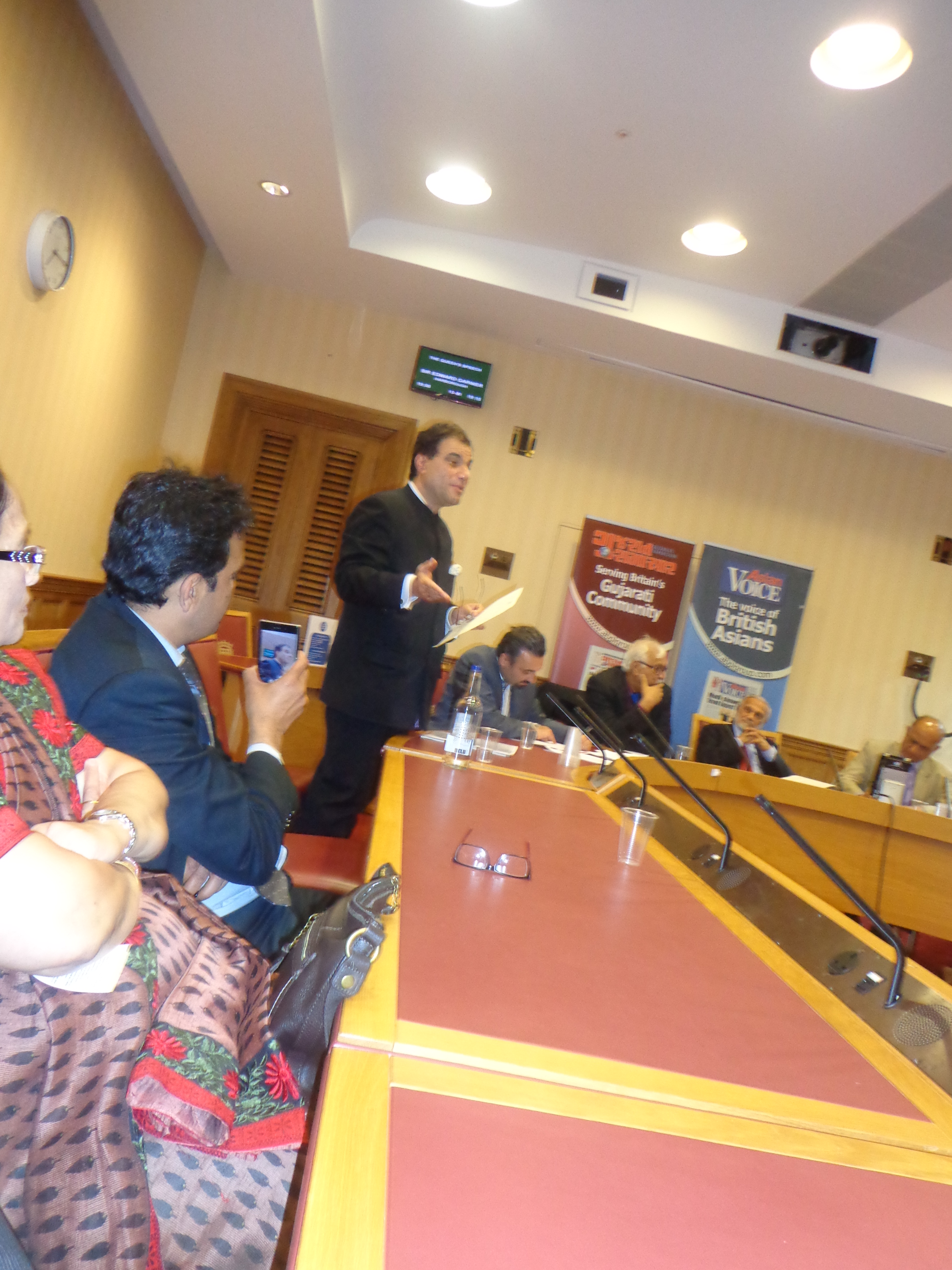
The Committee Room 4A in the House of Lords, brimmed with excitement on 27th May, as the who's who of the community gathered to discuss the importance of Indian voters in electoral politics and how they are shaping the future of Britain, hosted by Lord Prof Bhikhu Parekh and Asian Voice-Gujarat Samachar, Britain's largest Asian newsweeklies.
The timing of the debate was apt, especially in the wake of the recent research findings by think tanks British Future and Ipsos Mori. Incidentally it also coincided with the Queen's Speech, where there were particular emphasis on the importance of the bilateral relations between India and the UK. The discussion revolved around mainly three subjects:
- the growing shift in voting patterns amongst Indians
- the attitude of Indian voters, depending on the country of origin
- And why Labour party failed to win the confidence of Indian voters this election
Panelists included Lord Prof Bhikhu Parekh, CB Patel, Publisher/Editor of Asian Voice and Gujarat Samachar, Rt Hon Keith Vaz, MP, veteran Indian journalist Ashis Ray, Lord Karan Bilimoria, Runnymead Trust Director Omar Khan, Former election commissioner of India Dr S Y Quraishi and Deputy Indian High Commissioner to Britain, Dr Virander Paul. The panel was later joined by Senior MD at the Blackstone Group, Jitesh Gadia, Conservative MP Bob Blackman and Lord Raj Loomba.
The climax of the evening was the new appointment of Rt Hon Keith Vaz, as the Vice Chairman of the Labour party, announced by Lord Bhikhu Parekh- that highlighted the increasing value of Indians amongst Parliamentarians, and a corrective step by Labour party, after ignoring Indian interests in their party manifesto, prior to the elections.
While the British Peers and MPs discussed the importance of Indian diaspora to Indo-British relations, with statistical examples from Dr Omar Khan, where he exemplified the voting pattern difference between East African Hindus and Indian Hindus, Dr Quraishi did a comparative study of the electoral process between UK and India, in his usual witty style.
Former IJA President, veteran journalist and CEO of RayMedia, Ashis Ray kick started the discussion with statistics regarding the trend amongst Indian voters. Going through all the three manifestos, he was especially disappointed with the Labour party manifesto that he felt had deliberately ignored relationships with India. Conservative party however was able to secure that attention from Indians, because of their elaborate plan to engage with India on their manifesto. Ray also referred to the major goof ups by the Labour party while in power, that affected Labour-India relations further. In 2009 David Miliband went to India as the Foreign Secretary. Ignorant with an alleged colonial hangover, Oxford bred Miliband caused a diplomatic storm after he wrote an article for the Guardian, in which he claimed that resolving the status of Kashmir – the disputed territory over which India and Pakistan have fought three wars since 1947 – would help undermine support for terrorist groups in south Asia. India views unrest in Kashmir as an internal matter rather than an international dispute. The reports suggested Miliband's comments had angered the Indian government, and Mandelson's requests for meetings with Indian ministers had been turned down as a result.
Despite such anomalies and corrosive friendship with India, Ray went on to describe how Labour still continues to receive Asian endorsements. He said: “The Labour MPs have certainly looked after our community well. My study of 52 constituencies, show that only 22 have fair or large number of Asians. In these 22 constituencies, 20 were won by Labour party. The two seats won by Conservatives were not won by Asian candidates- Bob Blackman and Edward Garnier, which also shows that Indians tend to vote for those MPs, whatever be their origin, who serve them well.”
Speaking about Indo-UK relations, Mr Ray added, during this year's Queen's Speech, it has been highlighted that the government is looking at an enhanced partnership with India as well as China. In 2010, it was India alone. Perhaps this is a hint for India, to do a bit more with Britain.
Rt Hon Keith Vaz, MP spoke how in 1987 there were only 4 MPs from the BME background now increased to 41. He emphasised that for Indians to be mainstream, and have fair representation, it is important that we encourage our children to become politicians from early age. “This is a sign of great progress. Breaking down the barrier, making this a profession worth considering, is extremely important and healthy for the psyche of the people from ethnic background.”
He also spoke about the importance of such roundtable discussions on regular basis in the UK and the possibility to have an Indian chapter in India with the Indian Parliamentarians.
Praising Bob Blackman for community service and PM David Cameron for the Indians including lifting the ban on Alphonso mango, Vaz added, “David Cameron has visited India four times, much more than anybody else in similar period of time. This is a good thing for relations and it inspires the Labour party to do better...
However he went on to say, “Relations with India is above party politics. Do not wait for government to help to make it better. It is our (diaspora's) responsibility to ensure that India is an issue right at the forefront of British Public life.”
Next speaker, the Cobra beer founder and Indian tycoon, Lord Bilimoria said, “On political basis we do not have enough interaction between the parliamentarians here and in India. Indians are by far the most successful community in this country. The barriers of aspirations do not exist any more. Earlier Indians would vote Labour, but now look at the huge shift. 49% Hindus and Sikhs have voted for Conservative.
“Mr Cameron spoke about an Asian Prime Minister in the UK. But I think an Indian would become a British Prime Minister (earlier). David Cameron has shown huge commitments. Sadly the Indian PM has not made an official visit since 2006. PM Modi, we are waiting for you.
Hinting on the government's immigration policies affecting the Indo-British relations negatively, Lord Bilimoria elaborated, “The Conservative government has sent out a very negative message on immigration. Yes cut down illegal immigration, get exit checks, but do not deter good immigration, as UK needs business.
“Also whether we are going to stay in Europe- this uncertainty is unhelpful. India looks at UK as the gateway to Europe. We have better chances by staying within Europe, which helps the India-UK relations, and benefit India as well as UK.
Concluding he spoke about the dynamism in Indian diaspora, “Narendra Modi often uses the word Taqat, which means power. There is soft power and hard power, India has both. But India's strongest element of hard and soft power is it's diaspora. When you have a combination of soft power and hard power together- it is called smart power and Britain has 1.5mn of them.”
Dr Virander Paul, the Deputy High Commissioner of India, speaking on behalf of the Indian government said, “There is a tremendous resonance across party lines. The Indian diaspora is the strong pillar of the UK-India relations. 2.5% of the British Indians contribute 6% of UK's GDP. It is natural for British Indians to expect a corresponding response.
Lord Parekh, who was moderating the session rounded up the discussion on how this election revealed several important trends and reflected some of the profound changes taking place within the Indian community. He said, “First, like the South Asians and the ethnic minorities in general, Indians are no longer a homogeneous group. Apart from class divisions, there are also religious differences. More Hindus (47%) voted for Conservative than for Labour (41%) whereas Muslims from Pakistan and even India went predominantly for Labour (64% as opposed to 25% for Conservative). Sikhs voted broadly among the same lines as the Hindus. Among both Hindus and Sikhs, those from East Africa tended to vote for Conservatives in larger number than did their counterparts from India.
“Secondly, Indians have traditionally been Labour supporters, largely because Labour government gave India independence and was later responsible for anti-racist legislation. Indians did vote for Conservatives in the past, but they generally felt embarrassed or uneasy about it. In this election they proclaimed their Tory sympathies and took positive pride in it. This is a major change in their self-understanding.
“Thirdly, all political parties put up candidates from ethnic minorities. UKIP put up 6%, Green 4%, Labour 9%, Lib-Dems 10% and Conservatives as high as 13%. There were in all over 50 Indian Parliamentary candidates. For long Indians have tended to shy away from active politics, and not considered it as a career. These elections should change their attitude. There have been more ethnic minority candidates than ever before, their ethnicity was rarely held against them, and there are more of them in the Commons than ever before. There is every reason to believe that the ethnic minority including Indian youth should from now onward see politics as a career option in the same way as medicine or law.
“Fourth, as many as 150,000 of ethnic minority voters voted for the Green party, a larger number than ever before, showing their political sophistication and their willingness to move beyond the conventional political spectrum centred on three mainstream political parties.
“Fifth, nearly 70,000 ethnic minority voters including Indians voted for UKIP. In one constituency (Hull) an Indian UKIP a Sikh candidate collected over 3,000 votes. The fact that Indians were prepared to vote for UKIP shows their increasing self-confidence and a sense of security. They feel they are too deeply settled in Britain to need to worry about the threats posed by the UKIP. They also seem to feel possessive about the country and, like their white counterpart, want to protect it against new immigrants.
“Sixth, George Galloway was defeated in Bradford. This shows that British Pakistanis are more interested in local issues and expect their M.P. to work for Bradford rather than Syria, Iraq or Kashmir. Like British Hindus and Sikhs, British Muslims are beginning to look at issues within a British framework, and resist the pull of long distance political and religious nationalism.
“Finally, Indians made only a marginal difference to the outcome of the election, and David Cameron would have won even if no Indian had voted for him. Once labour lost Scotland and middle England, Conservative victory was a certainty. Some sections of the media however presented the matter differently and gave the ethnic minority votes greater importance. This has boosted the self-confidence as well as the sense of potency and power of the ethnic-minorities including and especially the Indians, the largest group among them. This should encourage them to become politically more active and assertive in future. The fact that nearly 45% of Indians are below the age of 30 means that Indian influence will continue to be felt in future elections too.”
The evening concluded with comments and questions from the audience, and a demand to make such discussions a more regular affair.