India and the United Kingdom have signed a landmark Free Trade Agreement (FTA), the UK’s most significant trade deal since leaving the European Union in 2020.
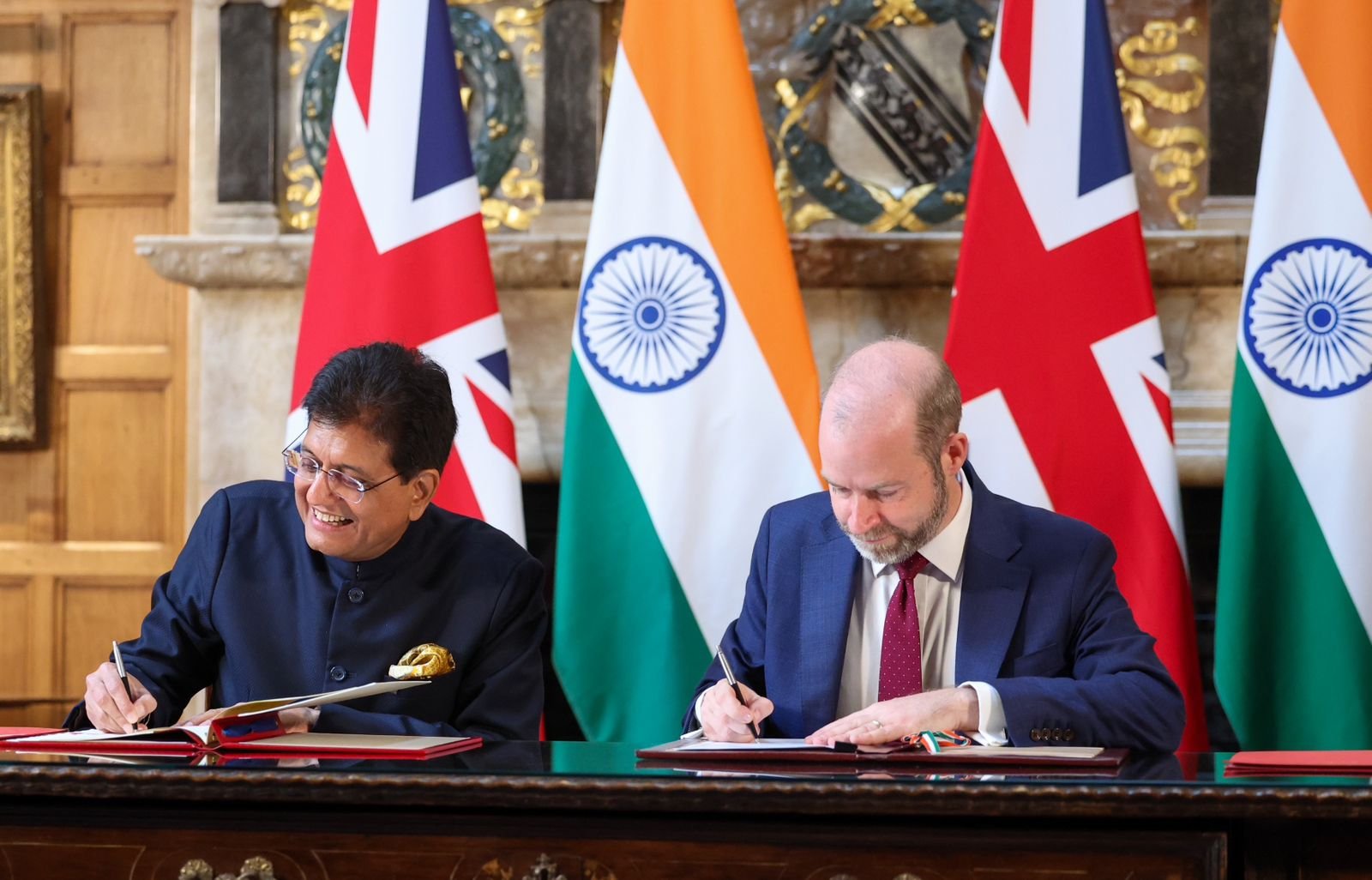
The pact, expected to boost bilateral trade by USD 34 billion annually, was formalised by Indian Commerce Minister Piyush Goyal and Trade Secretary Jonathan Reynolds at Chequers, the official country residence of the British Prime Minister. The signing took place in the presence of Prime Ministers Narendra Modi and Keir Starmer, following high-level discussions during PM Modi’s visit to the UK. Dr S Jaishankar, Indian Minister of External Affairs and Rachel Reeves, Chancellor of the Exchequer were also present during the signing.
Taking X, PM Modi tweeted, “A new chapter begins today in the India–UK economic partnership! The signing of the Comprehensive Economic and Trade Agreement (CETA) reflects our shared commitment to enhancing trade, driving inclusive growth and creating opportunities for farmers, women, youth, MSMEs, and professionals.”
The FTA is set to deepen economic ties and unlock new opportunities for businesses in both countries.
Welcoming the deal, Prime Minister Keir Starmer said: “This landmark agreement means jobs, investment, and growth for the UK. It cuts tariffs, makes trade quicker and easier, and puts money in the pockets of working people. It’s good for business, good for workers, and reflects our Plan for Change in action.”
Indian Prime Minister Narendra Modi was accompanied by a high-level business delegation of 16 Indian industry leaders, led by Sunil Bharti Mittal, Founder & Chairman of Bharti Enterprises and Co-Chair of the India-UK CEO Forum. Organised by the Confederation of Indian Industry (CII), the delegation highlighted the close collaboration between government and industry in advancing India-UK economic ties.
Welcoming the India-UK FTA, Mittal said, “This modern, forward-looking agreement will boost innovation, ease market access, and foster investment. It offers vast opportunities for businesses in both countries.”
The CII delegation met UK policymakers and business leaders to discuss collaboration in skills, mobility, digital tech, climate action, and healthcare. With over 970 Indian companies in the UK contributing £1.17 billion in taxes and employing 1.1 million people, the FTA is set to reduce trade barriers, boost investor confidence, and encourage joint ventures in key sectors. It also includes a Social Security deal for Indian professionals and builds on the Technology Security Initiative to deepen cooperation in emerging tech.
CII Director General Chandrajit Banerjee said, “This FTA marks a new chapter in our bilateral ties, fostering inclusive growth, regulatory cooperation, and next-generation partnerships.”
Rain Newton-Smith, CEO, CBI said, “In an era of rising protectionism, today's announcement sends a powerful signal that the UK is open for business and remains resolute in its commitment to free and fair trade.
“A trade agreement with India - one of the world's fastest-growing economies - is a springboard for long-term partnership and prosperity. UK firms can take advantage of this new platform to scale, diversify and compete on the global stage.
“The CBI looks forward to working closely alongside the Confederation of Indian Industry to turn ambition into action and negotiation into real-world impact. Ensuring this agreement delivers tangible benefits for businesses on both sides will be critical to meeting the UK's growth ambitions.”
Cricket, chai, and diplomacy: PMs bond at Chequers
The Indian Prime Minister first met Prime Minister Keir Starmer and held a bilateral meeting. They addressed cameras at Chequers, the prime minister’s country house near Aylesbury in Buckinghamshire, after signing the deal, which was finalised in May after nearly three and a half years of negotiations. Modi, speaking via a translator, described the UK and India as “natural partners”.
On taking X, PM Modi said, “Thankful to PM Keir Starmer for the warm welcome at Chequers. Our discussions reflect a shared commitment to deepen India-UK ties across sectors.”
He also wrote, “The talks with PM Keir Starmer were outstanding, particularly in the wake of the successful signing of the Comprehensive Economic and Trade Agreement. In addition to economic cooperation, this agreement sets the stage for boosting shared prosperity.”
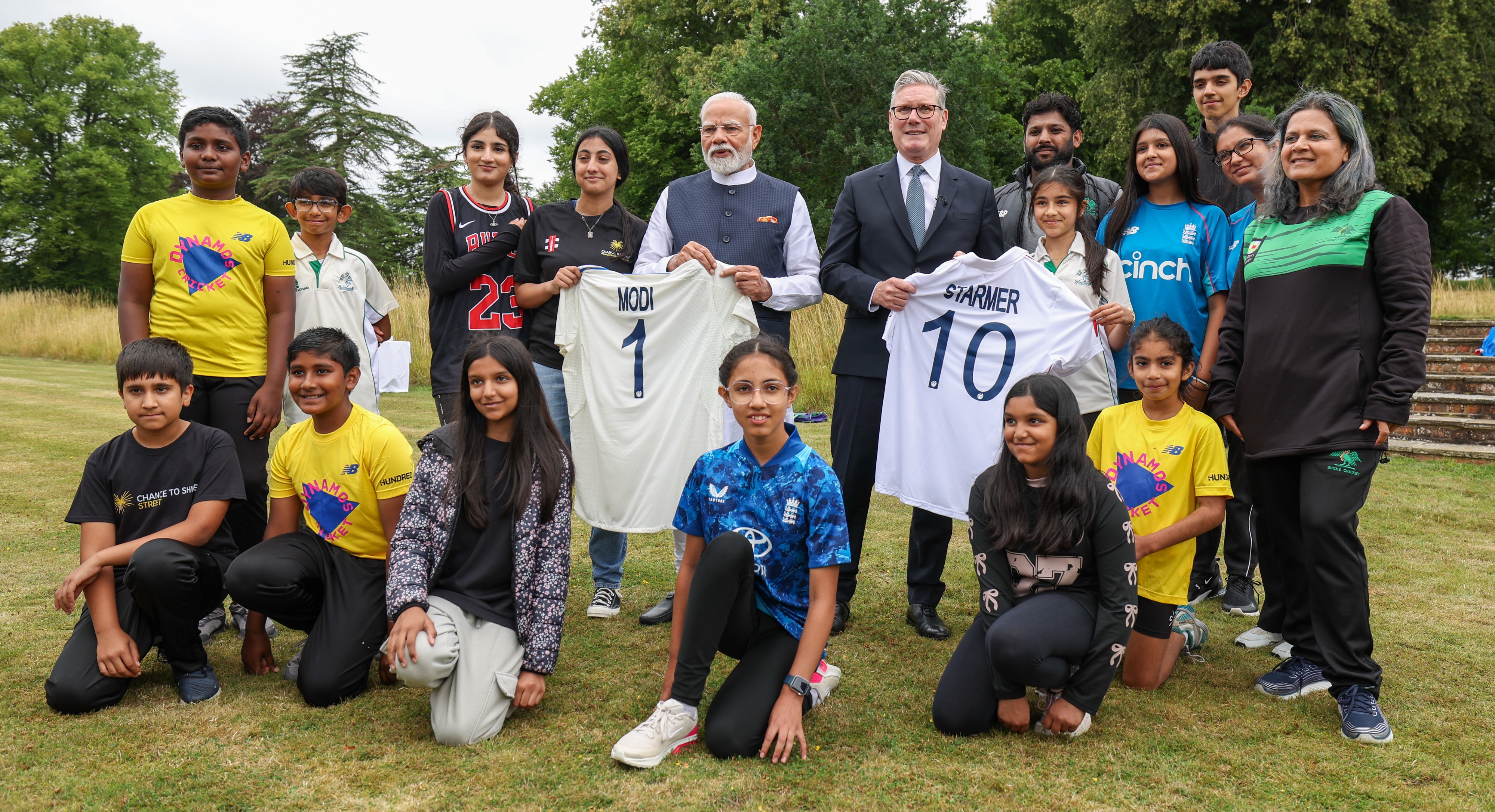
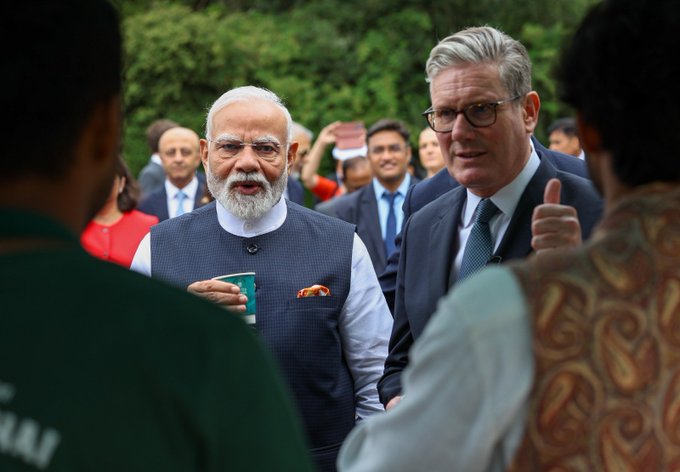
Both Prime Ministers interacted with players from Buckinghamshire Street Cricket Hubs. and Indian PM Modi also gave young girls a bat signed by the Indian cricket team which won the T20 World Cup. At Chequers, PM Modi and his counterpart Keir Starmer saw an exhibition which gave a glimpse of economic linkages between India and the UK. They shared a cup of tea together and while taking X, PM Modi tweeted, “‘Chai Pe Charcha’ with PM Keir Starmer at Chequers...brewing stronger India-UK ties!”
He also interacted with the business leaders, with the signing of the India-UK CETA it has opened up new avenues for trade and investment.
“Agreements to unlock jobs and investment in India and UK”
Addressing those present in Chequers, Indian Prime Minister Narendra Modi thanked Prime Minister Keir Starmer for the warm welcome and hospitality. “Today marks a historic day in India-UK relations,” he said, announcing the conclusion of the long-awaited Comprehensive Economic and Trade Agreement.
“This agreement is not just about enhancing economic ties—it’s a blueprint for shared prosperity,” PM Modi stated. He highlighted that the deal would boost access for Indian products such as textiles, footwear, gems, seafood, and agricultural goods in the UK, benefiting India’s youth, farmers, fishermen, and MSMEs. In return, Indian consumers and industries would gain affordable access to high-quality UK goods, including medical devices and aerospace parts.
PM Modi also welcomed consensus on the Double Contribution Convention, which will energise the service sectors, particularly technology and finance, by easing business operations and boosting investor confidence. “These agreements will unlock new investment and job opportunities in both countries,” he said.
The two leaders also launched Vision 2035, a roadmap for a stronger strategic partnership in areas like technology, defence, education, climate, and people-to-people ties. “From AI to cyber security, semiconductors to critical minerals, we are committed to shaping the future together,” PM Modi declared.
On defence cooperation, he noted that a new industrial roadmap had been drawn, and the two nations would deepen coordination on technology security. In education, he shared that six UK universities are opening campuses in India, with the University of Southampton having just launched one in Gurugram.
PM Modi thanked the UK government for its strong condemnation of the recent terrorist attack in Pahalgam and stressed that “there can be no double standards in the fight against terrorism.” He reiterated the need for accountability against those who misuse democratic freedoms and reaffirmed cooperation on security and extradition matters.
The leaders also exchanged views on global issues, including the Indo-Pacific, Ukraine, and West Asia, calling for peace, respect for sovereignty, and territorial integrity. “This is an era of development, not expansionism,” PM Modi emphasised.
He extended condolences to the families of British victims in the recent Ahmedabad plane crash and praised the Indian diaspora in the UK as a “living bridge” between the two nations. “They bring not just curry, but also creativity, commitment, and character,” he said.
Concluding with a cricket metaphor, he added: “Like in cricket, we may have swings and misses, but we always play with a straight bat. The agreements signed today and Vision 2035 are milestones in our high-scoring partnership.”
PM Modi ended by inviting PM Starmer to visit India soon: “I look forward to welcoming you in India very, very soon.”
Parliamentary Under-Secretary of State for Migration and Citizenship Seema Malhotra and Indian National Security Advisor, Ajit Doval were also in attendance.
India, UK tackle illegal migration, extremism together
During the detailed press briefing, Indian Foreign Secretary Vikram Misri outlined the key outcomes of Prime Minister Narendra Modi’s official visit to the UK. He highlighted the warm welcome PM Modi received from both Prime Minister Keir Starmer and the Indian diaspora. The two leaders spent over three hours together at Chequers, engaging in restricted and delegation-level talks, which also included a working lunch. A major highlight of the visit was the signing of the Comprehensive Economic and Trade Agreement (CETA) between India and the UK. Signed by Commerce Minister Piyush Goyal and UK Trade Secretary Jonathan Reynolds, and overseen by both PMs, the agreement is expected to boost trade, lower tariffs across key sectors, and promote investment; especially in labour-intensive industries.
Misri confirmed that PM Modi will meet King Charles III, and symbolically gift a tree plantation, reinforcing India's commitment to environmental sustainability. The Foreign Secretary acknowledged UK cooperation on addressing extremist threats targeting Indian diplomatic missions, reaffirming both countries’ shared commitment to security and stability. He also referenced India’s expectations for swift legal processes in the extradition of economic offenders like Lalit Modi, Nirav Modi, and Vijay Mallya, and welcomed the newly signed MoU between the CBI and the UK’s National Crime Agency to combat corruption, fraud, and organised crime.
Touching upon illegal migration, Misri reiterated India's clear stance against it and said cooperation would continue, especially for the repatriation of undocumented immigrants. In a notable cultural and symbolic gesture, he also mentioned that a sapling from Pahalgam, Jammu & Kashmir, a region known for its natural beauty and significance, would be planted as part of the tree plantation gifted to King Charles III, connecting India’s heritage with global environmental values.
Throughout the briefing, Misri emphasised that the visit not only marked a major step forward in India-UK bilateral ties, but also showcased a holistic approach, encompassing economic diplomacy, cultural engagement, environmental cooperation, and a strong people-to-people connect.