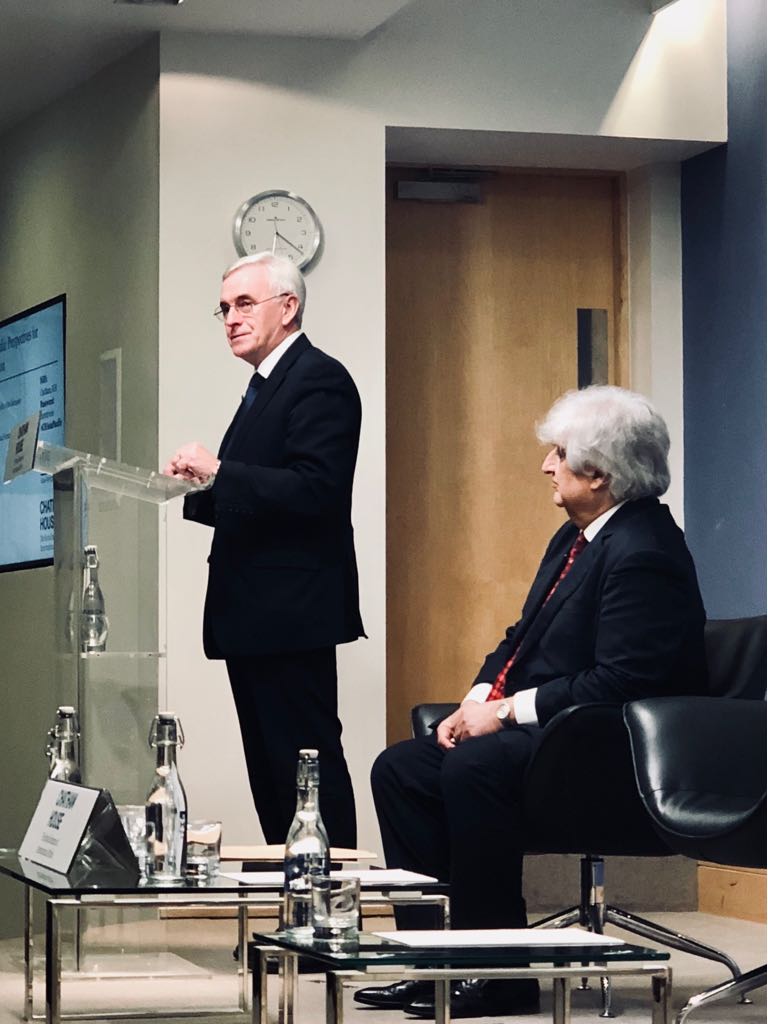
Labour's Shadow Chancellor of the Exchequer while speaking at the Indian Professionals Forum event in Chatham House on Thursday, expressed his strong commitment towards forging strong economic relations with a fast-growing India. The event focused on the future scenario of UK-India partnership in the context of Brexit and accelerating the pace of technological innovations and investment in the country.
In his keynote, covering Brexit and business, John McDonnell MP said, “Labour is a longstanding friend of India, dating back to the foundation of our party at the start of last century…right through to the close ties that continue today. Since the EU-India trade deal talks broke up in the last few years, there has been a significant opportunity for both Britain and India in agreeing a new Free Trade Agreement- one that matches the specific strengths and needs on both sides.”
He stressed that to strengthen economic relationship between the two countries, Britain need to understand what is needed on the Indian side as well. “It means not continuing to discriminate against students from India studying here. More generally, we don't agree at all with the government’s policy of setting targets for migrant numbers – it makes no sense to fix a target and then worry about the economic impact.”
“And it means dropping the foolish and frankly patronising talk we have heard from senior Conservatives about our post-Brexit ‘Empire 2.0’. If Brexit is to work for Britain, that sort of Empire nostalgia is a barrier to creating the new economic partnerships we will need. Instead, we need to recognise on the British side that the world economy is changing and fast. The old division of the world, there since the Second World War, between a developed North and an underdeveloped South, just doesn't fit anymore. “
He sees opportunities for symbiotic relationship between British and Indian companies in the technology sector. He also said that the hands-off, laissez-faire attitude of previous governments has failed. “Britain since 2010 has turned itself into an increasingly low investment, low productivity, low wage country… Countries that fail to invest ideas and new technology, or in training their people, lose out. ” Labour’s vision for Britain is that he stated, “we have to turn this country around into a high investment, high productivity, high wage economy.”
The keynote address was followed by a panel discussion featuring Chatham House’s Asia Programme Head Dr Champa Patel, Maggie Rodriguez-Piza, Chief Executive of Funding London, Jaime Reed, Head UK Civil Space Exports at Airbus Defence and Space, and, TS Narayanan of Colt Technology. The panellists raised concern about a flight of talent from Britain because of Brexit.
Jaime Reed, Head UK Civil Space Exports at Airbus Defence and Space said, “We are working hard today to become global. We want to build local supply chains. India has fantastic talent. We need to involve Indian engineers in start-ups, telecom and data. We want to do this with India. We also want to explore how to get together with India to grow in space sector.” On Brexit, he said, “We are worried about Brexit. It will affect our R&D. We cannot invest in UK without public support. Countries like India might benefit. On the other hand, benefit from Brexit is that it is forcing us to look globally and India stands out to be a good idea for future.”
Maggie Rodriguez-Piza, Chief Executive of Funding London, said, “We invest in C stage tech companies. It is very representative of what’s happening in London. UK market is too small, even European market is too small. We want to look to India. We work with mayor of London to help them access those markets. Ability for companies to navigate these markets is difficult. We want to see more export supporting networks.” On Brexit, she said, “Biggest concern we have is access to talent- we need high skilled labour coming in. Since referendum we have seen a sharp decline in talent coming from Europe. Sitting here in London, the impact of Brexit is felt very heavily.”
TS Narayanan of Colt Technology, said, India and Brexit Britain can have a strong symbiotic relationship. He sais there was no dearth of ideas in India, but the challenge is that for India’s future potential to be realised India will have to educate 120 million people. “Traditional education methods won’t work. Robotics, tech can help. India has scale. So, symbiotic investment with India will help Britain. India does not have maturity of technology. UK can help here.”
In his concluding remarks, Dinesh K. Patnaik, Deputy High Commissioner, India, said, “It’s true that India-UK trade has stalled. We need to look outside London for growth – we need to look at the Northern powerhouse. SMEs from UK also need help to go to India. We need to focus on that. Future lies in symbiotic relationship- there is scale in India. In return, India needs advance technology, Britain can play a crucial role here.
Dr Mohan Kaul, Chairman IPF, said, “Brexit offers great opportunity for Britain and India to forge closer ties. An appropriate Technological and Financial Eco System will encourage Innovation, energy and enterprise from young engineers and start-ups to provide a tremendous boost to the UK tech industry in the years ahead and the scope for collaboration between professionals of both countries are great.
“About 15% of start-ups in Silicon Valley in USA are set up by Indian entrepreneurs. There is a tremendous opportunity of growth in the UK given the appropriate technological and financial eco system. Indian businesses and professionals can be integral part of its future,“ he added.