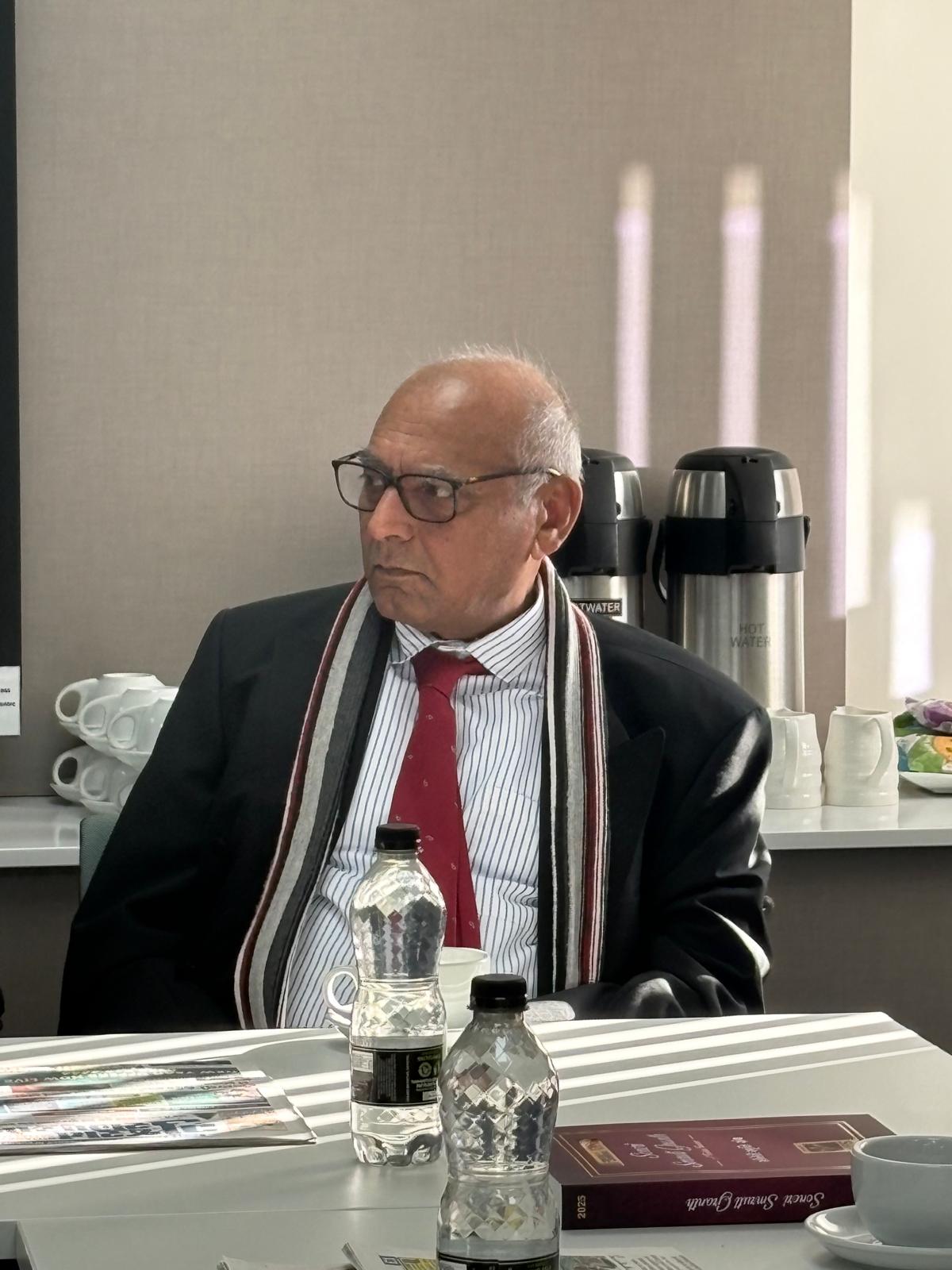
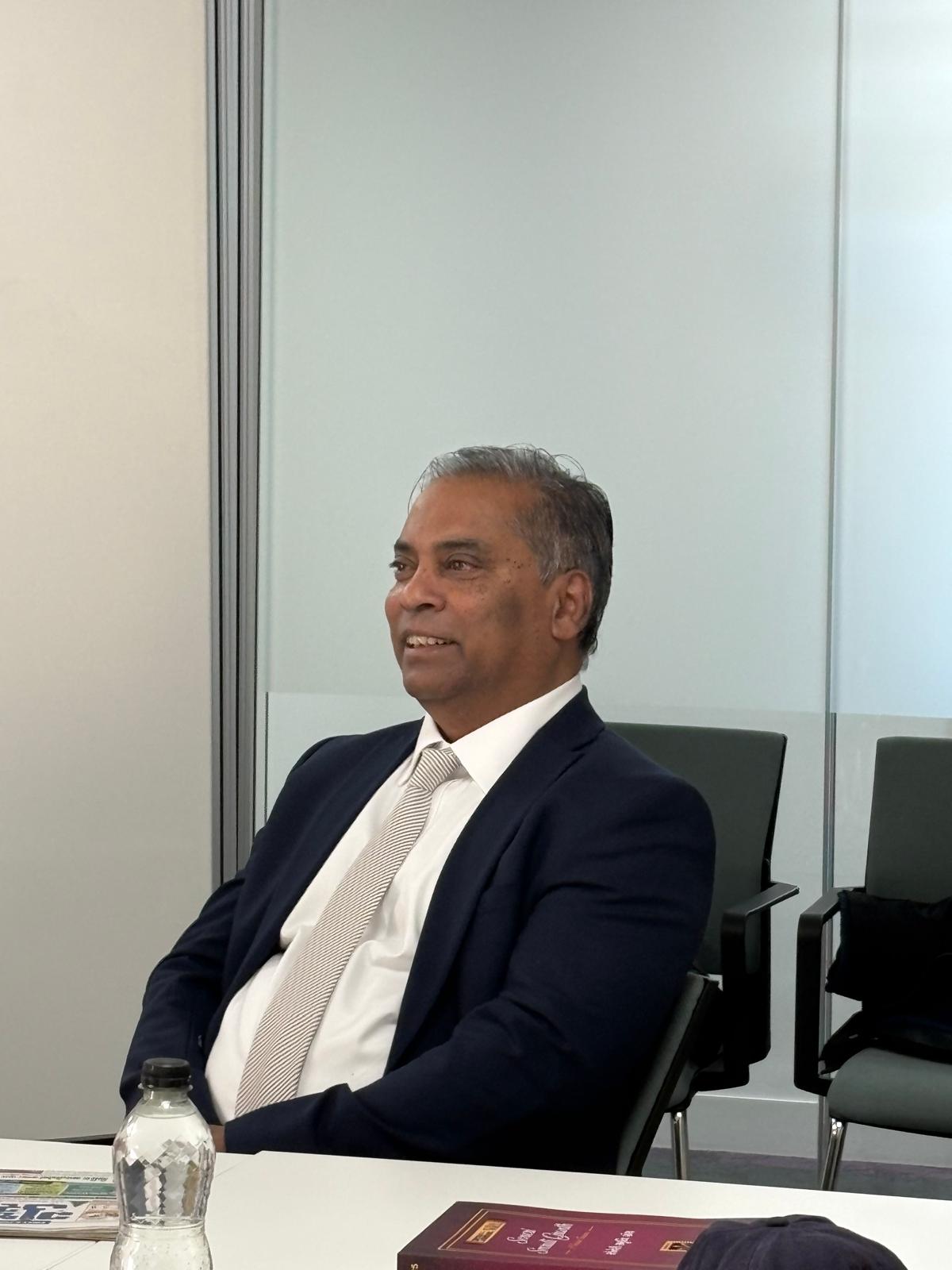
Asian Voice and Gujarat Samachar hosted a special reception in their office to honour Dhruv Chhatralia BEM, Partner (Corporate), Head of Venture Capital (UK), and Head of the India Group in London.
He is the founder of Shyam Bhagavad Gita classes and has authored 21 books on Hinduism, delivered over 400 public talks, totalling more than 450 hours, on several topics on spirituality. His talks have reached audiences in more than 161 countries and garnered over 400,000 YouTube views.
In 2020, Dhruv was honoured with the British Empire Medal (BEM) in Her Majesty the Queen’s New Year Honours List for his voluntary contributions to Hinduism and youth development.
Held on 19 December 2025, the reception also included the announcement of Asian Voice and Gujarat Samachar’s essay competition winners, who were recognised with cash prizes.
The event was facilitated by Pooja Raval, Operations Head UK at ABPL. Subhash Thakrar OBE and Kanti Nagda MBE, together with CB Patel, Publisher and Editor of Asian Voice and Gujarat Samachar, presented a token of appreciation to honour Dhruv.
Chhatralia discusses Hindu traditions
At the Asian Voice office, after presenting awards to the essay competition winners, Dhruv expressed his pleasure at attending and congratulated the winners. He mentioned Shyam’s growth from hosting talks on the Bhagavad Gita and other texts, and their future goal of registering as a charity to better support grassroots organisations and individuals interested in hosting talks.
He elaborated on aspects of Hindu traditions and said, “The root meaning of caste was Varna, which means different shades. Brahmins are knowledge seekers; Kshatriyas protect others; Vaishyas manage wealth; Shudras serve others’ needs. It was based on innate qualities, not birth. Vishvamitra, for example, was born a Kshatriya but became a Brahmin sage. The word ‘caste’ came later, from the Portuguese and British era.”
Chhatralia explained that Murti (idol) puja helps us focus our minds. While idols themselves are lifeless objects, Murtis are considered to be living representations. He outlined the three components of Yagna: Dev Puja, which involves worship aimed at self-improvement; Sangati Karnam, which means gathering for a noble cause; and Danam, which is about sharing and giving to others.
He also discussed the scientific wisdom in scriptures and said, “The Avatars show evolution, from Matsya (fish) to Kalki. Numbers like 18 and 108 are precise, 18 Puranas, 18 days of Kurukshetra war, 108 beads in a mala. Tulsi purifies air; cows provide nourishment and energy. Our culture is rich and scientific. When youngsters ask questions, explaining the reasoning behind rituals makes them more passionate than their parents.”
Chhatralia concluded by saying: “Every scripture is unbiased; we worship all Hindu deities and value knowledge imparted by all good gurus. This is a quick introduction to Hinduism and its depth.”
Subhash Thakrar OBE said he had followed Dhruv’s Gita sessions from the early days and praised his work for addressing “a very important gap” within British Hindu society. “Many Hindus are unfamiliar with our own culture, scriptures and way of life,” he said, adding that simply reading the Bhagavad Gita could offer “a lifetime of learning.” Thanking Dhruv for making these teachings accessible in English, Thakrar emphasised that Britain is now home for many in the community. “We are first-class British citizens, and we belong here,” he said, urging British Hindus to move beyond quiet contribution and actively shape wider society. “The time has come to bring Hindu values into British thinking and policy, so the whole society can benefit.”
Kanti Nagda MBE said, “I have been following Dhruv’s work through the newspapers and the updates shared by Bob Blackman, and it’s wonderful that you organise Gita recitals in Parliament.” However, he pointed out that access to Parliament can be difficult for many people, adding, “Why not take these talks to different local areas so more people can benefit? Initially the audience may be small, but the message will gradually reach more people.” He also suggested registering the group as a charity, saying this would make it eligible for government gift aid and help “enhance the outreach and spread of Hinduism.”
During the vote of thanks, CB remarked, “I sincerely appreciate your (Dhruv’s) presence, and what you have accomplished is truly remarkable. We are entering a new phase of our Gyan Yagna and Sevaa Yagna, continuing the tradition from the youngest to the oldest among us.
“Dhruv, your creativity stands out. The way you blend your career, knowledge, and service is outstanding. Sanatan dharma crosses boundaries, and your efforts inspire every generation. This book, Smriti Granth, serves as an encyclopaedia chronicling our migration and heritage. Feel free to take copies—there's no cost, thanks to Subhashbhai, Kantibhai, and several others.”
He then went on to say, “I am involved with the Community Security Trust (CST) and Karma Yoga Foundation. ‘Vyakti karta Sanstha mahan che’ translates to ‘the organisation is greater than the individual.’ Our aim is to support projects such as yours and help foster the spread of knowledge. I've organised talks from Satyananda Swami to Morari Bapu throughout Europe, since our role is to share important messages.”
Speaking about the essay competition and winners, CB added, “Over 40 essays were submitted and judged purely on merit. The prize money is secondary; it’s your commitment that matters. Keep contributing, and if you can, gift subscriptions to friends and family. This is not the end, our work continues, and I have confidence in the next thousand years, if not longer.”
The event concluded on a cheerful note with attendees enjoying a selection of snacks and refreshments, providing a warm setting for guests to mingle and celebrate the winners.
—-----------------—------------------------
Essay winners reflect on culture and community
Ruta Radia won the first prize in the essay writing competitions of £501, Dipika Butala came second earning £251, and Dr Amrut Shah secured third place with £101. In the Asian Voice essay competition, Tarla Modha claimed first place with £501, Mira Vyas MBE took second place with £251, and Bhupendra Gandhi was awarded third place with £101.
Ruta Radia, an essay competition winner, said, “I have lived in the UK for the last 18-19 years. I was born and brought up in Rajkot, India, and I have been working as a software developer here for the past 15 years.” Expressing her gratitude, she added, “I would like to thank Gujarat Samachar for providing Gujarati newspapers to our community. I still prefer reading a physical newspaper rather than an e-paper, which is why I requested a subscription.” Speaking about her inspiration, Ruta said the competition made her feel nostalgic. “It reminded me of my school days in India and of my father, who used to guide me while writing. Though he is no more, he felt like an editor in my mind, it was the icing on the cake.”
Dipika Butala said she works as a business analyst at the Ministry of Defence and lives in the UK with her husband and two children, while her in-laws are based in Baroda, India, and her parents live in Wembley. Explaining her motivation for writing the essay, she said, “When I read the topics, especially the one on our sanskriti and culture, it really touched me. I felt it came from our family values, so I had to write something.” She added that she wrote the essay within a few hours on the final day, saying, “I didn’t care whether I won or not, it mattered because the topic moved me.” On winning second prize, Dipika said, “The first person I told was my husband. He was shocked and very proud, and then I shared the news with my children, it was a really special moment.”
Meera Vyas MBE, another winner, shared, “I’ve been in this country for 50 years and a reader of Gujarat Samachar for 45 years. My late mother and grandmother loved the newspaper. I wrote the essay remembering my mum. I’m very grateful for this country and the opportunities it gave me. We need to advocate our culture to others and show the value of Sanatan tradition.”
Tarla Moda said, “I’m retired and do volunteer work for blind people in Harrow and for end-of-life care at Northwick Park Hospital. We support patients and families emotionally, which is very rewarding.”