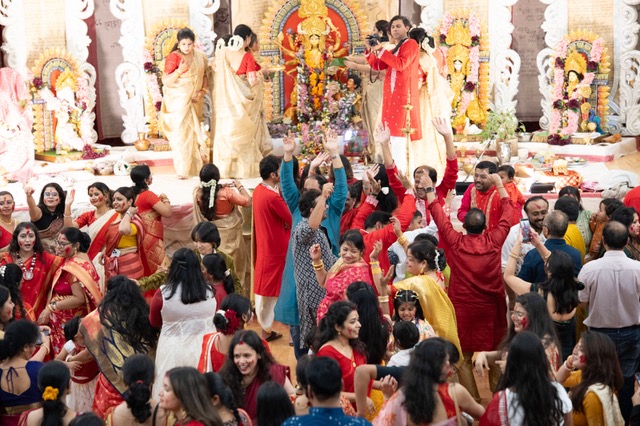
As autumn arrives in Britain, the beat of the dhaak will once again fill community halls across the country. For thousands of UK Bengalis, Durga Puja is more than a festival: it is a homecoming shaped by memory, identity and devotion, briefly replacing distance with belonging.
Associations nationwide are preparing to welcome families, friends and neighbours for Maa Durga’s arrival. Celebrating the goddess and the triumph of good over evil, the festival has become one of Britain’s most vivid expressions of Bengali culture, bringing together prayer,feasting, music, theatre, dance and community service.
London
In the UK there are about 90 Durga pujas already, with a new pujo inaugurated every year.
Arindam, who is a researcher at Imperial College London and wife Devanjali have founded the group Big Bong Connection London. Their inaugural Durga pujo called Aabahon will be held in a leafy part of West London at the Chiswick Town Hall from 16 to 20 October. But on the 16, very uniquely, they have organised a 45 min panel discussion from 7pm onwards. The topic will be ‘Rooted & Rising: Stories of enterprise, identity and community in London’.
The central question of this panel would be: How do culture, community and identity shape the things we build in London? Speaking to Asian Voice, Arindam said, “As the occasion is Matri Aradhana, we will have a panel of female entrepreneurs, founders and community leaders. Questions will revolve around, their work and reality of setting up businesses, cultural identity influencing the work, how diaspora communities create trust, visibility and opportunity, what events such as Durga Pujo mean for local businesses and how can entrepreneurs and organisations give back to the community.”
Hounslow’s ‘Prabashi’ Durga Pujo is celebrating a milestone of 15 years at the local Honey Moon Banqueting Hall from 16-19 October. Speaking to Asian Voice, an organising member told us, “We are having a new idol. Our idol is the largest outside India and this latest idol will have delicate artwork using some unique materials this year. They will also have 80 feet of Chandannagar lighting.”
Indian Bengalis in UK, a digital home for the diaspora, for networking and other social and cultural activities is also organising a ticketed ‘puja parikrama’ bus (bus tour) in London on 17 and 18 October to visit the top pujas organised in and around London.
Greater London and suburbs
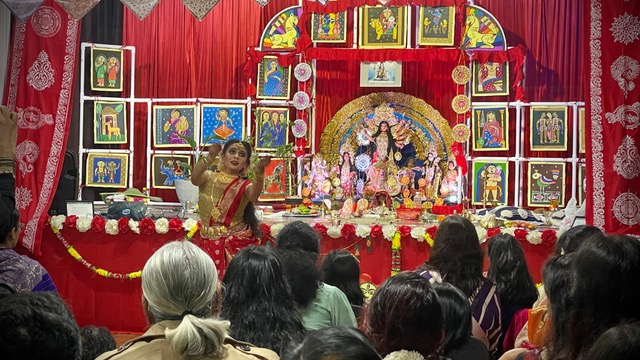
The Aantarik - Bengali Association of Bromley marks its 11th year of existence and its 8th Durga Puja celebration from 17-19 October at Chelsfield Village Hall. Founded in 2015 as a key cultural anchor for the British Bengali diaspora in south-east London, the community organisation’s core identity is defined by ‘Aantorikota’ - a spirit of heartfelt sincerity, warmth, and open-hearted hospitality. Set against the green sylvan backdrop of an expansive cricket field in Orpington, the celebration stands out for showcasing authentic Bengali visual art within its pandal aesthetics, including motifs inspired by legendary artist Jamini Roy.
Entirely community-driven through voluntary contributions (sewa), sponsorship, and dedicated volunteers, the grand festival offers traditional rituals from Shashti to Dashami and Sindoor Khela, along with free packed Prasad Bhog for all attendees.
The evening cultural showcase promises an extraordinary blend of local community talent and world-class performances, highlighting the richness of Indian heritage on an international stage. This year’s grand lineup features acclaimed artists from India, including Ratul Parbat of Zee TV Sa Re Ga Ma Pa fame, and Debolina Ghosh, an accomplished Kirtan singer, music researcher, and filmmaker.
England
In Warwickshire Sarbojonin Pujo is gearing up for their Sharodutsav from 16-19 October. The 4-day celebration will take place at Weston-under-Wetherley Village Hall, Leamington Spa.
This year, the organisers are building on last years’ experience with a stronger focus on family-friendly engagement throughout the day. Visitors can expect children's arts and crafts, creative activities, cultural performances, music, dance, recitation and other community-led programmes, alongside the traditional Durga Puja rituals, evening Arati and Prasad.
In 2018, a few Bengali families came together to start Durga Puja in Nottingham. That humble initiative completes nine years this year. Today, Nottingham Bengali Association at their puja in Hindu Temple at Carlton Road welcomes more than 3,500 devotees and visitors across communities.
An organiser told Asian Voice, “Our theme this year will showcase the handicrafts of West Bengal. As in previous years, we will handcraft the stage decorations ourselves—using handmade traditional fans (pakhā) and mats (mādur), adorned with hand-painted Bengali alpona (traditional floor art) and various folk-art designs. Through this Puja in Nottingham, we look forward to once again sharing Bengal's art, memories, and festive spirit with everyone.”
This year their Puja will be held on 17 to 20 October. Along with the Puja rituals, the organisers are also preparing to host cultural programmes and festive celebrations involving the entire community.
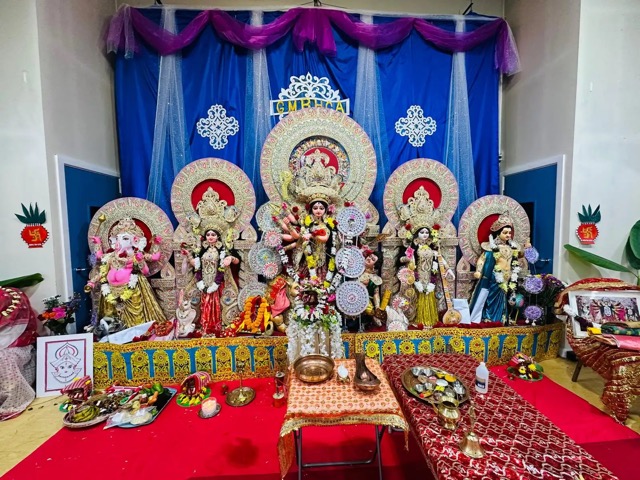
The Greater Manchester Bengali Hindu Cultural Association (GMBHCA) will celebrate its annual Durga Puja from 16-20 October at Gandhi Hall, Withington, Manchester.
Marking 34 years, the celebration honours Bengali tradition while reflecting the organisation’s continuing evolution and growing role across Greater Manchester.
This year, GMBHCA is partnering with Radha Krishna Mandir HRS, strengthening links among Manchester’s Indian and Hindu communities through shared cultural values.
Although rooted in Bengali customs, the Puja welcomes people from varied backgrounds, connecting generations and encouraging wider participation in community life.
GMBHCA is also introducing digital tools, including automated membership identification, improved RSVP and attendance tracking, and digital donation receipts, to increase efficiency and transparency.
Its new storytelling platform, “Khoj – Exploring Culture, Connecting Communities”, shares short digital features on Bengali food, festivals, history, traditions and contemporary life.
Designed for younger audiences and established community members alike, Khoj extends Bengali heritage beyond the Puja venue to a broader public.
Scotland
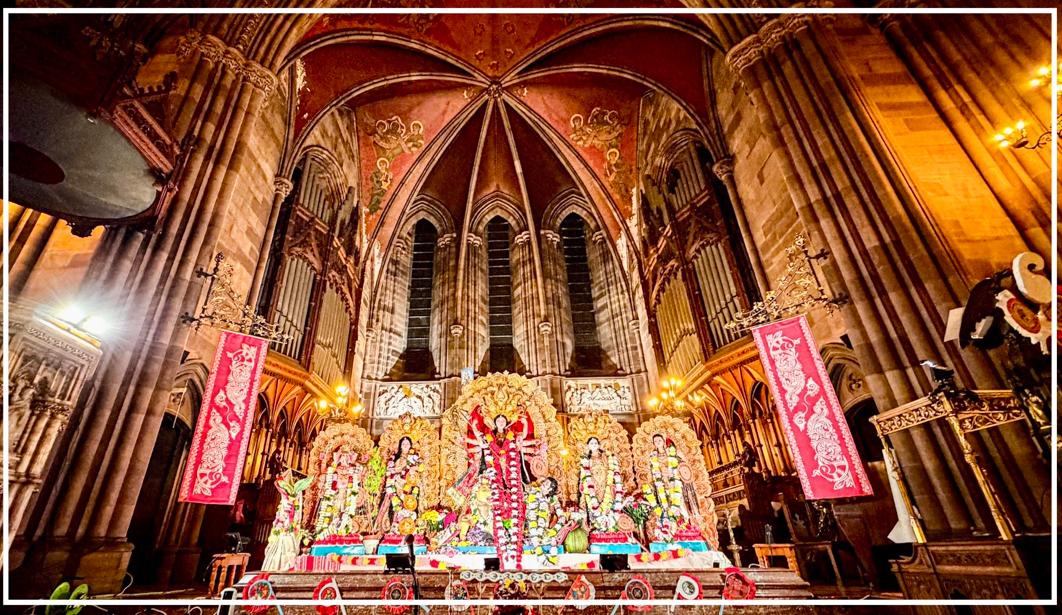
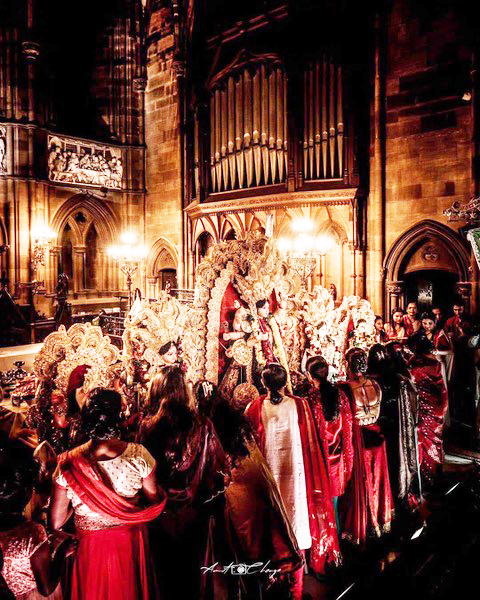
In its 46th year, Glasgow Durga puja is being held in Coats Paisley, High Street, Paisley. The puja will be held from 17-21 October in their usual but unique Thomas Coats Memorial Baptist Church - a prominent Gothic feature of the Paisley skyline for over last 100 years. The interior of the church is as majestic as the exterior. Organised by the Bangiya Sanskritik Parishad (BSP) Glasgow, their five-day puja marks the celebration of traditional Bengali culture and community spirit in Scotland. Besides anjali, bhog and the usual practices, there are cultural programmes too.
For those who crossed oceans to build a life in Britain, Pujo still carries the colours of Kolkata: crowded lanes, new clothes, glowing pandals and the comforting fragrance of khichuri bhog. For their children and grandchildren, every Bengali word, song and ritual becomes a thread leading back to a home they may know mostly through stories. By organising performances, welcoming guests and supporting charities, they are not merely preserving an inheritance; they are lovingly giving it a future.
Britain, too, has become part of that story. Neighbours enter the pandals, share bhog and listen as Durga’s victory is retold. Strangers become friends beneath the same lights, and tradition opens its arms without losing its roots. Through charity, sustainability and welcome, each gathering proves that belonging can grow when it is shared.
Then comes the final evening. The prayers soften, the dhaak falls silent, and Maa Durga begins her journey away. Eyes fill with tears, yet no one leaves empty-handed. Elders carry memories, the young carry responsibility, and everyone carries the promise of return. Across Britain, the farewell feels less like an ending than a whispered vow: wherever life takes them, this love will endure. For a few precious days, distance has vanished, generations have stood together, and home has found them again.