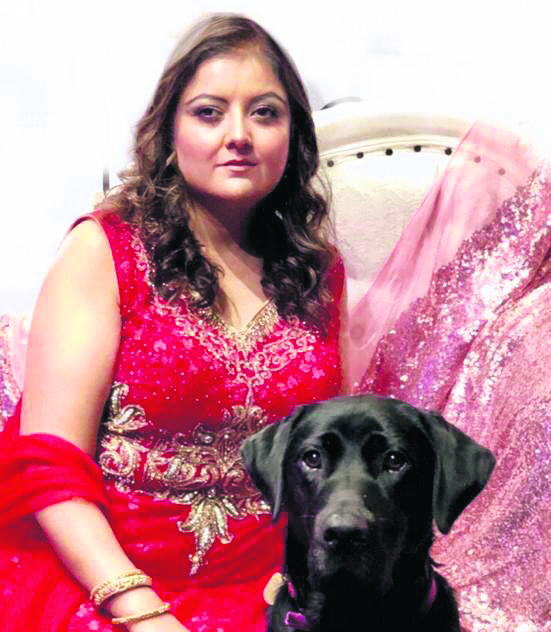
Bhavini Makwana uses a guide dog & advanced technology to live with a serious vision impairment with the support of her family. She’s now a volunteer for a UK based charity that helps more such people.
Imagine you are looking through a tunnel. When you’re walking down a lane, you may not see anything that’s above you until it has hit you in the face. Or, if you’re walking at home and there’s something that’s left open, like a cupboard door or a drawer, or if there are toys or something left on the floor, you won’t see that because your peripheral vision has gone. Teachers and parents sometimes think that the child is naughty or they can’t read or they might not want to do things. It’s not because they want to, it’s because they can’t. This eye condition is called RP or Retinitis pigmentosa.
RP is an eye disease in which the back wall of the eye (retina) is damaged. Symptoms include decreased vision at night or in low light and loss of side vision. There's no effective treatment for this condition. Asian Voice spoke to Bhavini Makwana who has overcome obstacles and learned to live with this serious eye condition.
Bhavini was coming out of a wedding reception when she couldn’t see at all and everything went pitch dark. She underwent tests for about eight months. She was 17. She said, “I thought I was normal. I thought everybody doesn’t see in the dark. I thought everyone wears sunglasses all the time because the Sun is too bright. It didn’t occur to me that I was different. I thought everyone was the same until I started bumping into things, missing steps.”
Unfortunately, the news of her condition wasn’t delivered to her in a sensitive manner. “We were told you would go blind and this cannot be treated, so we went into shock and I didn’t know what life was going to be like. I only became aware of how a blind person does things differently from 2012- 2013, so about 15 years later when I became aware of a charity,” Makwana said.
“I was married when I was 22,” she said. From her side of the family her mother was a great support. “It was challenging. I moved to London from Leicester and tried to learn a new city. But then I was a daughter-in-law. I came from a family that had a typical view of a daughter-in-law. I couldn’t make round chapatis. For instance, sometimes I spilled things and I’d freak out because, you know that Asian mentality. Because I grew up with a family like that, so I felt I had the duty to look after my in-laws, but I was struggling,” she added.
Explaining how she goes around her daily routine activities, Bhavini said, “The way I use Facebook, Twitter or social media - I have a phone which talks to me, I dictate my messages and whenever I touch my screen, my phone reads the messages you will type to me and I can dictate back. I use a Macbook. It also has an inbuilt software that talks to me. If I’ve received an email or some document, it speaks it out to me.” Over the years, she says that her daughters have really been supportive. “They’ve grown up with me losing my sight over the years,” she said.
At home, her family knows they can’t just leave things lying around because if she doesn’t know, Bhavini can trip and hurt herself. “In my bathroom, I know where my shampoo and conditioner or my shower gel is. And if there are similar bottles, I place them differently so that I know what’s what,” she explained.
“When the doorbell rings, they know that I’m not going to answer it. They ring in advance that they are coming or they ring me when they are outside because I don’t just open the door if I’m not expecting someone. So they’ve (her children) learnt, they’ve accepted that my eyes aren’t going to get better. When they were younger and they used to go to school, they made pictures and drawings they knew I couldn’t see so they used to put my hand on top of the drawing and then describe it to me so that I know what they’ve done.”
Bhavini has had her own guide dog named Colin since August 28, 2018. “When I used to go to a parents’ evening or school, there were teachers and children. Either they’d get scared of him or they’d want to play with him. But when he’s working, he shouldn’t be interrupted, so she (her daughter) did a whole presentation on all about my eye condition and the guide dog. I thought it was so lovely,” she said.
Her guide dog is trained to stop at the crossing. “He will only cross the road when the road is safe and there’s no car or anything. If there’s steps, again he would stop and then I stop. If there’s roadwork, he'll take me to the edge of the curve to tell me that there’s road work going on and that we have to walk a little bit onto the road and then back to the pavement again. I go to work in Central london and I can actually do that by myself now,” she said.
Makwana has just started a podcast to spread more awareness around her condition. “The podcast is mainly to spread awareness about the sight losses from the BAME community and to educate people. Because we’re in 2020, I still find that the Asian mentality hasn’t lost that. Disability doesn’t mean it is the end of your life,” she said.
Many old aunties and uncles meet her at a supermarket or outside and they come and speak to her husband while she’s sitting or standing right there but they won’t speak to her and ask if she’s alright. “I can speak for myself. If I say I’m fine thank you, they still keep talking to my husband. Then there are those who say to you, `Oh don’t worry it must be Karma’ or they say to me ‘I’ll pray for you’,” she stated.
“I always say that don’t assume that they (specially abled people) can’t do something. Ask them if they need your help first. People who don’t seek help may take longer or may do it differently, but they want to do it themselves and people should respect that,” Bhavini affirmed.
When Bhavini didn’t use a cane or a guide dog, she’d hold onto her husband’s arm for support and people gossiped about her being a controlling wife, not realising her condition. “I’m now in a phase where I don’t care anymore. This is my life, I’ve accepted it,” she said.