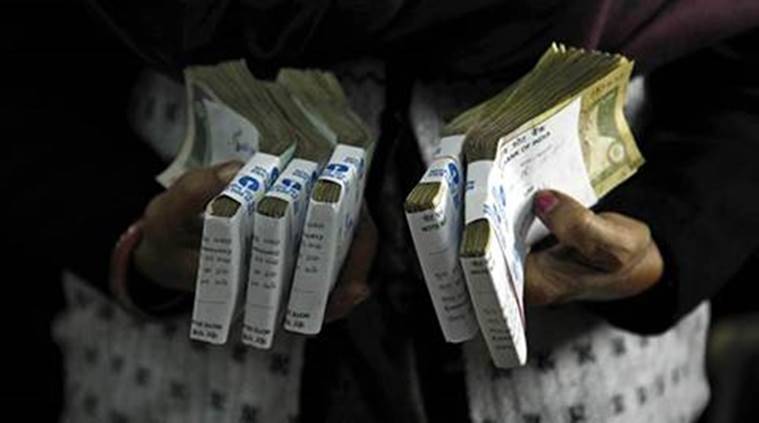
Demonetisation move is making waves as Indian Prime Minister Narendra Modi is making a strong pitch for it at every forum. But it has had a ripple effect on Indians living in the UK. He has also sent around emails, collecting feedbacks, including one received by the Asian Voice Editor himself, to take part in a survey to offer our honest and unbiased opinion regarding his demonetisation efforts.
Silently perhaps every one, across every continent, would agree that demonetisation of Rs 500 and Rs 1,000 currency notes in India is a positive move by the government, but undeniably it has created quite a stir within the Indian diaspora in the UK. There have been some anxious moments, with many finding themselves holding worthless Indian currency notes. Most of them are upset for lack of clarity on the issue, especially how they can exchange these invalid notes and where. Many NRIs, sailing in the same boat, have tried to exchange the notes but in vain. There are no takers as of date because of no clear mandate from Indian government to their embassies and High Commissions.
Priya Pattni from Wimbledon says: “I don't have any clue what to do with the few Rs 500 notes that I have. No Indian bank in the UK is ready to take these notes. Even currency exchange firms are of no help. There is no communication for NRIs either from the Indian government or banks so far. There is no clear mandate from currency exchanges' head office as well.”
However, one Francis from Colliers Wood, who works with a private company, didn't appear worried over the issue. He says his cash dealings or transactions hitherto have been legal, so he is not worried about it. Besides, there is enough time left to exchange notes. He hopes some positive development may come up in favour of NRIs in the interim period, he adds.
Abhishek Madhavan from Tooting says he doesn't bother much as he is going to India during the Christmas break and he will exchange the notes in India. His friend Prakash, also from Tooting, says he has a few currencies but it's not a big amount and so he is okay to dispense with them.
But Arghya Mukherjee's parents 80 year old Arun and 75 year old Ashima, who were travelling to Kolkata for a wedding, had a different fate. They had Rs 20,000 with them for immediate expenses and a bank card to withdraw cash, which they needed help to use, for their old age. They dont know how to make online payments, neither can they pay people using a bankcard chip and pin. They landed amidst this demonitisation chaos and had no clue what to do. Of course friends and family came to aid, but even taxis refused to take Rs 500 notes- leaving them stranded at the Kolkata airport, till a relative came and picked them up after 4 hours of wait.
The Rt Hon Keith Vaz, Member of Parliament for Leicester East and the longest serving Member of Parliament of Asian origin in the House of Commons, has made a statement on the demonetisation of the Indian Rupee, and its implications for the British Asian community.
Keith Vaz said: “The Indian government should be commended on this bold and courageous policy, and I completely understand why they have taken these steps. However the rupee recall has inadvertently caused concern and distress to many members of the Indian diaspora who live abroad who fear they will be unable to exchange their currency by the December-end deadline. I have therefore written to Prime Minister Narendra Modi with a three-point plan to address the concerns of the diaspora. The first priority is to extend the deadline to after the summer holidays in 2017. It would also be practical and beneficial for British Indians to be able to exchange this currency in UK banks, and until this issue is addressed I have asked that a Special Envoy to the diaspora is appointed to the High Commission in London. Concerns have also been raised that the money withdrawn by UK citizens on holiday in India for the cricket is now unusable, and addressing this issue now will prevent them from being frustrated and unsatisfied with their experience in India.”
Dinesh Patnaik, the Acting High Commissioner of India in the UK, told the PTI, “Our endeavour is to help everybody. We have asked New Delhi about it (any banned notes with NRIs). I have a feeling we will work out something so that people who have carried certain amount of cash in their pocket (maximum Rs 10,000/head), should be able to deposit it in any Indian bank abroad.
“Basically, it means people abroad should not have more than that. Also, not everybody will have an account with an Indian bank – either they will have to open one or find an alternative. So, it is something we will have to look at very closely. There is a lot of time, until December 30,” he said.
“This is not an amnesty scheme or any scheme to garner black money. This is a method to achieve cashless transactions, which in itself will stop corruption, and to make sure that the money which is lying within the non-legal system, gets into the legal system.
“And, of course, the threat of fake Indian currency will be eliminated, because that threat was mostly with Rs 500 and Rs 1,000 notes. The new Rs 2,000 and Rs 500 will have greater security features and it will make it more difficult for counterfeiters to try and copy it,” he added.
An advisory published by the Indian High Commission on 18th Nov said, “The Ministry of External Affairs has taken cognizance of the different requests on the issue of demonetization from India’s Missions in various countries about the clarifications sought by NRIs abroad, Money Changers Associations and foreign visitors and tourists (including for medical purposes) in India.
“MEA has referred these matters to the Department of Economic Affairs. The Department of Economic Affairs has in turn formed an inter-ministerial committee headed at the level of an Additional Secretary. A Joint Secretary from MEA is also a member of that committee. Decisions taken based on the recommendations of the Committee shall be shared as soon as these are made available.”
On their website the high commission clarified in a different advisory (in frequently asked questions format) for persons currently not in India, holding Indian currency in 500 and 1000 denominations:
“1. I am right now not in India, what should I do?
“If you have Specified banknotes in India, you may authorise in writing enabling another person in India to deposit the notes into your bank account. The person so authorised has to come to the bank branch with the Specified banknotes, the authority letter given by you and a valid identity proof (Valid Identitiy proof is any of the following: Aadhaar Card, Driving License, Voter ID Card, Passport, NREGA Card, PAN Card, Identity Card Issued by Government Department, Public Sector Unit to its Staff)
“2. I am an NRI and hold NRO account; can the exchange value be deposited in my account?
“Yes, you can deposit the Specified banknotes to your NRO account.
“3. I have no account but my relative / friend has an account, can I get my notes exchanged into that account?
“Yes, you can do that if the account holder relative/friend etc. gives you permission in writing. While exchanging, you should provide to the bank, evidence of permission given by the account holder and your valid identity proof.
“4. Should I go to bank personally or can I send the notes through my representative?
“Personal visit to the branch is preferable. In case it is not possible for you to visit the branch you may send your representative with an express mandate i.e. a written authorisation. The representative should produce authority letter and his/her valid identity proof while tendering the notes.”
Kamal Dev told Asian Voice, “These advisories don't help. I cannot operate my NRO account from the UK. I have been to all the Indian banks here and none know how to help us.”
When Asian Voice tried to contact Bank of Baroda the response there too was not in the affirmative. State of Bank of India in the UK in a notice on its website has clearly mentioned: “State Bank of India UK does not deal in Indian Rupee Notes from our UK branches and hence, we will not be in a position to handle the Rupee note exchange process (including withdrawal of old notes). Further details including the process and FAQ are available in RBI website...”