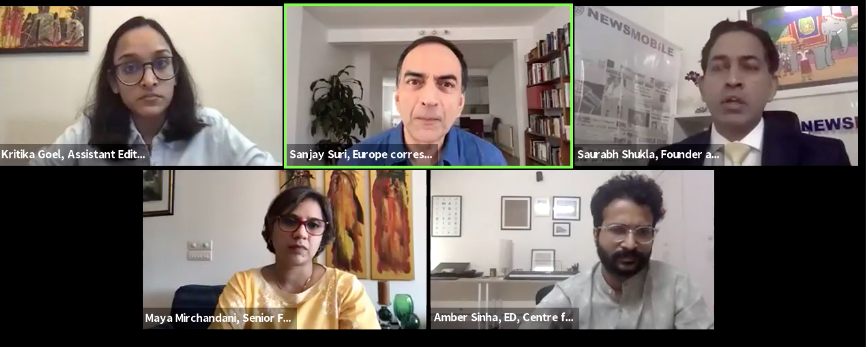
A joint session was organised by Bridge India and Logically (the world’s largest dedicated fact-checking team) to discuss “Combating fake news in a ‘sharing’ nation”. The session was moderated by Sanjay Suri, Europe correspondent, Network18 group.
Saurabh Shukla (Founder and Editor-in-Chief, News Mobile) said, “Essentially when we select the fact check, what we have in mind is the public interest. We have recently launched a bot with WhatsApp to report misinformation. People need to understand in this era of social media that there’s so much misinformation going around, sharing is so easy. Even a lot of times people who are very well read and celebrities hold powerful positions, end up sharing fake news. That’s the reason why the role of fact checkers becomes even more important.”
Kritika Goel, Assistant Editor at The Quint shared that she has fact checked over 2000 stories over four years. She shared that there’s an overwhelming skew against the Muslim community when it comes to targetted hate speech and misinformation. She said that during her investigations she found that the “trust level of receiving something on WhatsApp is really high” among people. Goel emphasised the constructive use of reverse image search on Google and taking a step back to question the source of the information before sharing any information on social media.
In context of the lynching incident that took place in Karnataka, Maya Mirchandani, (Asst. Professor, Ashoka University; Senior Fellow, Observer Research Foundation) said, “The government had summoned WhatsApp and asked them what they were doing about it. WhatsApp decided at that point in time that they were going to limit the number of times you were going to forward a message to someone and had a marker on the message that said it was a forward, and I do think that that step made people a little more alert about what they were sharing. I’m not saying it’s foolproof but there’s enough evidence to indicate that for some people the fact that the message they received was forwarded, gave them the information that ok that the person who is sending it to me is not the source of the message. Now you get forwarded as received as a new caveat of messages and now in the course of the pandemic they’ve restricted that forward to one.”
“Overall there needs to be a fair amount of introspection across the media and technologies of the blurring of lines between news and opinion When you have a senior member of a party writing an op-ed in papers, should that be just a press release from the political party? The second is the nature of prime time TV debates and pitting one person against the other, and the so-called moderator anchor trying to maintain a balance between giving equal time to all panelists,” said Mirchandani.
India has undergone something of a digital revolution in recent years, with consumer technology growing at a remarkable rate. Unsurprisingly, social media companies have benefited from the nation’s growing connectivity, with the nation’s active social media users growing by 24 percent between 2018 and 2019. Such growth in misinformation-friendly platforms has had inevitable consequences on the information ecosystem in India. With Covid-19, actor Sushant Singh’s suicide, the pandemic ruling out in-person rallies ahead of Bihar state elections in November, there are plenty of opportunities for groups, often with hundreds of members, to become echo chambers congenial to the spread of misinformation. In such environments, a network of potential propagators are ready to embrace content supporting their common worldview.
This trend is expected to continue and exacerbate in the coming years. The role of social media in spreading misinformation is well established; the engagement-oriented content discovery algorithms and gossip rather than detailed and balanced journalism. WhatsApp is the most likely significant avenue by which misinformation is circulated in India. Significant not just because of the frequency in which it is used, but also because of its encrypted nature.