GLASGOW: The scene is not very different from November 2015. The Indian Prime Minister Narendra Modi was greeted with chants and loud cheers from supporters, who travelled from across Britain to Glasgow, to welcome him on a wet and windy night.
As the Prime Minister walked into the 18th century estate converted into a hotel near Glasgow, decorated with beautiful flowers, scent and lights, he was received by Scottish bagpipers. About hundred supporters gathered at the hotel doorstep, loudly cheering “Modiji ki jai”, “Har Har Modi” and “Bharat mata ki jai”. The Gujarati diaspora’s beloved Modibhai, returned the affection with his unique style of hand-waving, short bows and namastes.
The Prime Minister started his morning on Monday 1 November, by meeting around 45 members of Indian diaspora, academics, Indologists as well as the Earthshot prize winner Vidyut Mohan and finalist Vinisha Umashankar. Vidyut is the inventor of Takachar, which is essentially to do with utilising leftovers of paddy field stubbles that are left in fields. Vinisha was one of the finalists who invented a solar powered pressing iron, which is very common in India.
PM Modi was gifted with a bust that looked like his younger self, by Prof Nadey Hakim, who is a British Lebanese surgeon and travelled from London to meet the Prime Minister.
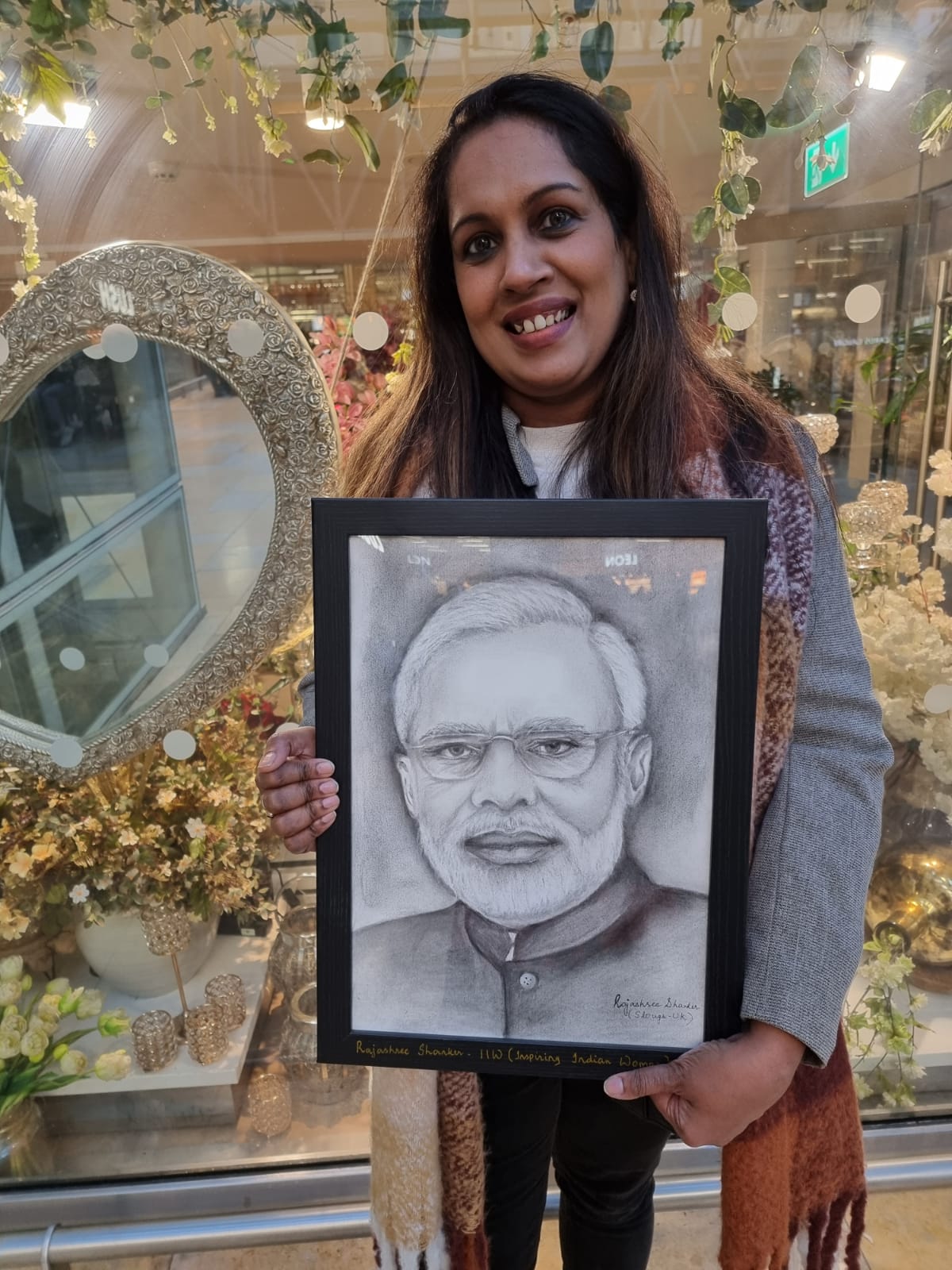
Just before the Prime Minister left for New Delhi on 2nd, members of the Indian diaspora arrived in buses to send him off with dhols and traditional music. It also included women from Inspiring Indian Women, who were there to present the Prime Minister with a charcoal sketch by Rajashree Nair Shankar from Slough.
Most of the diaspora members were dressed in gorgeous and festive Indian clothes such as sarees for women and Kurtas for men. Some also wore tri coloured clothes with pagdi, as they played dhol and danced to the tune.
The welcome and send off initiative by the diaspora, is believed to have been led by the members of the Overseas Friends of BJP.
Bilateral relationship b/w UK-India
As the COP26 leadership summit formally started, with 100 leaders, Prime Minister Narendra Modi was greeted by Britain’s Prime Minister Boris Johnson and United Nations Secretary-General Antonio Guterres.
During the inauguration of the summit, PM Johnson said, “Humanity has long since run down the clock on climate change.
“It’s one minute to midnight and we need to act now.
“If we don’t get serious about climate change today, it will be too late for our children to do so tomorrow.
“We have to move from talk and debate and discussion to concerted, real-world action on coal, cars, cash and trees.
“Not more hopes and targets and aspirations, valuable though they are, but clear commitments and concrete timetables for change.
“We need to get real about climate change and the world needs to know when that’s going to happen.”
The first day also included a bilateral meeting with PM Johnson- the first one in two years.
India’s Foreign Secretary Harsh Vardhan Shringla, at a later press conference said, “The Prime Minister reiterated India's commitment to closely work with the UK on climate finance, technology, innovations and adaptation including green hydrogen, renewables, clean technology, and joint initiatives under the International Solar Alliance and Coalition for Disaster Resilient infrastructure. Both these international organisations have very prominent UK involvement. The two Prime Ministers reviewed the roadmap for planning the 2030 priorities between India and UK in areas like trade, economy, people to people ties, health, defence and security.”
At the bilateral, the two Prime Ministers also discussed issues of security, counter-terrorism and extradition. The Foreign Secretary added, “The meeting was short, but it did allow exchanges on concerns that both our countries have on increasing radicalism. We're seeing in certain fringe groups that seem to be speaking out on issues that they have no legitimate right to do so and without clearly, without traction of any kind, but nonetheless causing certain level of disequilibrium and concern in both our countries. Prime Minister Johnson, agreed that some of these groups need to be reined in and that clearly steps have to be taken to see how such activity which under no means is democratic, or constitutional should be or could be used to address these recent incidents.
“The issue of extradition cases is important. The two Prime Ministers agreed that a number of these specific issues would be discussed between our National Security Advisors who are going to meet in London on 3 November. So they would go into detail on all of these issues that are important to the Consular and Security and other aspects of our relationship.”
Speaking on Free Trade Agreement (FTA), he added, “It would also be recalled that at the last summit, the two countries elevated our relationship to a comprehensive, strategic partnership and both sides expressed satisfaction on the progress in delivering enhanced trade partnerships, including steps taken to commence towards the launch of FTA negotiations. I think both sides also felt that there should be some attention given to the earliest conclusion possible of this important trade-related partnership between our two countries.
“There was a discussion in regional and global issues, including Afghanistan, supply chain resilience in post-Covid global economic recovery.”
Prime Minister Modi reiterated his invitation to Prime Minister Johnson to visit India at an early opportunity. It is not yet clear if Mr Johnson would be India’s Republic Day guest.
The COP26 Agenda
At COP26, Prime Minister Narendra Modi also attended the side event, which is called 'Action and solidarity-The critical decade'. This is hosted by the UK presidency of COP26. In his remarks, the Prime Minister spoke about the criticality of climate adaptation in development policy, the importance of traditional practices and the need for Global support for adaptation.
The highlight of the day was the Prime Minister's national statement on COP26. Foreign Secretary Shringla said, “India will reduce its projected carbon emissions by 1 billion tons from now until 2030.
“For the first time, India has spoken about reaching ‘Net Zero’ by the year 2070.
“The Prime Minister, of course, highlighted the need for greater ambition on climate finance and technology. He felt that given the sort of commitments that were there, climate financing to the extent of a trillion dollars would be required. He did say that while developing countries, he spoke on behalf of the developing world when he said that there was pressure on the developing world to increase and enhance their commitments. There should be similar pressure on developed countries to enhance their financial contributions, that would ensure that our target of 1.5 degrees Celsius is met.”
Presenting his five-point agenda, which he called the five ‘amrit tattva’ (nectar elements), while delivering the ‘National Statement’ at the COP26 conference, Modi said, “In the midst of this global brainstorming on climate change, on behalf of India, I would like to present five nectar elements, Panchamrit, to deal with this challenge.”
Referring to COP26 as ‘global brainstorming’ for climate change policies, Modi said, “India will cut down its net projected carbon emission by 1 billion tonne from now until 2030. Fourth, by 2030, India will bring down the carbon intensity of its economy by more than 45%. Fifth, by 2070 India will achieve the target of 'net zero'”
However, this statement was critiqued by a UK official involved in overseeing COP26, who reportedly said that India's 2070 target was “an interesting political choice”, and that they found it “quite curious” India had opted for a date that put them 10 years behind China, explaining that they would ordinarily want to be seen as “less competitive” than their economic rival.
Despite the criticism, it is important to note that India is the second largest populated country in the world, and this statement by its prime minister may have been a well calculated move.
On Tuesday there was a launch of the Infrastructure for Resilient Island States initiative and Accelerating Clean Technology Innovation and Deployment. The India led international solar alliance launched a new Green Grids initiative in partnership with the UK. He also held a series of bilateral meetings with leaders of Israel, Nepal, Ukraine, Japan, and entrepreneur Bill Gates.
Infrastructure for Resilient Island States
Prime Minister Modi also said that the launch of 'Infrastructure for Resilient Island States' - IRIS, gives a new hope, a new confidence. It gives the satisfaction of doing something for the most vulnerable countries. “Through IRIS, it will be easy and faster for SIDS to mobilize technology, finance, and necessary information. Promotion of quality infrastructure in Small Island States will benefit both lives and livelihoods there,” Modi said.
One Sun One World
Laying out a plan through the ‘One Sun, One World and One Grid' solution, the Prime Minister said, “Through a worldwide grid, clean energy can be transmitted anywhere and anytime.”
Indian space research agency ISRO will provide a solar calculator application to the world.
“The 'One Sun, One World and One Grid' solution will not only reduce storage needs, but also enhance viability of solar projects. This creative initiative will not only reduce carbon footprints and energy cost but also open a new avenue for cooperation between different countries and regions.
“I am hopeful that a common and strong global grid can be developed through cooperation between 'One Sun, One World and One Grid' and 'Green Grid' initiatives,” Modi further added.
Prime Minister Narendra Modi on Tuesday underlined the need to ensure transparent climate finance as part of important aspects in infrastructure creation during a roundtable event initiated by US President Joe Biden led Build Back Better for the World event.
Recalling that next year would mark 30 years of the establishment of full diplomatic relations between India and Israel, Prime Minister Modi extended an invitation to Israeli PM Naftali Bennett to visit India. PM Modi also met Prime Minister of Nepal, Sher Bahadur Deuba, India and met the President of Ukraine H.E. Mr. Volodymyr Zelenskyy on the sidelines of COP26.