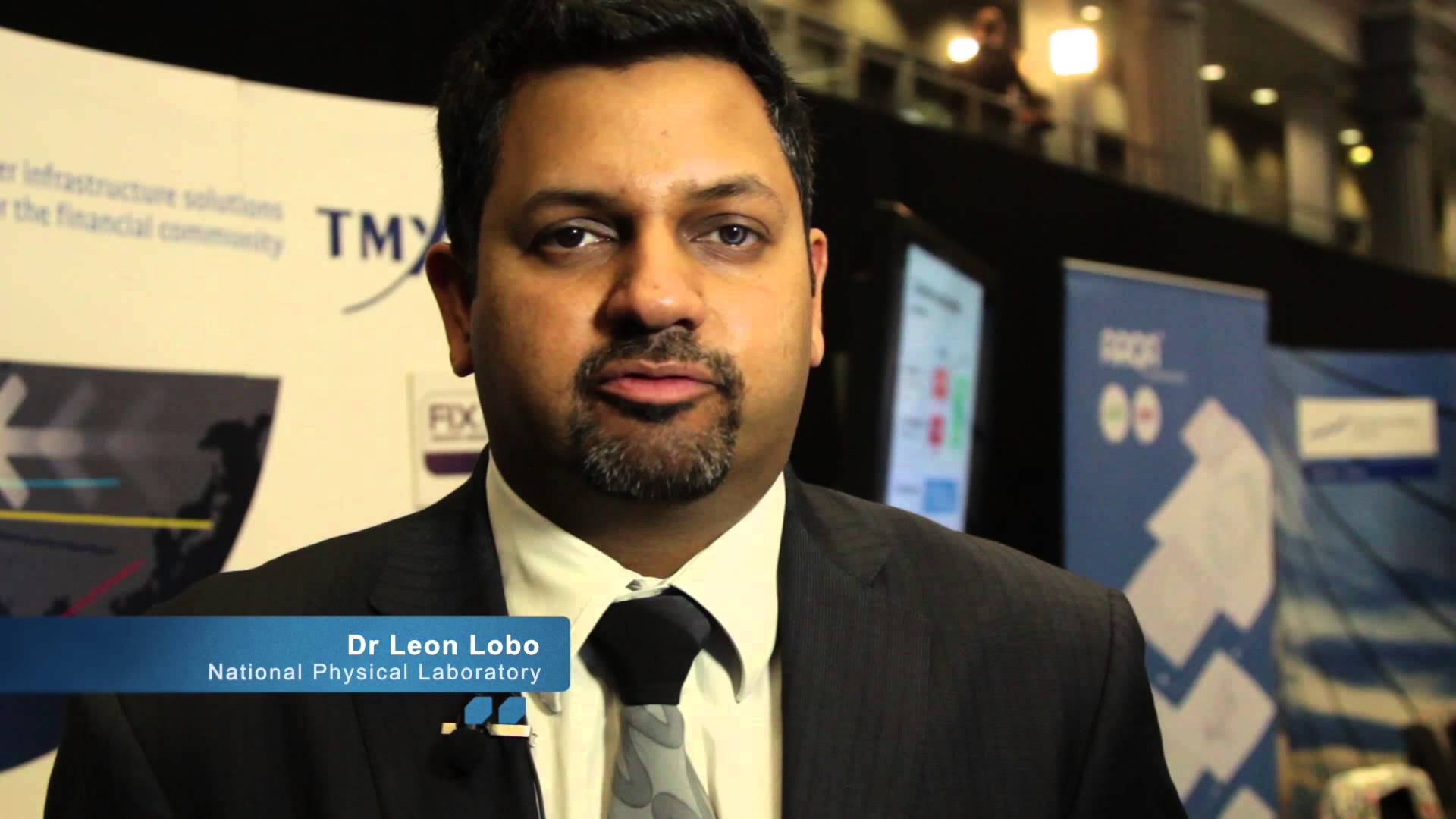
Dr Leon Lobo the current Strategic Business Development Manager at the National Physical Laboratory (NPL) that primarily focusses on precise time dissemination solutions, was interviewed by the Financial Times regarding the changing timekeeping of global financial markets and how British scientists' global chronology system can help regulators to keep tabs on high-speed transactions.
The FT wrote that in 21st century trading is conducted across continents in imcomprehensible speed and for regulators policing in such a world is very difficult. Now, European legislation has decided to tighten the rules around high-speed trading, leading the markets to rethink the way they measure time in digital age. The new rules (Mifid II), introduced beginning of this year, offer greater protections for investors and inject more competition into markets.
Dr Lobo said this could affect the infinitesimal timekeeping of global financial markets in the same way the railway changed the way time was measured in the 19th century. He has previously been the Group Leader for Time and Frequency, working with the team managing the UK’s timescale and developing quantum frequency standards. His background is in mechanical and optical engineering, with a PhD in high power laser material processing. He has previously developed solutions for standoff IED and trace explosive detection, remote in-vehicle personnel monitoring and less than lethal weaponry.
The NPL has been located in a sleepy suburban town of Teddington in South-West London since 1900. The laboratory is the UK's national measurement institute- it keeps the official time and holds responsibility for making thousands of high-precision calibrations for science, physics and technology. Now it has a new commercial market added to its clientele, providing a reference point for superfast computers that power global trading of 21st century. More than a dozen institutions have signed up including giants like UBS and Swiss Bank.
With a job to sell time, Dr Lobo told FT, “NPL's product is the finest thing that is almost creating a network of time around the world. We have been developing new techniques to disseminate time.”
Traders and exchangers hence have decided to timestamp events against a globally agreed standard known as Coordinated Universal Time or UTC. But timestamping all the trades in Europe is not easy, as clocks on trading computers are not collectively synchronised, therefore time is not uniform. It has its own challenges, and Dr Leon is here to find solutions. So if the NPL scientists are proved right, Teddington will become a time standard for a new commercial age, like Greenwich Mean Time (GMT) was for railways in 19th century.