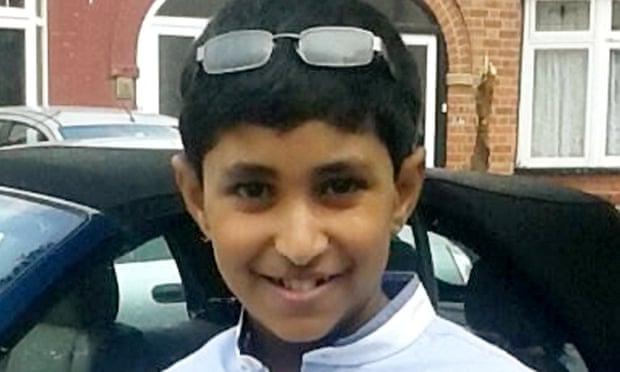
A schoolboy in west London succumbed to his dairy allergy after a fellow pupil flicked cheese at him, as heard in an inquest. Karanbir Singh Cheema, 13, was left gasping for breath as he went from “absolutely fine” to unconscious in under 10 minutes after the incident at William Perkin Church of England high school in Greenford. Karan died 10 days after the incident that took place on June 28, 2017, at Great Ormond Street hospital. Teacher Lucjan Santos told the inquest at St Pancras coroner's court in north London that Karan approached him to as him if he knew of a particular pupil.
“He said, 'He put some cheese down my collar for no reason', and then he pointed towards the back of his neck,” Santos said. He said he told Karan that that was not a nice thing to do, at which point the teenager said, “And I've got a cheese allergy.” He then sent the child to see the school's welfare officer and to fill in an incident report. Describing the boy's demeanour at that point, the science teacher said he “appeared fine and spoke calmly.” Karan was said to have multiple food allergies, including to wheat, gluten, dairy products and nuts. He also had asthma and atopic eczema.
The boy who flicked the cheese and another who passed it to him, now aged 15, said they were unaware Karan had an allergy to the food. When asked whether pupils at the school were aware of the potentially fatal consequences of allergies, Santos answered, “Hopefully”. School administrator Bonny Campbell said that when Karan first arrived in the welfare office, he was scratching his neck but sat down calmly, but he became increasingly panicked, “leaning over the sink, gasping for air, still scratching his neck.” Campbell said blood was seeping through Karan's shirt from the scratching and he was lurching around the room. “He pulled his shirt off, he was very itchy and couldn't breathe. He had scratch marks on his neck and his stomach, he was screaming,” she said. She also added that at one point he was shouting, “I'm going to die.”
They gave Karan and over-the-counter allergy relief medicine, and his inhaler. His condition deteriorated and they then administered his EpiPen. Campbell said it appeared to have no impact as he went “quite grey” and limp and his eyes glazed over. The EpiPen used was a year out of date, the inquest heard. When senior coroner for inner north London, Mary Hassell, asked why a second EpiPen was not administered, Campbell told the court that in first aid training she was told to wait 10 minutes before another dose, an ambulance was on the way, and that the emergency operator had not advised staff to do so. She added the first dose did not have the desired effect and staff would not use another student's device, which would have been the only option for administering a second dose.