In a result almost no political pundit believed was possible, Britain has voted to leave the European Union. In the days that have followed, Britain has seen the resignation of its Prime Minister, the attempted coup against Jeremy Corbyn, a collapse in the value of the pound, the loss of the esteemed AAA credit rating, the push for independence by Scotland (and perhaps even London), the collapse of the property market and a sharp increase in racist abuse and hate crimes.
The breakdown of votes exposes how divided a nation Britain has become. London, Scotland and Northern Ireland all voted overwhelmingly in favour of Remain, yet the rest of England and Wales voted in favour of Leave. Generationally the country is split also. Over three-quarters of those aged 18-24 voted to Remain while more than two-thirds of over 65s voted to Leave.
Middle England’s voting has created a powerful desire in Scotland to hold another independence referendum. First Minister for Scotland Nicola Sturgeon stated that Scotland would not be “dragged out of the EU against our will”, calling a second referendum “extremely likely”. In London, 175,539 people have signed an online petition demanding the capital declare itself an independent city state and rejoin the EU. Mayor Sadiq Khan dismissed these ideas but did say that London must “take back control of its own destiny “right now”. Mr. Khan also demanded that London has a say in the terms of Britain’s exit, stating London “simply has to have a seat at those negotiations”.
Anguished Remain voters are also desperately trying to apply for citizenship in Ireland. The Irish Republic’s foreign minister says the country has been overwhelmed by passport applications and is putting “significant pressure on the system”. The minister has appealed to Brits to stop applying unless the circumstances make it “absolutely necessary”.
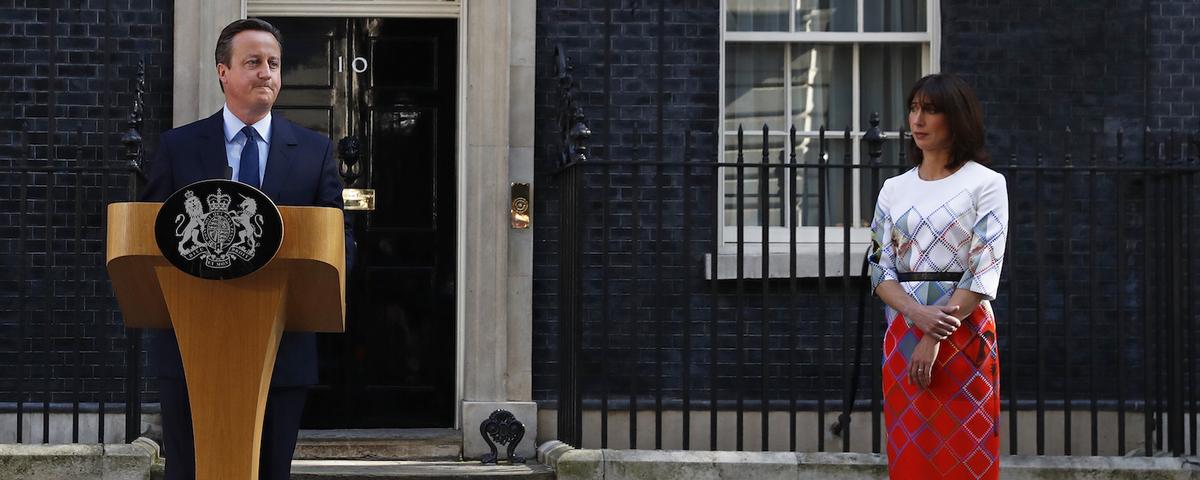
Politically, David Cameron was the major casualty. In a dignified and emotional statement on Friday morning, Mr. Cameron said he “fought the campaign the only way [he] knew how” but does not “think it would be right…to try to be the captain that steers our country to its next destination”. With his wife standing stoically by his side, the Prime Minister did not immediately enact Article 50 (as he had promised he would before the referendum campaign) instead choosing to allow his successor to carry out all facets of the negotiations.
The Prime Minister’s resignation not only shocked the nation, but also placed his wife under emotional stress. A family friend revealed in The Sunday Times that the Prime Minister’s wife had been “so stressed by it all that she has taken up smoking”. The source continued: “she doesn’t really smoke, but the stress has driven her to cigarettes”. A No.10 source added that Mrs. Cameron has begun drinking “the odd glass” of wine to try and calm her nerves.
With Mr. Cameron’s departure, there is political vacuum in Number 10 and at the top of the Conservative party. Three MPs have emerged as the leading candidates to take his place. Boris Johnson, former Mayor of London, was seen as the face of the Vote Leave campaign. The charismatic MP has long been suspected of having his eye on the top job, despite his claims that he was more likely to be “reincarnated as an olive”. Within the general public he is probably the most popular Tory MP, but within his own party he has a“likability problem” with the “Stop Boris!” movement gathering momentum. Nonetheless, one minister says that Boris’s connection with the “grassroots” means “if he makes the ballot he will win”. Another described Mr. Johnson as “box office”. The major question is whether Boris can make the transition from showman to statesman? He is the current favourite to be the next leader.
Michael Gove, former party whip and current Justice Secretary, was one of Mr. Cameron’s closest friends and allies. Despite a highly controversial reign as Education Secretary, Gove is seen as politically savvy. He is astute at making deals, and was smart enough to see which way the public was leaning on the EU vote, quickly attaching himself to the campaign. While it is unlikely that he will take over as the next leader, he will play the role of kingmaker. He is set to become the go-between of the two sides when negotiations begin. Furthermore, in a statement delivered immediately after the vote, Mr. Gove appeared to be positioning himself as chief negotiator with Brussels, outlining his vision of a deal for Britain.
Finally, Theresa May, currently Home Secretary, quietly supported the Remain side, yet is now the most favourite for the job. Mrs. May made sure she was not vocal in her support so as to not burn any bridges with her party colleagues. Seen as the prime “Stop Boris!” candidate, Mrs. May has seen an upsurge in popularity over the weekend. 31% of Conservative voters support her bid for Tory leadership (up from 14% in April) placing her 7 points clear of Boris Johnson, currently sitting at 24% (down from 36% in April).
One man who will not be fighting for the top job is current Chancellor George Osborne. Seen as the front runner prior to the referendum to succeed David Cameron, Mr. Osborne has suffered a fatal blow to his candidacy after being a staunch Remain advocate. In an article in the Times in Monday, Mr. Osborne wrote that “I am not the person to provide the unity my party needs”. The polls reflect this, with only 4% of Tory voters backing the Chancellor as the right man to take over from Mr. Cameron.
The Tories are not the only party suffering through inner turmoil. Jeremy Corbyn’s shadow cabinet is haemorrhaging ministers. As of Monday evening, only ten of the thirty members remain. Corbyn has seen 19 members resigned after he sacked his shadow Foreign Secretary Hilary Benn. Mr. Corbyn was accused of running a pro-EU campaign that “failed” by Dame Margaret Hodge, while some sources within the Labour party have accused Mr. Corbyn of “deliberate sabotage”. In a fighting statement in the Commons on Monday, Mr. Corbyn called the coup unpatriotic before continuing “the country will thank neither the benches in front of me, nor behind, for indulging in internal factoring manoeuvring at this time”. His statement was met with a chorus of “Resign!”.
Following the filing of a no-confidence motion by Dame Margaret Hodge and backbencher Ann Coffey on Friday afternoon, rumours of a coup have been swirling. In the very early hours of Sunday morning, Hilary Benn was sacked after sounding out fellow shadow cabinet ministers about a potential party takeover. Throughout Sunday, many prominent ministers resigned including Heidi Alexander (Shadow Health Secretary), Lucy Powell (Shadow Education Secretary), Seema Malhotra (Shadow Treasury Secretary) and Chris Bryant (Shadow Commons Leader).
Perhaps most damaging of all the blows to his leadership came on Monday morning, when deputy party leader Tom Watson said in a meeting with Mr. Corbyn that he has “no authority” over Parliamentary MPs and that it “looks like we’re moving towards a leadership election”. Despite the Labour leader’s attempts to regain control of his party by announcing a dramatic cabinet reshuffle, it appears more likely that he will face a direct election for the leadership.
Such internal turmoil is caused by the apparent inability of many MPs to accept the result. Health Secretary Jeremy Hunt has joined calls for a second referendum after the terms of Brexit are formally negotiated with Brussels. Writing in The Daily Telegraph, Hunt believes any deal “should be put to the British people” either in the form of “another referendum” or a “general election”. While this is not a claim that the referendum result should be ignored, there are clearly grounds through which a potential Brexit could be blocked if voters continue to reject the deal future governments bring back from Brussels.
As political turmoil has erupted, so has economic. The markets in the UK have been sent in to free-fall, with the pound falling to it’s lowest level since 1985 (stooping to $1.3118 on Monday). The blue-chip FTSE 100 stock has fallen 2.6% since the vote, while the FTSE 250 has fallen by 14% since the vote (the largest collapse since the crash of 1987). All of the uncertainty lead to a hammer blow yesterday when Standard & Poor downgraded the UK’s credit rating two notches from AAA to AA. This has only compounded fears within the markets. Both George Osbourne and Mark Carney have made statements to try and reduce fears.
Socially speaking, the result has created an ugly environment, with a sharp increase in the number of reported cases of hate crimes and racially-motivated attacks. In Hammersmith, the Polish centre was defaced with what Mr. Cameron described as “despicable graffiti”. Anecdotal evidence for the increase in such crimes has also been confirmed while the National Police Chiefs’ Council has reported a 57% increase in such crimes since last Thursday’s vote.
There are however, some small positives emerging from the result. British tourism is expected to see a significant increase in revenue due to the decrease in value of the pound. This has had the dual effect of making Britain a more popular destination for foreign tourists, as good and transport become much cheaper with the foreign exchange rates, while also forcing more British families to take a “staycation” as foreign holidays become more expensive for Brits with the unfavourable currency exchange.