US President Donald Trump made a State visit to the UK with his wife, the first lady of Melania Trump on September 16 to 18.
He was received by King Charles III at Windsor Castle and later met Prime Minister Keir Starmer at the Chequers, where they held a joint news conference covering foreign affairs, trade, and immigration.
This was Trump’s second State visit to the UK, his first, during his initial presidency, was in June 2019 when he met Queen Elizabeth II.
Prime Minister Keir Starmer met US President Donald Trump in the Oval Office on February 27, 2025, marking his first visit to the White House after Trump’s return to office. PM Starmer hand-delivered a letter from King Charles III inviting Trump for a second state visit to the UK, which he accepted, making him the first world leader to receive more than one official state visit.
On arrival at Stansted Airport, President Donald Trump and First Lady Melania Trump were received by Warren Stephens, the United States Ambassador to the Court of St James's. They were formally welcomed on behalf of King Charles III by the lord-in-waiting, Henry Hood, 8th Viscount Hood. The President and First Lady flew in Marine One to Winfield House, the official London residence of the US ambassador, located in Regent's Park, where they stayed overnight.
US President Trump receives royal welcome at Windsor
After arriving at Windsor Castle aboard Marine One, the Trumps were welcomed by the Prince and Princess of Wales, William and Catherine, before receiving a formal greeting from King Charles III and Queen Camilla. To mark the occasion, Windsor Castle and the Tower of London fired a royal salute.
The President and First Lady then joined members of the royal family for lunch, followed by a private viewing in the Green Drawing Room of a special exhibition showcasing items from the Royal Collection connected to the United States.
Later, President Trump and First Lady Melania laid a wreath on the tomb of Queen Elizabeth II at St George’s Chapel, with the president calling the visit a “great honour.”
Accompanied by King Charles III and Queen Camilla, they then watched a special Beating Retreat on the East Lawn of Windsor Castle—a joint performance by British and American musicians and the first of its kind for a state visit.
That evening, a formal state banquet was held in St George’s Hall, where both the King and the president delivered speeches celebrating the enduring US-UK Special Relationship.
Trump hailed the US-UK alliance as “priceless and eternal,” calling the visit “one of the highest honours” of his life. On his historic second state visit, he said “special” scarcely captures the bond between the two nations, likening them to “two verses of the same poem” that together have “done more good for humanity than any two countries in history.” He added, “We had a very sick country one year ago, and today I believe we’re the hottest country anywhere in the world.”
King Charles III reflected on the deep US-UK ties, noting that such a partnership would have been unimaginable to George Washington and King George 250 years ago. “We celebrate a relationship between two countries that surely old George could not possibly have imagined,” he said.
The King hailed the enduring US-UK defense alliance, recalling their joint victories in two world wars and their united stand against Russian aggression. “Today, as tyranny once again threatens Europe, we and our allies stand together in support of Ukraine,” he said.
Despite concerns that President Trump has not pressed Russia hard enough on peace talks, Charles praised his “personal commitment to resolving some of the world’s most intractable conflicts to secure peace.”
The banquet hosted 160 distinguished guests, including Tiffany Trump; tech leaders such as Apple CEO Tim Cook, OpenAI’s Sam Altman, Microsoft’s Satya Nadella, and Nvidia’s Jensen Huang; media mogul Rupert Murdoch; U.S. diplomats Marco Rubio, Scott Bessent, and Steve Witkoff; Conservative leader Kemi Badenoch; the prime minister’s special advisor on business and investment Varun Chandra; and Barclays CEO C.S. Venkatakrishnan with his wife. Rupert Maddock, 95, was the oldest attendee, joining a roster of other prominent dignitaries.
London Mayor Sir Sadiq Khan did not attend the state banquet and said he neither sought nor expected an invitation. A source close to him accused Donald Trump of spreading “fear and division.”
Speaking to reporters aboard Air Force One, the US president claimed he “didn’t want” Khan at the King’s Windsor Castle banquet, calling him “one of the worst mayors in the world.” The remarks reignite their long-running feud: in 2019 Trump branded Khan “a stone-cold loser,” while the mayor accused Trump of fueling far-right politics.
State visit showcases ‘unbreakable’ US-UK bond
After the president and first lady formally bid farewell to the King and Queen, Trump then travelled to meet the Prime Minister, Keir Starmer, and his wife Victoria Starmer, at Chequers, the country house of the prime minister in Buckinghamshire.
Before their meeting and joint press conference at the Chequers, the president and prime minister toured the Winston Churchill archives.
Meanwhile, the First Lady joined Queen Camilla to visit Queen Mary’s Dolls’ House and the Royal Library at Windsor, then attended a scouting event at Frogmore Gardens with the Princess of Wales, co-president of The Scout Association. Together they hosted Scouts, sharing miniature books and leaf printing, before the First Lady traveled to Chequers to meet the president for their return to the United States.
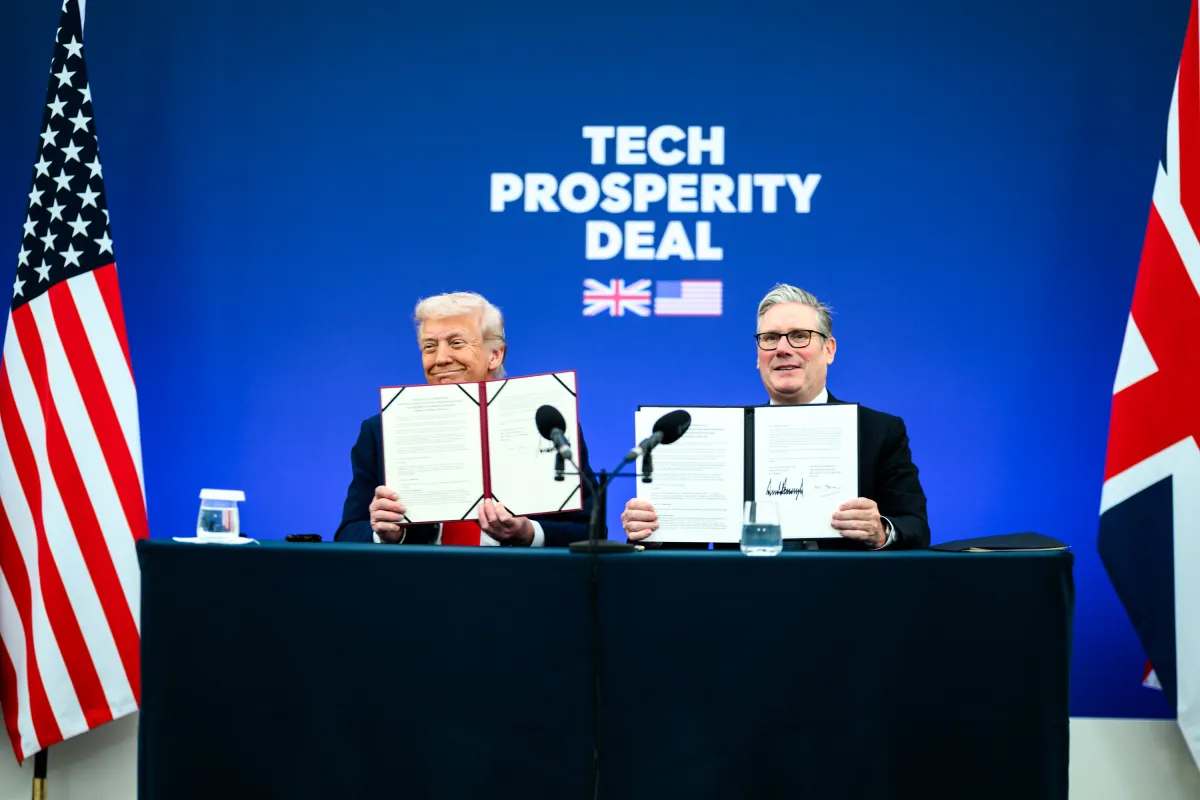
Later, Starmer and Trump attended a business reception hosted by Chancellor Rachel Reeves, where they signed the “Tech Prosperity Deal,” a landmark science and technology pact. Starmer said it would send “billions both ways across the Atlantic,” while Trump pledged £150 billion in US investment.
The agreement commits both nations to collaborate on advanced technologies—AI, quantum computing, and nuclear energy, launching a joint AI-for-Science program, speeding nuclear reactor licensing, and ending reliance on Russian nuclear fuel by 2028. It forecasts $350 billion in new commercial ventures, including UK purchases of U.S. tech and defense, GSK’s $30 billion AI investment in America, and BP’s $5 billion Gulf energy plan.
At their joint press conference, Trump called the US–UK bond “unbreakable” and “closer than ever.” Starmer said they also discussed ending the Gaza conflict and his plan to recognise a Palestinian state, a move Trump opposed as “one of our few disagreements.”
Speaking to Asian Voice, Rishi Khosla, co founder and CEO of OakNorth, who attended the Prime Minister’s business reception at Chequers, said, “The US State visit marks a pivotal moment in UK-US relations, with both governments reaffirming their shared commitment to free enterprise, strategic cooperation, and sustainable growth. The scale and ambition of the investments being made reflect the unique strength of the economic partnership between our two nations. At OakNorth, we see this relationship in action every day - since July 2023, we have lent nearly $2bn to lower mid-market businesses in the US, and we are committed to investing billions more in the coming years. By supporting these vital businesses, we aim to help drive innovation, create jobs, and fuel sustainable growth across both economies."
Protesters mock Trump with baby blimps and costumes
Thousands of protesters in Parliament Square voiced a starkly different response to Trump’s visit to the UK.
Organised by the Stop Trump Coalition—a coalition of over 50 unions and charities—demonstrators marched from Portland Place to Whitehall, carrying signs reading “No to racism,” “No to Trump,” and “Stop arming Israel,” as well as smaller versions of the 20ft Trump Baby blimp from 2019.
The Metropolitan Police estimated up to 5,000 attendees and deployed more than 1,600 officers, including 500 from other forces.
Polling shows widespread British disapproval of Trump, with an Ipsos survey finding 61% of Britons dislike the US President.
While Trump lunched with the Royals in Windsor, demonstrators gathered in London waving signs and flags with slogans like “Dump Trump” and “Stop Trump,” some featuring expletives. Protesters dressed as figures such as Vladimir Putin, Benjamin Netanyahu, and Andrew Tate held signs reading “War criminals for Trump,” “Murderers for Trump,” and “Misogynists for Trump.” Many signs also addressed specific political issues, including the Russia-Ukraine conflict and Israel’s war in Gaza.
The activist group Donkey, known for viral stunts targeting politicians, projected a video montage of Trump and Epstein on a Windsor Castle tower where Trump was expected to stay. The footage showed Trump’s mugshot, Epstein’s portraits, headlines, and clips of the two dancing. AFP reported that four people were arrested on suspicion of malicious communications. Some Trump supporters in the crowd, however, welcomed his visit.
Professor Yunas Samad of the University of Bradford said, “Britain’s tradition of rolling out the red carpet for authoritarian leaders makes Trump’s welcome seem unsurprising. On the surface, it seems normal, given the UK's ‘special relationship’ with the United States. But the UK–US ‘special relationship’ was built on free markets, democracy, rule of law, and NATO. Trump has dismantled these foundations.
“This is a new era in US politics where Trump isn’t a temporary blip; he signals a lasting shift. The US is turning inward, sidelining Europe, and treating allies like the UK as ‘vassal states,’ expected to defer to Washington while being exploited. While being subservient to Trump might seem like the best short-term strategy, it’s a huge mistake. He respects strength, not sycophancy, admiring leaders like Modi and Xi over a pliant Britain. Inviting Trump isn’t a mistake because of his personal flaws or stances on Ukraine and Gaza; it’s a mistake because he is actively dismantling the Western order that the UK relies on. Starmer needed to show backbone—failing to do so may go down as a historic error, perhaps a Munich moment, “ he added.