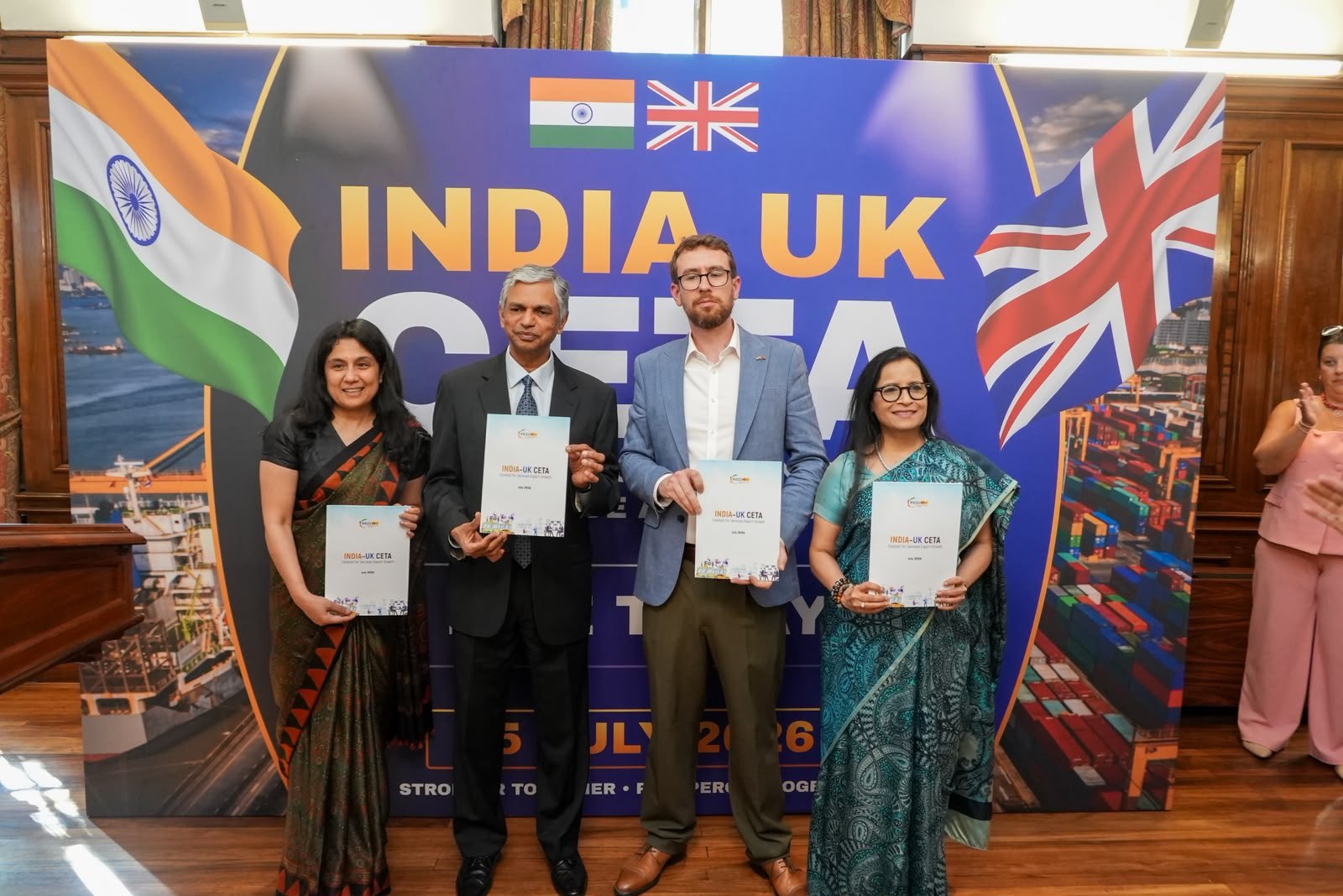
India’s new High Commissioner to the United Kingdom, His Excellency P Kumaran, assumed office on 13 May 2026 and presented his credentials to King Charles III on 9 June.
A 1992-batch Indian Foreign Service officer, he brings more than three decades of diplomatic experience across Europe, the Middle East, South Asia and North America.
Asian Voice spoke exclusively with the High Commissioner on India’s journey, its global partnerships and the road ahead, as the nation marks its 80th Independence anniversary.
AV: What have been some of the defining moments that shaped your journey as an Indian diplomat?
I have been fortunate to have a number of interesting assignments that took me to Egypt, Libya, Belgium, Pakistan, USA, and Sri Lanka, in addition to assignments at the Ministry of External Affairs in New Delhi and also as the Regional Passport Officer in Bengaluru.
My Ambassadorial assignments have been in Qatar, Singapore and now in the United Kingdom. Just before coming to London, I served as Special Secretary (Economic Relations & Development Partnership Administration), and then as Secretary (East) in the Ministry of External Affairs.
There have been several rewarding and satisfying opportunities during the course of my career. As the Regional Passport Officer in Bangalore, and a few years later as Joint Secretary (CPV) in the Ministry of External Affairs (MEA), I was able to leverage my training as an Engineer to introduce a number of e-governance solutions and systemic improvements to enhance service delivery by MEA and Indian Embassies and Consulates abroad. These include several innovative ideas to enhance the efficiency of the passport processing system. A number of these best practices were adopted by other passport offices and subsequently incorporated into the Passport Seva Project a few years later. I was also involved in the design and implementation of the ’Madad’ Consular Services Management System. This was a game-changer in the way grievances were logged and processed by the Ministry of External Affairs and today forms the backbone of the grievance redressal procedure followed by MEA. I also helped develop a ‘Nationality Verification Module’ linking our Embassies and Consulates abroad to police authorities in various states, for verifying the nationality and antecedents of illegal migrants detained in various countries before they can be confirmed as Indian nationals and deported to India.
As Joint Sectary (CPV) earlier, I had helped negotiate India’s first ‘Common Agenda on Migration and Mobility’ between India and the European Union in 2015. This became the template for subsequent Migration and Mobility Partnership Agreements with several countries.
Following the intensification of conflict between the warring factions in Libya, I was deployed to Tripoli in 2014 to coordinate the evacuation of Indian nationals from that country. It was a complex exercise that required coordination with representatives of factions that controlled various parts of Libya, Indian community leaders in different provinces in Libya, Indian Embassies in neighbouring countries, Air India and shipping lines hired for this purpose. We were able to successfully repatriate nearly 4000 Indians during a 30-day period.
As Deputy High Commissioner of India in Colombo, I coordinated India’s development assistance projects in Sri Lanka, including the rehabilitation of damaged railway lines, establishing livelihood restoration projects, and the construction of 50,000 houses for the internally displaced people during the civil war in Sri Lanka.
As India’s High Commissioner to Singapore, during the Delta wave of the Covid crisis, we were able to use our extensive contacts in Singapore to help source oxygen tanks, cylinders, concentrators and PPE equipment to meet emergency needs in India. I was also able to help complete the UPI-PayNow link between India and Singapore, enabling faster and lower-cost cross-border remittances.
My appointment as India’s High Commissioner to the UK, of course, provides me an opportunity to strengthen one of India’s most strategically important bilateral relationships, focused on trade and investment, technology, education, diaspora engagement, maritime cooperation and the implementation of the India-UK Comprehensive Economic and Trade Agreement.
AV: How have your experiences influenced your approach to diplomacy?
We live in turbulent times when the world is witnessing a poly-crisis. The challenge for diplomats is that the relative certainties that shaped the post-Cold War moment are eroding; the assumptions of globalisation are being revisited; major-power rivalry is sharpening; and many regions across the world - from Europe to West Asia, from the Indo-Pacific to Africa - are experiencing simultaneous and overlapping challenges.
India’s foreign policy is therefore required to adapt to these rapid changes to safeguard national interests while contributing to the global common good, and to maintain strategic autonomy while deepening partnerships.
The coming decades will test whether the international community can re-imagine multilateralism, humanise globalisation, discipline technology with ethics, and align climate ambition with developmental fairness. India’s foreign policy seeks to position India as an active shaper of these debates - as a civilisational state, as a rising pole in a multipolar world, and as a steadfast partner to the Global South and the wider international community. In this quest, sustained economic growth, technological competence, enhanced defence capabilities, and credible disaster and humanitarian relief operations, have provided us the means to act on our choices.
As we move towards 2047, I believe India’s external journey will be guided by three enduring impulses: securing its sovereignty and people, enabling accelerated and inclusive development, and shaping a new order in which a diversity of paths and perspectives is truly respected.
AV: How do you view India's transformation and its growing influence in international affairs?
India's position on the global stage is, naturally, a function of developments in the world and also the changes that have taken place within India in recent years. The end of the Cold War and the changes in the international order since then; the emergence of India as one of the largest G20 economies; increasing integration with the global economy; rising technological and defence capabilities; and a young, upwardly mobile and aspirational population, have all shaped the evolution of India’s role on the global stage.
India’s rise is not merely a story of economic growth or demographic weight; it is about the expanding responsibilities and expectations that accompany strategic capability, diplomatic credibility, and normative influence. India is no longer being asked whether it will contribute to addressing global challenges; rather, it is increasingly expected to do so.
Over the years, India’s foreign policy has been built around the idea of strategic autonomy in an interdependent world: engaging all, aligning with none, and remaining firmly anchored in national interest. The overall approach has been interdependence without undue dependence, partnerships without exclusivity, and an emphasis on shaping the environment rather than choosing sides.
In a fragmented world, India’s approach reflects the logic of strategic hedging, coalition pluralism, and risk diversification. It is no longer an abstract doctrine, and is enabled by growing comprehensive national power at home and expressed through diversified partnerships abroad.
AV: As India aims to become a leading global economy, what are the key areas where international partnerships will play a crucial role?
India today is one of the fastest-growing major economies, soon to become the world’s third-largest economy and a vision to attain the status of an upper-middle income nation by 2047.
The geo-economic upheavals resulting from global turbulence has led to the weaponisation of tariffs and sanctions as leverage, financial flows as instruments of pressure, and supply chains as theatres of contest. A world that once celebrated efficiency above all now increasingly values security, resilience, redundancy and reliability, even at higher cost.
For India, this environment poses both risks and opportunities.
On the one hand, excessive concentration of manufacturing in a single geography and the securitisation of interdependence have underscored the perils of over-reliance on any one supplier or market. On the other, India’s scale, growth trajectory and reform momentum position it as a natural hub in the re-architecting of global value chains, especially as companies and governments look for trusted, diversified partners and locations.
Domestic policy has accordingly shifted from a narrow participation in global value chains, to a more ambitious strategy of building competitive capacity at home - through production-linked incentives, infrastructure expansion, labour and skill development, logistics reforms, and a focus on sunrise sectors such as semiconductors, critical minerals, advanced manufacturing and clean energy.
Externally, India has sought to negotiate fair and balanced trade agreements, deepen connectivity platforms, support frameworks that enable mobility of professionals, democratise production and extend manufacturing to more geographies in the Global South. At the systemic level, India has consistently cautioned against a slide into hyper-protectionism and fragmentation of the multilateral trading system.
An increasingly key frontier of diplomacy is the digital domain. Emerging areas such as artificial intelligence, quantum technologies, robotics, cyber tools, outer space systems and biotechnology are reshaping both power hierarchies and vulnerabilities. India approaches this landscape with a dual consciousness: the imperative of technological sovereignty and security, and the need to leverage technology for inclusive development at scale.
On the global stage, India advocates democratic technology governance. In parallel, it is investing in semiconductor ecosystems, telecom diversification, cyber resilience and space capabilities, while exploring technology partnerships that are de-risked from excessive dependence on any single supplier or jurisdiction.
Perhaps no aspect of India’s foreign policy has seen greater normative articulation than its engagement with the Global South, where India has sought to position itself not as a spokesperson but as a bridge, an enabler of agency, and a provider of public goods. The Voice of the Global South summits convened by India have brought together over a hundred countries to articulate shared concerns on debt, food and energy security, climate justice, and technology access. Initiatives such as the International Solar Alliance, the Coalition for Disaster Resilient Infrastructure, the Global Biofuels Alliance, and support for digital public infrastructure across continents exemplify how India seeks to move from rhetoric to tangible public goods. India’s own development journey, and its record of sharing vaccines, medicines, capacity-building and infrastructure support with partner countries, provides a degree of credibility to this leadership claim.
AV: The Indian diaspora in the UK plays an important role in strengthening bilateral ties. How do you see the community's contribution evolving?
One of the most rewarding aspects of serving in the United Kingdom is the opportunity to engage with such a vibrant and accomplished Indian diaspora.
As the India-UK relationship evolves, I think the diaspora's role is likely to evolve from being primarily a “living bridge” between India and the UK into a more active co-creator of the bilateral relationship, particularly in terms of shaping investment, innovation, public policy and people-to-people links in both countries. With around 1.9 million people of Indian heritage in the UK, the community already has the scale, institutional presence and professional diversity to influence the relationship well beyond cultural diplomacy.
The community is increasingly represented not only in business and politics, but also in the NHS, universities, technology, the creative industries, local government and civil society. Its influence will therefore become more distributed. This matters because bilateral ties are no longer confined to diplomacy and trade. They encompass technology and innovation, health, education, climate policy, defence, and digital regulation.
Indian-origin entrepreneurs and Indian-owned companies in the UK will remain important channels for two-way investment, supply-chain development and market access. But a major shift will come from younger British Indians, who are often more globally connected, digitally networked and professionally mobile than earlier generations. Their relationship with India may be less centred on ancestry or family remittances and more on entrepreneurship, research collaboration, climate action, technology and public-interest work.
The community’s political role will become more mature and pluralistic in the coming years, with the diaspora embedded in permanent institutional mechanisms: business councils, university partnerships, city-to-city links, professional associations, youth networks and technology forums. This can enable the diaspora to offer both governments a more realistic understanding of public opinion, encouraging a more informed dialogue on sensitive issues.
The community can thus become one of the relationship’s most important long-term assets: not simply a bridge between the two sides, but a dense network connecting both societies.
AV: Looking back at 79 years of India's independence, what achievements make you most proud as a diplomat?
India’s greatest achievements since independence are not confined to any single sector. Taken together, they represent the transformation of a poor, food-deficit and recently-partitioned country into a functioning democracy, a major economy, a technologically capable state and an influential global power.
India’s most important achievement is arguably the survival of a vibrant constitutional democracy at continental scale. India adopted a democratic Constitution in 1950 based on universal adult franchise, parliamentary government, fundamental rights and an independent judiciary. It has conducted regular national and state elections despite enormous linguistic, religious, caste and regional diversity. It integrated hundreds of princely states and created a workable federal structure, later accommodating linguistic reorganisation rather than allowing language differences to fragment the Union. Power has changed hands peacefully through multiple election cycles.
Other major achievements include food security and agricultural transformation; impressive long-term economic transformation with rapid growth in services, telecommunications, finance, pharmaceuticals, automobiles and technology; developing substantial scientific, technological and strategic capability and institutions despite limited resources and a relatively low historical level of per-capita income; development of world-class digital public infrastructure; significant gains in health and social development; and maintaining considerable strategic autonomy through turbulent periods.
Our task, however, remains unfinished. We continue to have challenges but our direction is unwavering, and we are increasingly building the institutional, economic and technological foundations from which to address them more effectively.
There is a quiet confidence about India's future today that is recognised internationally, and I think that is significant.
AV: What are the biggest opportunities and challenges India faces as it moves towards 2047?
The global order is undergoing one of its most profound transformations in decades. Along with the advent of disruptive technologies such as AI, ML, IoT, quantum etc., we find ourselves at the cusp of three transitions – the digital transition, the industrial transition and energy transition. The defining feature is not merely rapid change, but also heightened uncertainty and newer opportunities.
In a remarkably short span of time, the sources of global disruption have shifted repeatedly - from a global pandemic to the weaponisation of trade and finance, to geopolitical conflicts, trans-national extremism, and more recently, to disruptions affecting critical maritime routes, energy supplies and commerce. Each of these crises has generated not only immediate shocks but also cascading effects across economies and societies. It has compelled countries to rethink governance frameworks, regulatory systems, and development strategies.
The scale, speed and the interconnected nature of these challenges have outpaced the ability of multilateral institutions, such as the UN or the WTO, to deliver timely and coordinated responses. Indeed, these developments have tested the resilience of multilateral systems.
The biggest challenge is to continue to preserve room for independent decision-making, in such a fluid situation. India’s response has been the pursuit of greater domestic resilience, focusing on strengthening supply chains, securing critical infrastructure, energy and critical mineral access, and reinforcing economic security in order to mitigate vulnerabilities arising from concentrated dependencies and systemic shocks. We have also dwelled on strengthening domestic competitiveness, through quality investments in modern infrastructure, innovation and technology, advanced manufacturing capabilities, maintaining financial stability, and focussing on human capital. The third part has been to foster variable-geometry partnerships as part of our economic diplomacy, including diversifying trade and manufacturing ties, pursuing de-risking strategies, and strengthening cooperation through trade agreements, technology collaborations, connectivity initiatives, and broader strategic alliances.
India’s relationships with the democratic world are driven by shared strategic concerns including supply-chain resilience, critical technologies, digital governance, cyber and maritime security. We also seek to build trusted technology ecosystems, and uphold open societies against authoritarian and digital threats. The conclusion of the India-UK CETA, the India-EFTA Free Trade Agreement, the India-EU Free Trade Agreement, the India-EU Trade and Technology Council, the India-UK Technology Security Initiative (TSI), and cooperation in green and digital transitions, all reflect this widening agenda.
Over the past decade, we have taken significant strides in terms of enhancing international engagements aimed at mitigating geopolitical risks and enhancing energy security. The partnership today is deep, yet purposely non-allied. This is an important nuance: India seeks to cooperate, but without compromising autonomy.
AV: What message would you like to share with the diaspora on India's 80th Independence Day?
An anniversary such as this is an occasion for both celebration and for reflection. It is a time to celebrate our achievements as an independent nation, take stock of the challenges that remain and resolve to continue to work to make things better.
To the Indian community in the UK, I would like to express my sincere appreciation. You have contributed immensely to the success of this country, while continuing to strengthen the bonds of friendship between India and the UK. That is something of which you should be justifiably proud. As we look towards 2047, we should continue to build on this partnership - in business, investment, education, science, culture and innovation. The future of the India-UK relationship will be shaped not only by governments, but by the people and communities who bring our two countries closer every day.
On this occasion, I wish everyone a very happy Independence Day. May we continue to work together towards a future that is peaceful, prosperous and full of opportunity for both our countries.