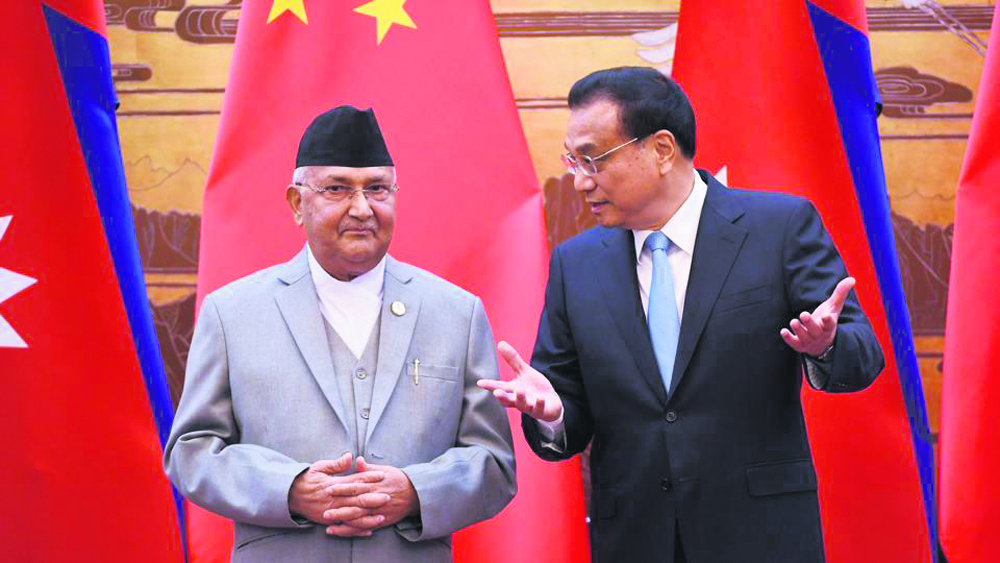
Beijing: Nepal can serve as a bridge between India and China, PM K P Oli has said, insisting that his country will maintain close ties with the two neighbours while pursuing independent foreign policy. Oli, who was is China o a five-day visit, held talks with President Xi Jinping and Premier Li Keqiang, following which an MoU was signed to build a railway link connecting Tibet with Kathmandu, along with 14 cooperative documents.
In an interview to China’s state-run Global Times, Oli said since the formation of his government, Nepal has intensified engagements with both neighbours. “We have made it clear that we pursue an independent foreign policy and a balanced outlook in the conduct of international relations,” he said.
Asked whether Nepal will be the “land of the competition” or “bridge of cooperation” between China and India, Oli said Nepal has remained a sovereign and independent nation throughout history. “We are firmly committed to not allowing our territory to be used against the sovereign interests of our neighbours. We have the resolve to maintain this and we naturally expect similar assurance from our neighbours.”
“We believe that Nepal can serve as a bridge between our two neighbours. In fact, we want to move from the state of a land-locked to a land-linked country through the development of adequate cross border connectivity. Our friendship with both neighbours places us in an advantageous position to realise this goal.” On China’s Belt and Road Initiative, he said: “Nepal wants to benefit from the initiative and at the same time, it works for the benefit of the international community.” India has reservations over the BRI as it includes the China-Pakistan Economic Corridor which is being laid through Pakistan-occupied Kashmir.
Dilling tunnel under Himalayas
China is attempting to drill a tunnel to build a rail link from Chinese-controlled Tibet to Nepal which would ultimately link the mountain state's capital Kathmandu with Beijing. The new rail route would boost trade and tourism between China and Nepal in a development that risks more tension with India over China’s ambitions in south Asia.
The new line would join an existing line from Qinghai, a central Chinese province, to Lhasa, the capital of Chinese-controlled Tibet, and is being planned “at Nepal’s request,” according to reports in the China Daily. Everest’s 29,029ft summit sits precisely on Nepal’s border with China. The rail project’s specific details are few, but engineers may look for guidance to the makers of the world’s current longest and deepest tunnel, under the Swiss Alps. The Gotthard Base Tunnel is 35 miles long, and runs beneath more than 7,500ft of mountain. It was completed in 2013, with trains expected to pass through it in 2016. For most of the work, its builders used a 300-ton mechanical mole to crunch through 125ft of rock every day, with the rest done by conventional drilling and blasting.
China’s foreign minister, Wang Yi, who visited Kathmandu in December said the line could eventually be extended to that city and beyond. Chinese tourism to Nepal, which is home to eight of the world’s 14 peaks higher than 8,000 metres (26,246 ft) is also growing. Wang Mengshu, of the Chinese Academy of Engineering, said: “If the proposal becomes reality, bilateral trade, especially in agricultural products, will get a strong boost, along with tourism.”
He added: “The line will probably have to go through Qomolangma (the Tibetan name for Everest), so workers may have to dig some very long tunnels.” The challenging Himalayan terrain, with its “remarkable” ups and downs, means that trains on any line to Kathmandu would probably have a maximum speed of 75mph, he said.