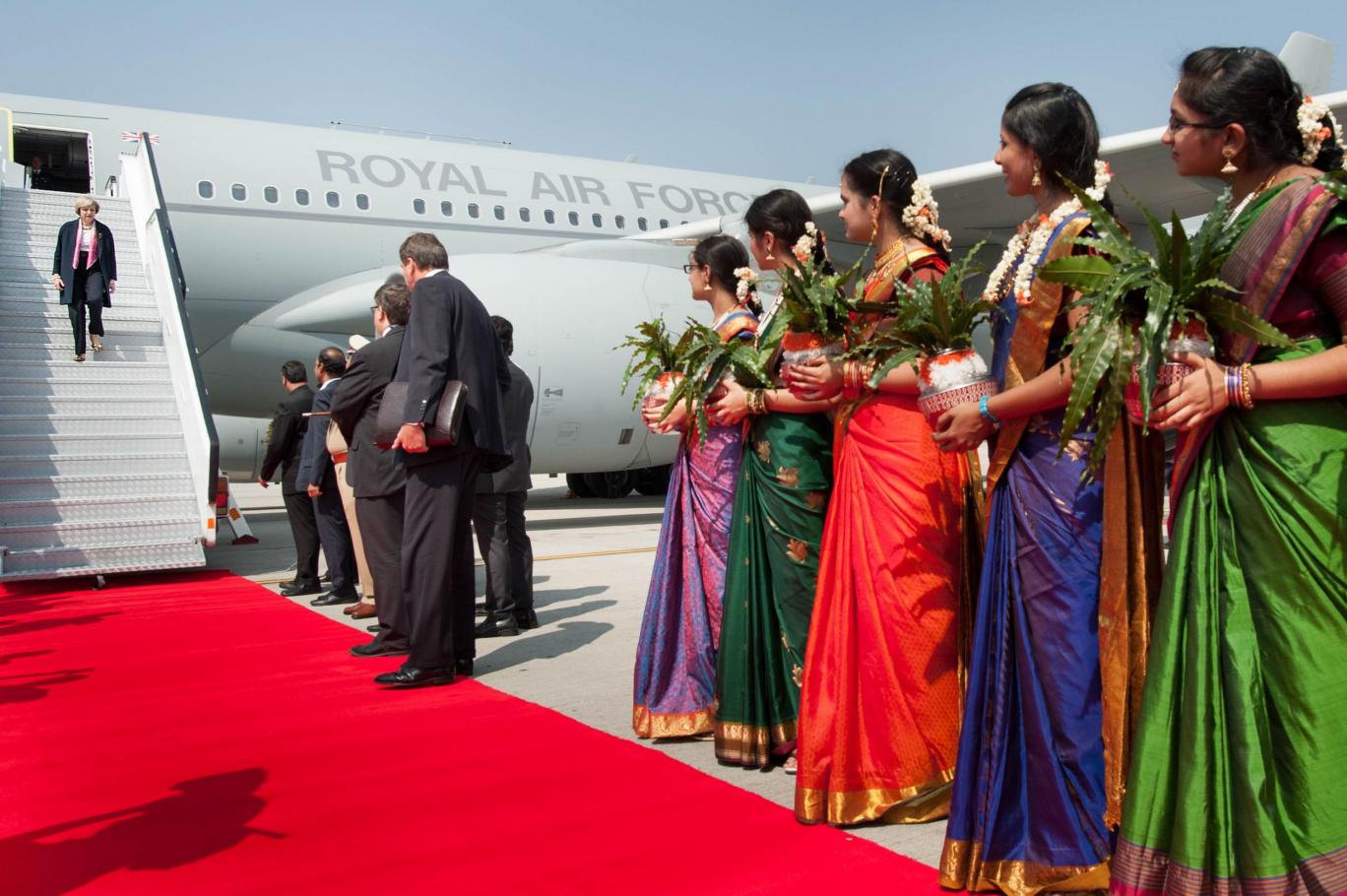
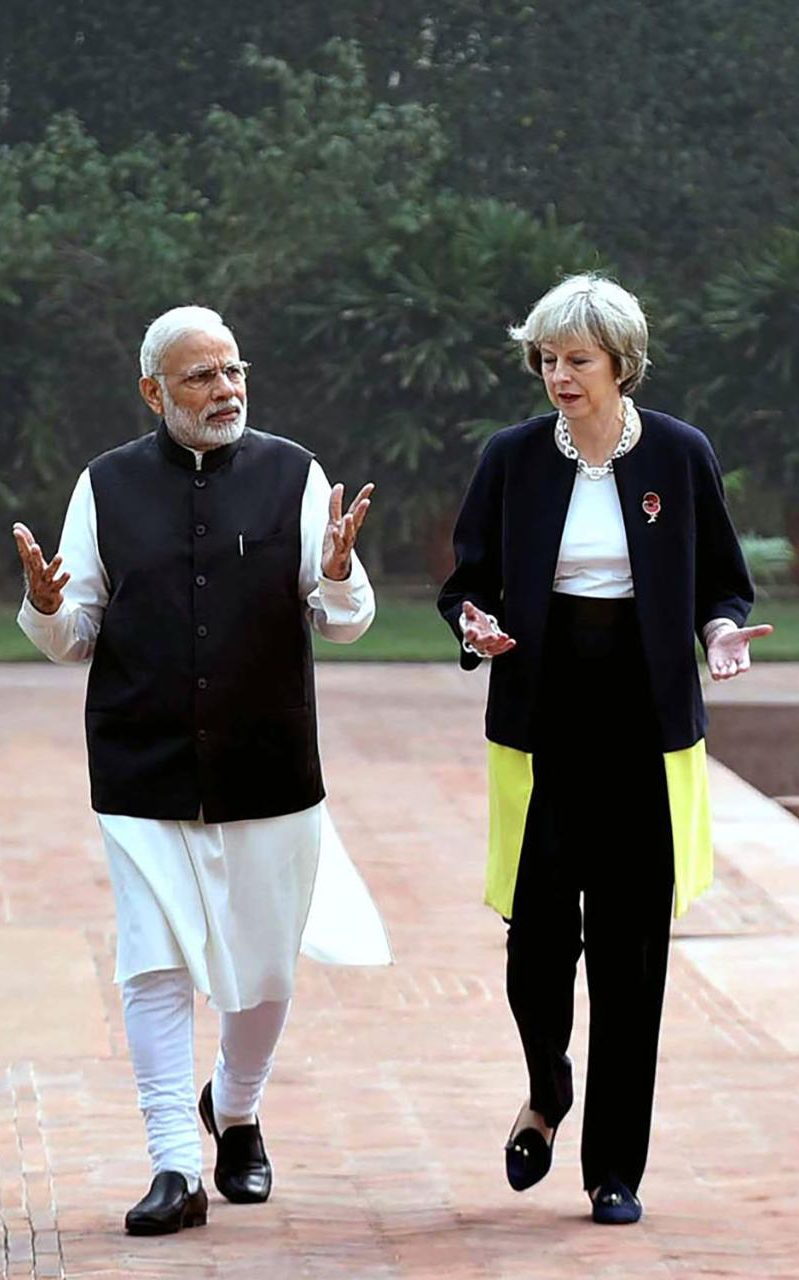
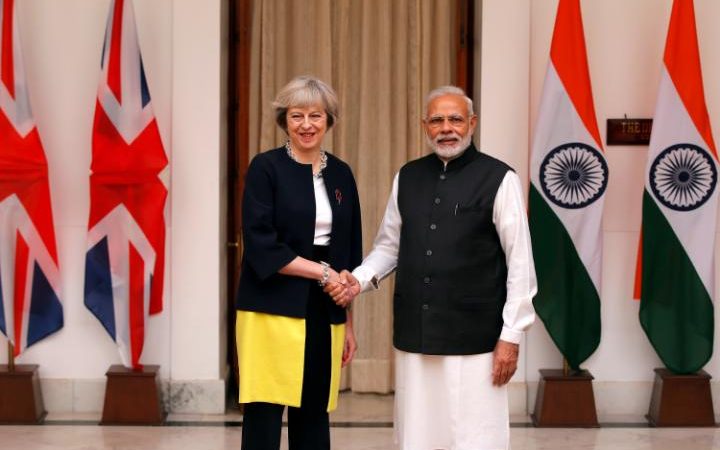
In her first bilateral foreign trip outside Europe since becoming the Prime Minister, Theresa May headed to India at the invitation of Indian Prime Minister Narendra Modi. The three-day visit between November 6 and 8 was also her first trade mission as the Prime Minister of Britain. The trip saw her travel to New Delhi and Bangalore accompanied by Dr Liam Fox, Secretary of State for International Trade, and Greg Hands, Chief Secretary to the Treasury. As she left India to return to the UK, she declared the trade mission a success in her drive to build “global Britain”.
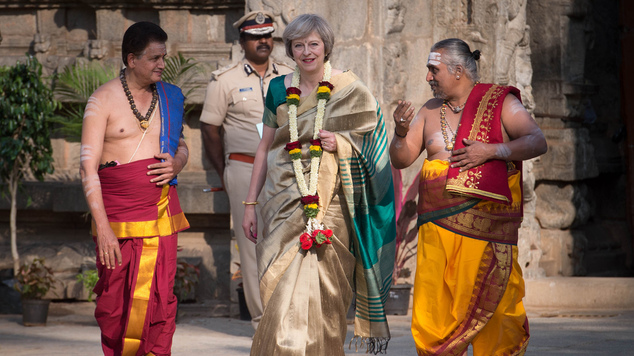
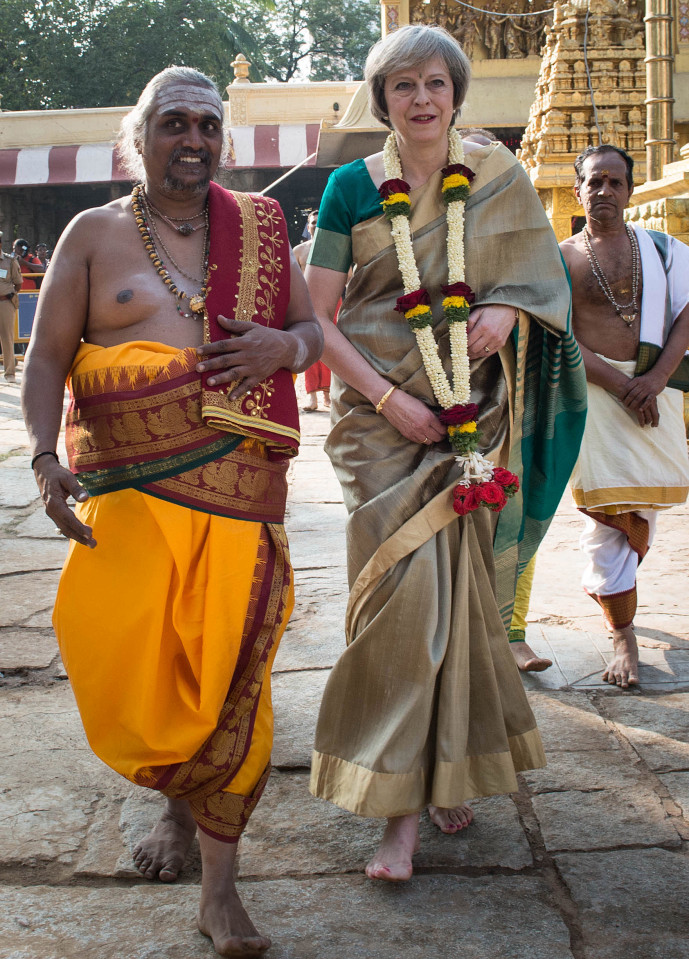
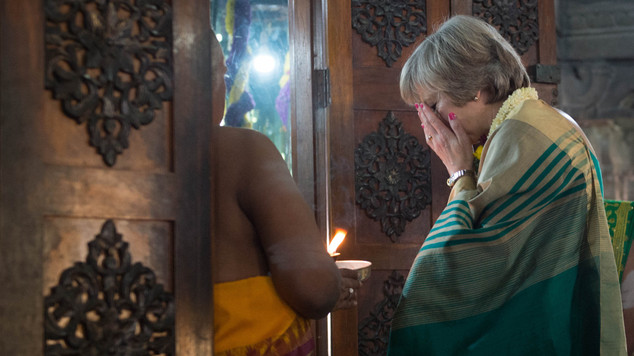
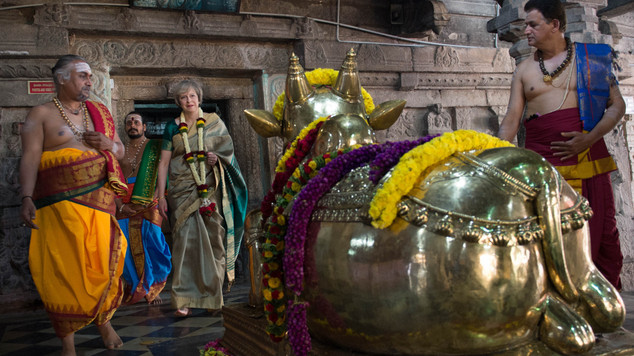
While in Bangalore, on the last day of her trip, Mrs May won hearts of million Indians, when she visited Sri Someshwara Hindu temple, donning a beautiful golden South Indian silk saree. She elegantly draped it over her shoulder with a contrasting emerald green silk blouse matching the geometric lines on the sari border. She had a garland of flowers placed around her neck when she arrived at the temple to the sound of musicians playing drums and horns. She impressed people as she walked around in the temple completely bare foot and participated in the Aarti (blessing) rituals with much faith. The Prime Minister drew her hands together across the top of the aarti flame (Deeya) and touched her eyes, in a traditional ritual. She was then given a Kumkum Tika (red power) to dab a single spot on her forehead. The Prime Minister toured the temple, built by the Chola dynasty (300 BCE–1279 CE), showcasing an impressive mixture of Chola, Hoysala and Vijayanagar architecture. Someshwara means “he who wears the moon on his head”, and is another name for Lord Shiva, one of the principal deities in the Hindu triumvirate.
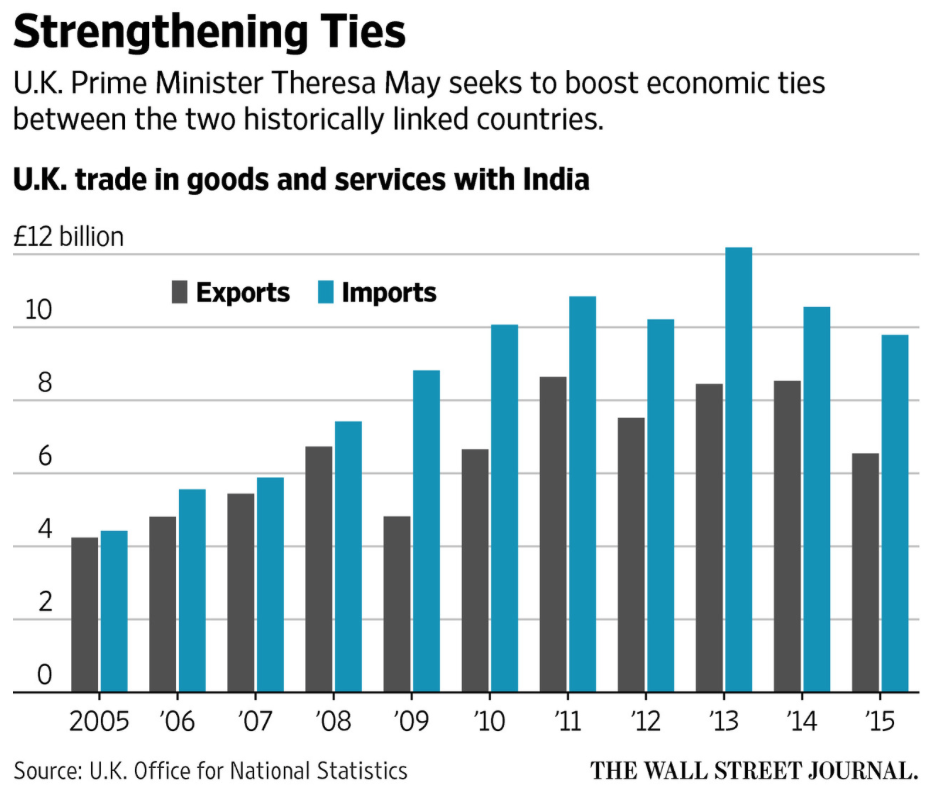
At a press briefing in 10 Downing Street before Mrs May had headed to India, the PM’s official spokesperson had outlined details of the visit to journalists. Being one of the fastest growing countries in the world, India was categorically chosen as PM May’s first bilateral destination to harness the potential, turning ambition into action. Although EU rules block the UK from entering formal negotiations on a free trade deal with India until withdrawal is complete, Mrs May has made it very clear she is determined to do the groundwork for an early post-Brexit agreement and to tackle barriers to trade which can be dealt with immediately.
The politicians travelled with 40 business leaders from the UK and met Indian business leaders at the India-UK TECH Summit 2016 in Delhi.
Speaking to Sky News at the end of her three-day visit, she said: “Leaving the EU presents us with a world of opportunities and I’m determined to seize them.
“That’s why I’m here in India, delivering on global Britain. And I have to say the response has been very good.
“During this visit, we’ve seen £1 billion worth of deals being signed and we’ve come to an agreement with the Indian government that we will work together with them on developing our trade relationship for the future.
“What does that mean? It means more jobs, more investment in the UK, more trade for British businesses and that’s good for everyone.”
Tension over visa
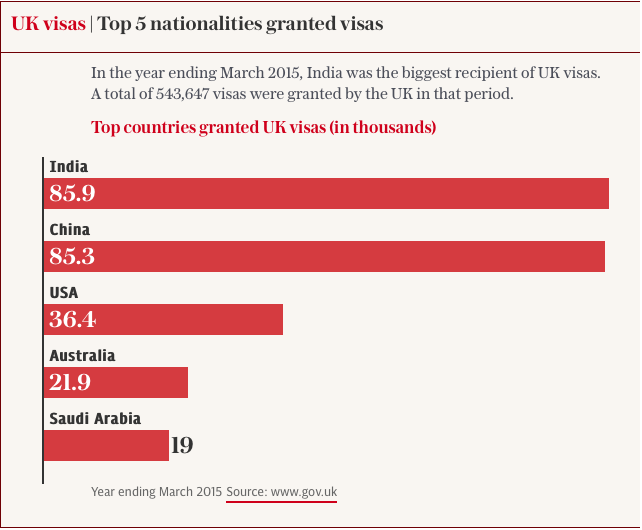
The first leg of PM May’s visit to New Delhi, India’s capital, was dominated by tensions over visas, with Indian PM Narendra Modi putting pressure on the UK to ease restrictions on students and skilled workers coming to Britain.
Mrs May reportedly announced new measures to make trips to the UK easier for senior business executives, and she offered to discuss improvements in the visa application process for Indian citizens in return for greater co-operation over the return of migrants who have overstayed their permission to remain.
But for the PM trade has been the priority, with deals sealed during the trip expected to create more than 1,300 jobs in the UK.
Mrs May issued a warning on Monday of the risks of stagnation and falling incomes if the UK fails to make a determined push for new trade opportunities after Brexit.
“As Britain leaves the EU, we’re determined not to turn our backs on the world but to forge a new, global, outward-looking role for ourselves,” she told a business summit in New Delhi.
“Because we know from history what happens when countries do not embrace the opportunities of the world –they stagnate, they get poorer, they don’t protect their people, they make them worse off.”
Mrs May said she had detected real interest in India in doing more trade with Britain after its departure from the EU, which she aims to complete by 2019.
She told ITV News: “The message I’ve had here is that people actively want to do business with the UK.
“The message I’m getting is that everybody wants to build on the trade relationship that the UK has with India. They see opportunities and benefits for India and the UK going forward.”
Modi called on Britain to support more Indian students who want to enroll at universities in the UK as he appeared alongside May at a technology summit in New Delhi. He said, “Education is vital for our students and will define our engagement in a shared future,” he said. “We must therefore encourage greater mobility and participation of young people in education and research opportunities.”
But she rejected calls to relax Indian visa rules, saying the UK has a “good system” for applications but could give ground if Indians who overstayed their visas could be returned more swiftly.
She said the UK was already able to attract “the brightest and the best” from outside the EU.
“Nine out of 10 visa applications from India are already accepted,” she said.
“The UK will consider further improvements to our visa offer if, at the same time, we can step up the speed and volume of returns of Indians with no right to remain,” she told reporters.
Her government also intends to make it easier for wealthy Indian business executives to come to the UK.
A small group of high-net-worth individuals and their families will be offered access to the Great Club – a bespoke visa and immigration service – to make visa applications smoother.
Thousands of Indians on work visas will also be able to join the Registered Travellers Scheme which will mean they can get through UK border controls more quickly.
“As we leave the EU, we want to ensure that the UK remains one of the most attractive countries in the world to do business and invest,” Mrs May said.
Her trip has seen memorandums of understanding signed on intellectual property rights and the ease of doing business in India, and she and Mr Modi agreed to co-operate on cyber-security and tackling violent extremism online.
Speaking from Delhi, London’s Deputy Mayor of Business Rajesh Agrawal, visiting Indian businesses and entrepreneurs to discuss investing in tech companies in London, said: “In the aftermath of Brexit it is more important than ever that companies in London and across Britain have access to the global talent they need to grow and create jobs and prosperity.
“If we are to make the most of the opportunities presented by Brexit then we need to be more open to highly-skilled workers from countries, including India coming to work for British companies.
“Of course we must and will do more to improve skills training for Londoners, but in sectors like financial services and tech, London has always benefited from the best of British and worldwide talent.
“Without access to skills, growth will not happen, jobs will not be created and Britain will be less prosperous than it could be.
“This is something the Prime Minister could do today to minimise the economic impact of Brexit and to create more jobs and prosperity across Britain.”
One of Britain’s richest men has criticised the government’s stance on visas for Indians, claiming that Theresa May’s tough talk on immigration risks souring trade relations, The Times has reported.
Gopichand Hinduja, 76, said that Theresa May’s visit to India to forge closer commercial ties and a bilateral trade deal after Brexit had been “overshadowed” by ill-judged remarks on the need to curtail visas for Indian visitors and students.
Mr Hinduja, who has lived in London since the 1980s and is a UK citizen, said: “I wish her advisers could have briefed her properly on all the concerns that India had . . . Unfortunately this visa problem has overshadowed her visit . . . She could have been better advised.”
Based in London, the Hinduja Group employs 70,000 people in 37 countries. Mr Hinduja, whose family’s $14bn fortune makes it Britain’s second richest, said that UK officials had not adequately considered India’s views on the issue, and the importance of fostering closer ties by encouraging Indians to study, work and invest in Britain.
“When you have to build closer relations with any country you have to think of their concerns,” he said, adding that the timing of an announcement last week on increasingly strict student visa rules was also a mistake. “It was the wrong timing. It’s unfortunate that only on Thursday [was] the announcement of tightening up of visas and the visit came on Sunday.”
Mr Hinduja said he was optimistic that Britain and India could build a more successful trade relationship based on common ties of history, language, law and culture, but the Brexit vote had dealt a significant blow to the UK’s reputation and generated uncertainty which was discouraging Indians from investing in Britain, he said. “[Wealthy] Indians always believed that London was a good hub because of language, law and the City. Unfortunately, because of these uncertainties that excitement has disappeared.”
In the five years that Mrs May was home secretary, the number of Indian students in Britain fell to 11,864 in June 2015 from 68,238. More than 400,000 Indians visited the UK in 2015 and spent almost twice the amount of the average visitors.
Rajesh Agrawal, who is also the chair of the Mayor’s promotional company London & Partners, is on a seven-day visit of Indore, Delhi and Mumbai, to meet key investors and to reinforce the message that London is open to investment, trade and talent.
Lord Beith called on the Prime Minister to use her trip to India to raise the plight of imprisoned UK veterans. Six former soldiers have been held in an Indian jail in dire conditions whilst a string of appeals have been delayed by the Indian justice system. They were all working on a ship offering protection to commercial shipping against pirates operating in the Indian Ocean and are appealing convictions for possession of illegal arms.
Environmental experts however have predicted that Mrs May’s life expectancy may have reduced by a few hours because of Delhi’s post Diwali air pollution, that has been affecting the health of locals for a few days now.
May reaches the tech-capital of India
In Bangalore, she visited a Dynamatic Technologies factory where Indian workers assemble components machined in the company’s Swindon and Bristol facilities for Airbus jets. Worth up to £120 million to the UK economy over a 10-year period, the contract creates 60 new jobs across Dynamatic’s two UK sites and 100 jobs at their Bangalore site.
Udayant Malhoutra, CEO & Managing Director, Dynamatic Technologies, said: “Our facilities in the UK & India are able to provide Global Best Value to Airbus, with the manufacture of complex parts at our factories in Bristol & Swindon, along with artisanal craftsmanship and assembly at our facilities in Bangalore. We are grateful for the support we have always received from Her Majesty’s Government, and take great pleasure in welcoming Prime Minister Theresa May to our factory at Bangalore.”
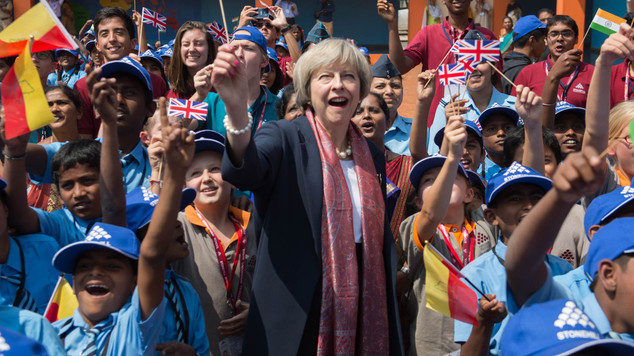
After that she joined flag-waving children at the city’s Stonehill Primary School to witness a flypast of Indian Air Force jets and helicopters in her honour. The Stonehill Government Higher Primary School was started as primary school in 1942, with 45 students. The school now has around 350 students, half of which are girls. The school teaches in Kananda, and English is taught from age 12.
The flypast was the first of its kind offered to a visiting head of government, and follows a similar display by the Red Arrows during Modi’s visit to the UK last year.
She later welcomed plans for the Science Museum in London to host a season of exhibitions and events dedicated to Indian innovation next year as part of the UK-India Year of Culture 2017-18.
Mrs May said: “This celebration of India’s rich culture and history of innovation is another clear demonstration of the close ties between our two countries.”
=====
The British PM enjoys a ‘curry’ lunch
On 7th November, Mrs May was served a multi-course Indian banquet for her working lunch with Prime Minister Narendra Modi. The two prime ministers took a break out of their busy schedule to enjoy lunch.
Among the delicacies on offer for the sumptuous feast at Hyderabad House in New Delhi was a pudding course garnished with gold leaf.
The full menu
Appetiser
Kumbh Galouti Nazakat with Burhani Jhag and Chutney Soil
Starters
Mahi Dariya (fish marinated in buttermilk)
Silbatte Ke Shammi Kebab (pan grilled lamb)
Paneer Angaar (cheese kebab)
Hara Kebab (spinach)
Soup
Pista Shorba (pistachio soup)
Mains
Jhinga Dum Nisha (prawns in spiced cream)
Murgh Handi Qorma (chicken in onion gravy)
Guncha wa Kheema (cauliflower florets)
Dal Maash Qaliya (moong lentils with spinach)
Dumpukht Gosht Biryani (lamb with basmati rice)
Paneer Dum Anari (cottage cheese with pomegranate)
Dum Ki Bharwan Gucchi (mushrooms)
Kathal Dum Biryani (jackfruit with rice)
Desserts
Shahi Tukra (fried bread with java berry, saffron and pistachio)
Kulfi Badshah Pasand (cardomon ice cream)
Phirnee (rice pudding with gold leaf).
=====
Science Minister announces £80m UK-India research investments
The UK Science Minister has announced a series of research programmes from the Newton Fund worth up to £80 million to address global challenges affecting people in India.
The new programmes take the total joint UK-India investment in research through the Newton Fund up to £200 million by 2021, demonstrating the Fund as a major bilateral initiative in India. It brings together the world class excellence of the UK and India to address global challenges through science and technology.
A number of the new UK-India Newton Fund programmes that were announced at the Education, Science and Innovation Futures event on 8 November were:
- £16 million programme to support commercially focused research and development partnerships that bring innovative biotechnologies to market for cleaning, processing and using industrial waste streams (Research Councils UK - RCUK).
- £8.4 million programme to improve water quality (RCUK).
- £7.4 million programme on energy demand reduction in the built environment to improve health and well-being and lower energy costs for building users (RCUK).
- £12.6 million launch of phase 2 of Global Research Programme in Women and Children’s Health between the UK and India to study reproductive health issues facing women and their unborn children in low and middle income countries (RCUK).
- £13 million UK-India research programme to strengthen the global fight against anti-microbial resistance, announced during the opening of the first RCUK-DBT Strategic Group on AMR on 9 November (RCUK).
During the event, Jo Johnson also launched the first annual £1 million Newton Prize, which will recognise the Newton Fund’s best science or innovation that promotes the economic development and social welfare of partner countries. For 2017, the Prize is open to existing Newton Fund programmes in India, Malaysia, Thailand and Vietnam which focus on the challenges of public health and well-being, covering issues such as, anti-microbial resistance, disease, healthcare, and nutrition.
The Minister also celebrated a significant programme to digitise the vast wealth of Indian printed books held by the British Library dating from 1713 to 1914. Two Centuries of Indian Print – a British Library project funded by the Newton Fund through the Arts and Humanities Research Council (AHRC) – have been extended to digitise an additional 3,000 books from the collection, meaning that 4,000 early Bengali books will be digitised and made accessible to researchers around the world.