Britain’s wealthiest individuals are increasingly being judged not only by the fortunes they accumulate, but by the causes they choose to support. This year’s Giving List, published alongside the Sunday Times Rich List, offers a revealing glimpse into how philanthropy is evolving among the country’s billionaire class and where British Asian donors fit within that changing landscape.
At the very top stands hedge fund billionaire Sir Chris Hohn, who became the first British philanthropist to donate more than £1 billion in a single year.
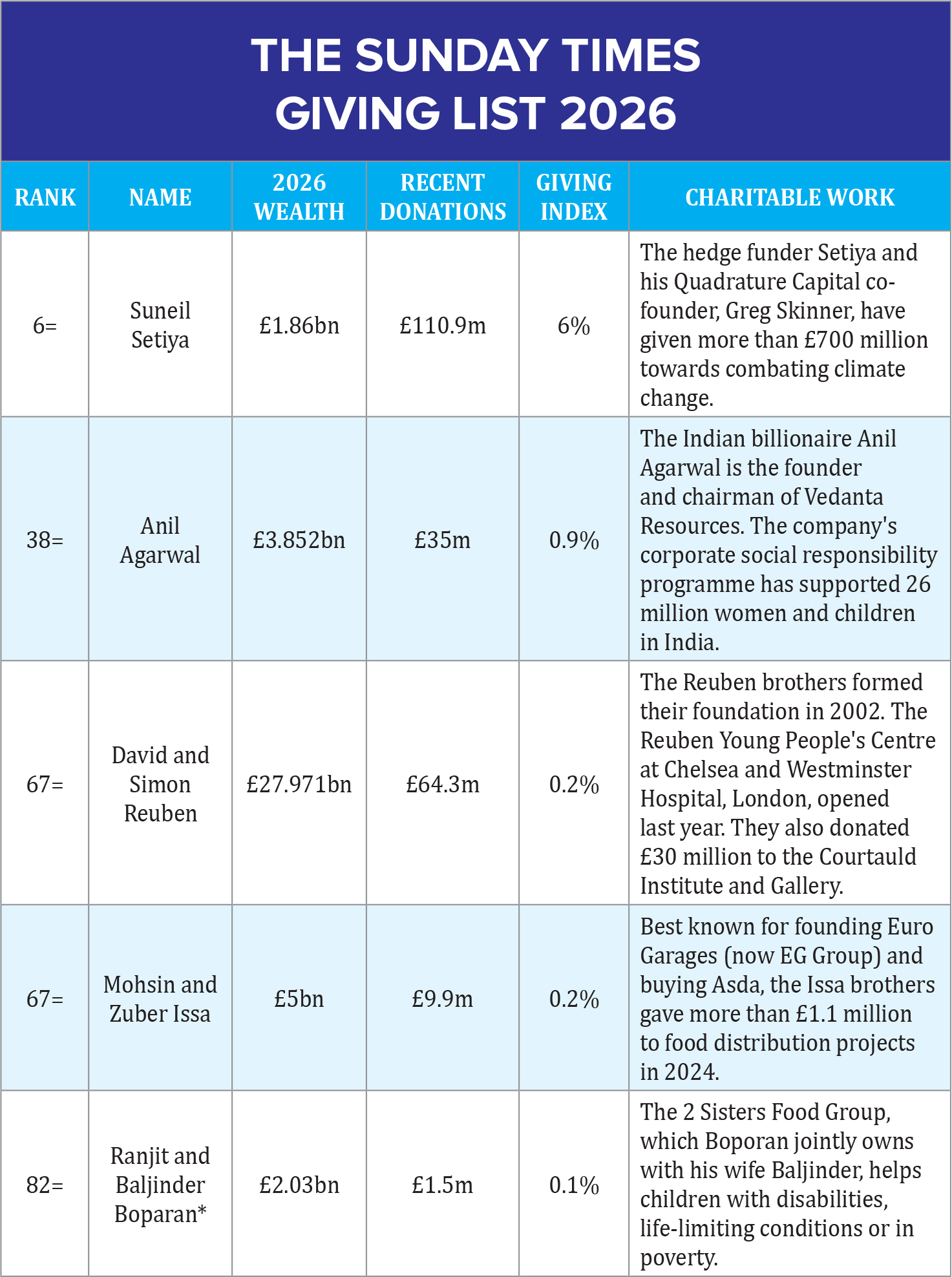
Among British Asian billionaires, the figures reveal a mixed and highly uneven philanthropic landscape. Of the 22 British Asian individuals and families featured across the Rich List rankings, only five appear prominently on the Giving List and even among them, the scale of giving varies dramatically.
Leading the group is hedge fund manager Suneil Setiya, ranked joint sixth on the Giving List. With an estimated fortune of £1.86 billion, Setiya donated £110.9 million, equivalent to around 6% of his wealth, the highest proportional contribution among British Asian philanthropists on the list.
Further down the rankings, Anil Agarwal, founder of Vedanta Resources, donated £35 million, around 0.9% of his £3.85 billion fortune. While modest compared with Setiya’s proportionate giving, Agarwal’s philanthropic footprint remains extensive through Vedanta’s social responsibility programmes, which the company says have supported millions of women and children across India.
The Reuben brothers, David and Simon, despite commanding one of the UK’s largest fortunes at nearly £28 billion, donated £64.3 million, representing roughly 0.2% of their wealth. Their giving has focused heavily on institutional and cultural philanthropy, including healthcare projects and a £30 million contribution to the Courtauld Institute and Gallery.
A similar pattern appears with Mohsin and Zuber Issa, founders of EG Group and former owners of Asda. The brothers donated £9.9 million, approximately 0.2% of their £5 billion wealth. Much of their giving has centred on food distribution and community-based support initiatives, reflecting a more localised charitable approach.
At the end of the rankings are Ranjit and Baljinder Boparan, whose £1.5 million in donations accounts for around 0.1% of their estimated £2.03 billion fortune. Through the charitable work linked to 2 Sisters Food Group, their philanthropy has focused on supporting children living with disabilities, life-limiting illnesses and poverty.
What emerges is not a single model of giving, but a broader transition. Older traditions of quiet philanthropy are increasingly colliding with a newer expectation that wealth should carry visible public responsibility.
Mark Greer, managing director of the Charities Aid Foundation, which supports the Giving List, argues that visibility matters. Britain’s wealthy, he suggests, have traditionally been more discreet about charitable giving than their American counterparts. Yet public philanthropy can create a ripple effect, encouraging others to follow suit and helping to normalise large-scale giving.