For the first time, this November, the internationally renowned Aga Khan Music Awards will arrive in the UK, unfolding across a four-day festival from 20–23 November, coinciding with the closing weekend of the EFG London Jazz Festival.
What audiences will encounter a sweeping artistic vision that challenges dominant narratives about the East and reasserts its historical role as a cradle of innovation, beauty and imagination. The Aga Khan Music Awards, established in 2018 by the late His Highness Prince Karim Aga Khan IV and his brother Prince Amyn Aga Khan, honour musicians and cultural practitioners who sustain and reimagine musical traditions shaped by the East.
Beyond the prestige, winners receive professional development support ensuring that living heritage continues to evolve rather than stagnate. This year’s programme celebrates artists from Asia, Africa, and the Middle East, spotlighting remarkable figures who preserve centuries-old traditions while pushing them into new sonic realms.
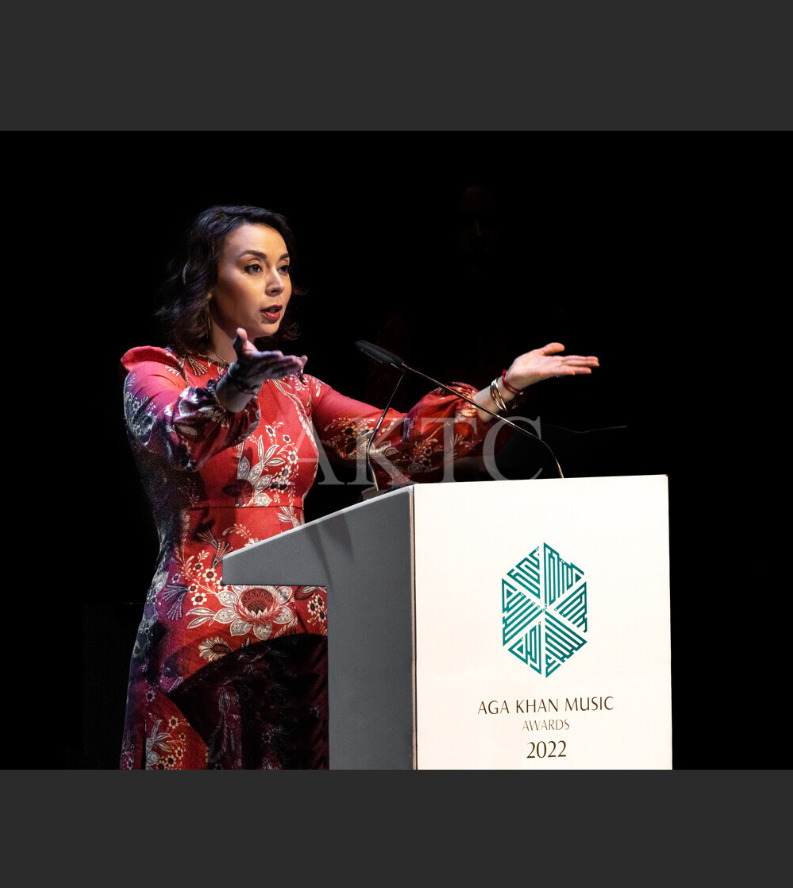
In this interview, Fairouz Nishanova, Director of the Aga Khan Music Awards, reflects on the ethos of the Awards and the vision behind their landmark London debut.
Excellence inspired by the East
“The Music Awards were created to celebrate excellence that comes from the East,” Nishanova said. “His late Highness was deeply concerned that 99% of what we hear about the East is negative- poverty, conflict, crisis. In this kaleidoscope of negativity, we forget that the East has historically been the birthplace of extraordinary creations: architecture, poetry, music, astronomy, medicine. It was, and still is, where the world looks for inspiration.”
The Aga Khan Music Programme began in 2000 as an education initiative. At the time, artists across Central Asia could no longer create new music rooted in their traditions because the master–apprentice system had collapsed. Rebuilding musical education became the first mission. That evolved into global concerts, high-quality recordings, and finally, the commissioning of “East–East” creative encounters that reconnected musicians whose cultural links had been disrupted by politics or borders.
“But many artists still fell outside our geographic reach,” she explains. “Diaspora communities in the West needed a broader framework of support and that’s how the Awards emerged as the final pillar.”
London as a stage for shared heritage
This year marks the first time the Awards will take place in London, within a major international festival. “I wanted to host this edition in a country that lets émigré music flourish despite whatever is happening in the world today, which is very scary. It needed to be in a place that lets all these voices speak out loudly.” said Nishanova.
“I had a dream of doing the Awards against the backdrop of a large festival, and opening it up to audiences who would never otherwise have access to this kind of music. London Jazz Festival has embraced us, giving us their stages while letting us bring our own content”, she added,
The result is a programme that spans West Africa to the Eastern Mediterranean, bringing together musical lineages that rarely share a stage; particularly as many come from regions currently in conflict.
Artists such as Soumik Datta and the Warsi Brothers exemplify the breadth of this year’s vision. Soumik, a 2022 award recipient, reinvested his winnings into work with émigré and Indian communities, producing new forms that London audiences will now witness. The Warsi Brothers, bearers of a 700-year-old Amir Khusrau lineage, will perform in the UK for the first time, carrying with them the roots of qawwali and khayal.
“What we present is an extraordinary cluster of musical journeys and proof that music remains the one medium through which cultures can unite”, says Nishanova.