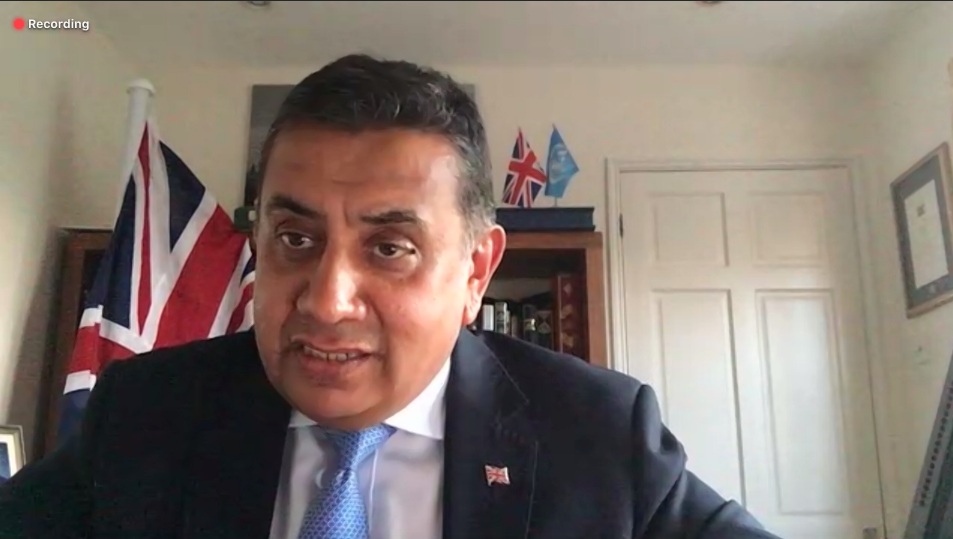
To discuss the importance and relevance of the Commonwealth and what it can do now that the UK has left the EU, a Conservative Policy Forum was recently hosted by Conservative Friends of India with the Conservative Friends of the Commonwealth. Lord Tariq Ahmad of Wimbledon (UK Minister of State Foreign Office at Department for International Development - South Asia, Commonwealth,United Nations PM's Envoy Preventing Sexual Violence- Minister for Human Rights) spoke extensively about burning issues and the mission of the Commonwealth in strengthening the UK-India ties.
Lord Ahmad spoke about the current pandemic and his work with India during these times. He said, “In the context of the Commonwealth, we were one of the few organisations that very quickly and rapidly put out a statement of joint action in collaboration to actually meet the challenge of Covid-19. We worked on the issues of repatriation of 17-18 thousand people within six weeks with the government of India and in a massive effort. We received incredible cooperation by the Indian authorities.” He further stated that India is on a mission to make more than one billion vaccines, which underlines the strength of the country within the Commonwealth. “India is often referred to as the pharmacy of the world and that’s really come to light in the pandemic that we’re facing currently,” he said.
Immigration: Come to Britain, word hard and move the country forward
Lord Ahmad was asked if he’s seen a change of mood in the country because there have allegedly been a lot of antagonism towards immigration and that many people haven’t understood the socio-economic and cultural benefits of welcoming immigrants. According to Lord Ahmad, there’s been an upward trend in Indians students coming to the UK and he reiterated that they can come and work in the UK after finishing their studies. “The ability to stay on and not worry about the immediate issues of the pandemic or visa running out,” is what he aims to offer when it comes to immigration policies. “In very practical terms, there are tools available to us. We need a visa regime which is agile, dynamic and responsive. I’m certainly pushing the case of how we can liberalise certain categories of visas, especially business visas, to allow free flow of trade with other parts of the Commonwealth,” he said.
Taking the opportunity to further affirm his beliefs, Lord Ahmad said, “Who’d have thought that here in 2020, 20 years ago or 25 years ago, even 15 years ago, that a conservative government would have Patel, Sharma, Sunak and Javid and no one would blink an eye? I’m very proud of what immigration has brought to our country.”
He added, “As a migrant who is willing to come to our country, they can roll up their sleeves, get a job in Britain and move the country forward. Britain’s always been a place which welcomes people who are working and willing to work harder and remains so. I’m proud that we are in 2020 and without boasting about it we have achieved levels of integration where we celebrate diverse cultures and communities and people are free to practice their faith in whatever way they choose to. I think sometimes we underestimate the strength of what we’ve achieved. That doesn’t mean we’ve done so without problems and challenges. Those remain. But when you reflect and travel around the world and return back home, I actually say, Thank God I’m British. Thank God I live in Britain.”
The Living Bridge
In reference to climate change, he sees a real potential of collaborating on this aspect and working closely for the larger benefit of the global community. Talking about India’s PM, he said, “Prime Minister Modi coined the term, ‘The Living Bridge’ and I think the living bridge is very alive in between the UK and India. That living bridge is extended over the strengths we find in the Commonwealth family. The educational links, community links, business links, cultural links are not being emphasised enough. So I think in the post Brexit world, the opportunities are huge. I’ve already seen the benefits of how countries are working and leveraging the opportunities. There’s much more to be done in terms of how we look at visas, especially business visas of how we allow trade to take place but the Commonwealth community allows for huge changes to take place in India is a living working example of potential that lies ahead.” He also stated that let’s not forget, we are a permanent member of the UN Security Council, NATO and other international organisations like the G7, G20 and more. He said that he is looking forward to working with India in the context of them joining the UN Security Council for two years at the start of next year. He also said that the Commonwealth office has sought through this merger to empower High Commissioners and ambassadors.
Sharing his point of view on the abolition of Article 370 in India and its economic impact, he said, “India’s act of abolishing Article 370 has raised interests in different quarters for different reasons.” Calling it a “very much an internal matter for the Indian government” he said that it now allows for greater levels of investment and for raising the bar in terms of education, investment into Ladakh and Kashmir. He accepted that while the situation in Kashmir is still challenging in terms of human rights, the CW office will “raise its concerns privately, bilaterally and constructively”.
“India is a democracy and it fulfils its obligations in communities. India represents a sort of a micro version of what the commonwealth is all about and brings different people, communities and faiths together for a single purpose. I believe very strongly, that our relationship with India is not just with the federal government but also with state governments to look at what the different opportunities are within different states and to ensure that we understand them fully and that we address them appropriately. I believe that it’ll provide good returns for the UK,” said Lord Ahmad.
India-China border issues
“I think we have to stand very firm. China is a strategic partner but at the same time we’re upholding all the rules laid by the international system (the UN security council). It is important to recognise that China is an important partner to the UK, but as recent events have shown in Hong Kong and internally in China and the tension on borders with India, we need to be very firm in strengthening alliances and also the UK voice for standing up for the rules based international system.”