Once upon a time the left Front government headed by the Communist Party of India (Marxist) was so powerful in the West Bengal that the Congress Government headed by Chiman Patel in Gujarat and the RSS-run Rambhau Mhalgi Prabodhini headed by Pramod Mahajan, the strongman of Bharatiya Janata Party(BJP) in Vajpayee era, were sending study teams to grasp the magic of holding power. Jyoti Basu could run the leftist government for more than two decades in his home state. Even when the Soviet block was crumbling, the Marxists continued to rule over the Writers’ Building in Kolkata which was the centre of British power till 1911 when the capital was shifted to Delhi. Right from 1977 till 2011, for more than three decades, the Marxists could call the shots. Only in 2011, Mamata Banerjee, the Trinamool Congress supremo, known as the Tigress of Bengal, could demolish the Communist hold like a house of cards. She could re-establish her hold on Bengal again and again in the Parliament, the Legislative Assembly and even in the Local bodies’ election in 2014, 2017 and 2018 respectively. Now all eyes are set on Ms Banerjee since the Bharatiya Janata Party of Prime Minister Narendra Modi is all out to defeat her in next elections of Parliament and Assembly.
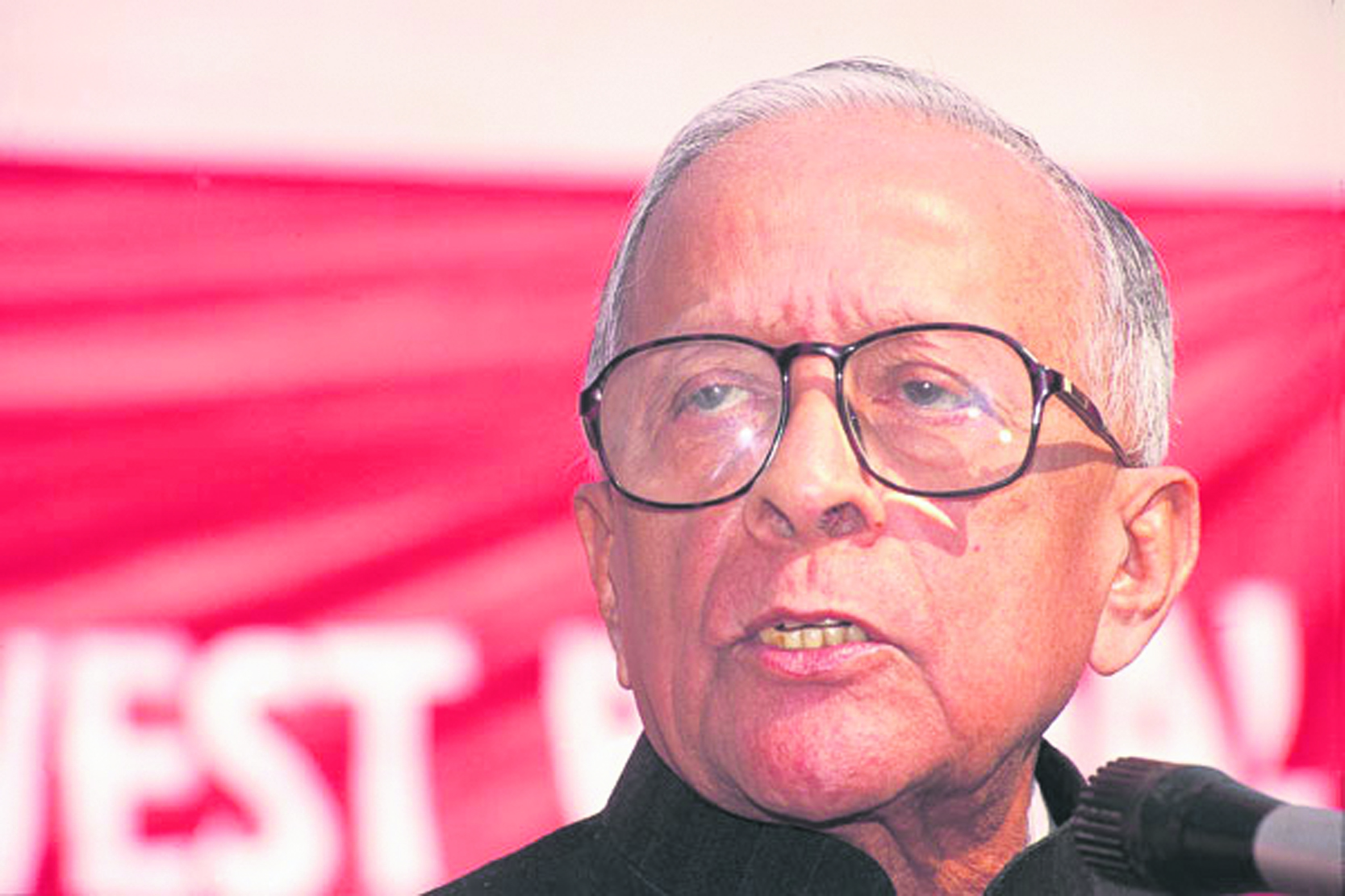
Jyoti Basu(8 July 1914-17 January 2010) got enrolled in the Middle Temple “but, honestly, my heart was not in it” as he confessed once. Hailing from an affluent Bengali family i.e. Bhadralok, his communist vision took roots and blossomed attending weekly lectures delivered by Professor Harold Laski at the London School of Economics sometimes around 1936. Surabhi Banerjee, his biographer in her book “Jyoti Basu: The Authorised Biography” records: “In 1930s, time was out of joint all over the world. There was turmoil in Europe as one country after another fell prey to ethnic hatred and dictatorship: in Italy it was Mussolini and his Fascists, in Germany it was Adolf Hitler and his Nazis, in Spain General Franco and his Falangists. Nazism was spreading its tentacles across Eastern Europe and Hitler openly supported General Franco in his bid to overthrow a democratically elected government. The only country that stood like a solid, impenetrable wall against the surge of aggressive fascism was the Soviet Union ruled the iron hand of Joseph Stalin.” Basu started participating in the anti-fascist movements in Britain, joined the London Majlis which, like the Oxford and Cambridge majlises, was an organization of London students agitating for Indian independence. In 1938, he was put in charge of arranging receptions and meetings for Pandit Jawaharlal Nehru.
Jyotida alighted at Bombay harbor on the first day of 1940 after four years and two months abroad. Instead of going straight to meet his parents in Kolkata, he preferred to visit the headquarter of the Communist Party office at Mumbai and stayed for three days. He started organizing the workers on reaching his hometown. Later was selected as a PCO(provincial committee organizer) following the first legal congress of the Communist Party of India(CPI) in 1943. He became a popular face in the communist circles drawing just Rs.1200 per month as a full timer. Basu continued to be a full timer even after his marriage. He was elected to the Assembly on CPI ticket. On 31 August 1959, as a part of the Food
Movement, when he was leading the Kisan Sabha procession of thousands of farmers to Writers’ Building, the police, without giving warning, started beating the people and without firing a single bullet killed 80 people using the lathis. This was a turning point in his life. Raising the issue in the Assembly, cornering the Congress government, comparing it with Jallianwalla Baug massacre, Basu created hell for the government.
In 1962, when China attacked India, the Communist Party refused to call it an attack and faced internal as well as external rift. In 1964, following the ideological struggle, pro-China Communist Party of India (Marxist) took shape parting way with the CPI. Basu could become the Deputy Chief Minister twice in the Ministry headed by Ajay Mukherjee of the Bangla Congress in 1966 and 1969. Siddharth Shankar Ray, the last Congress Chief Minister, paid for his ill advised imposition of the Emergency in India during 1975 and 1977, which not only made Smt. Indira Gandhi loose her Premiership but also got her defeated from Raebareli, her own constituency. It was death-nail for the Congress in the WB too. In June 1977 Assembly election, the CPI(M) headed Left Front won 243 seats out of 294 member West Bengal assembly. Till November 2000, Basu continued as the Chief Minister winning all the assembly elections. His successor Buddhadeb Bhattacharya could win only two assembly elections i.e. 2001 and 2006 and lost to the most aggressive Mamata in 2011. Basu had a chance to take up the responsibility of the Prime Ministership in a coalition government in 1996 but his party did not allow him to be the Prime Minister, paving way for H.D. Deve Gowda to be the PM. This was a biggest blunder on the part of the Politburo of the CPI(M).
Basu could manage to take the entire left front with him and people of Bengal on his side. The secular credentials and corruption free regime continued to be darling of West Bengal. Of course, as a rough and tough Chief Minister, Basuda had to get the Naxalites eliminated who took arms and went on killing spree. During the Communist regime, the West Bengal suffered on the Industrial front since the leftist labour unions created scare in the minds of the industrialists. Every sector was politicized and only the Communist network could call the shots everywhere including the allocation and spending of the budget from the metropolis to the country side.
When Pranab Mukharjee, who retired as the President of India, was the President of the West Bengal Congress Committee, the firebrand Youth Congress President Mamata Banerjee was declined entry to Rajya Sabha. She left the Congress to establish her own All India Trinamool Congress in 1998, accusing the state Congress leaders dancing to the tune of the leftist and launched various agitations challenging the Communist regime. Initially, Ms Banerjee joined the National Democratic Alliance (NDA) and became the Union Minister in Vajpayee government. Later, she joined the United Progressive Alliance (UPA) headed by the Congress leader Dr. Manmohan Singh and withdrew her support. Though she is known for her simplicity, at times she becomes difficult due to her tantrums. Known as Didi, unmarried Mamata is a celebrated poetess and a painter. She easily gets associated with people. Her aggressive temperament and secular credentials make them feel that she provides the only alternative to fight for their cause.
Correction: Inadvertently, in the last column (4 August 2018), instead of the picture of G.Parthasarathy, the first Vice Chancellor of JNU, the picture of another G. Parthasarathy, who is also former diplomat, was published. The error is regretted.
Next Column: The Assam King repeatedly defeated Mughals
(The writer is a Socio-political Historian. E-mail: [email protected] )