In the wake of the Finsbury Park Mosque terror attacks, the police have pledged to step up patrols around Muslim places of worship.
Speaking to Mohammed Mahmoud, the imam at Finsbury Park, PM Theresa May said on Monday: "This was an attack on Muslims near their place on worship, and like all terrorism, in whatever form, it shares the fundamental goal to drive us apart; and to break the precious bonds of solidarity and citizenship that we share in this country. We will not let this happen."
London Mayor Sadie Khan reassured that extra police have been deployed and said police were already "working their socks off."
Labour leader Jeremy Corbyn said "The only way to deal with this kind of issue is communities coming together ... We have to protect each other's faith, each other's way of life, and that's what makes us a strong society and community."
But despite the odds, Muslims in Britain are getting ready to celebrate one of their main festivals of their faith, the Eid al-Fitr.
Every year across the globe Muslims gather together to celebrate Eid as the month-long fasting of Ramadan comes to an end. Eid kickstarts the month of Shawwal, which begins with a feast to end the period of fasting.
Eid al-Fitr, a term that translates from Arabic, is the “festival of breaking the fast” with friends, relatives and family, and is celebrated whole-heartedly when the entire Muslim community come together. This year, Eid will take place on 25 or 26 June. As the Islamic calendar is based on the lunar cycle, the day is set when we get to see a new moon. In Urdu, the phase "Eid ka chand" epitomises the significance of the new moon, to the festival of Eid.
CELEBRATING EID
Eid is the most important festival of the Muslims and is celebrated with much fanfare between one to three days all over the world. During Eid, Muslims buy new clothes, and take part in festivals and celebrations. They wake up early to pray at a mosque, and often at an outdoor prayer venue.
There are special celebratory meals that are shared with family and friends. Gifts and cards are often exchanged among friends and family. The younger members often go around collecting small amounts of money from elders (Eidi) to top up their pocket money.
The phrase commonly used by Muslims to wish each other is “Eid Mubarak”, which is Arabic for blessed Eid. Those celebrating the festival greet each other with this phrase throughout the day.
EID CELEBRATIONS AT TRAFALGAR SQUARE
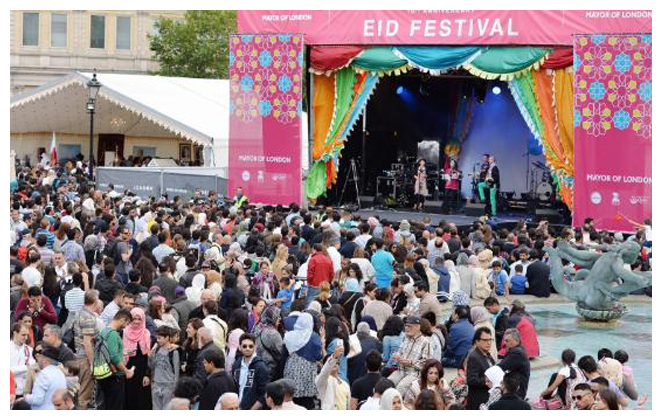
This year, everyone has been invited to come and celebrate Eid on Trafalgar Square on Sunday 2 July. Thousands of Londoners and visitors come to this free event every year to celebrate the end of Ramadan and enjoy an array of entertainment, delicious food and have some clean family fun.
Thousands of Londoners and visitors come to this free event every year to celebrate the end of Ramadan and enjoy an array of entertainment, delicious food and family fun.
* There will be contemporary and traditional acts from across the world at Eid. Stay tuned for some very exciting announcements.
* The stalls at the Global Food Market will be serving the best spread from Moroccan to Malaysian, Indian to Middle-Eastern and help you cool off with refreshing lassies and shakes.
* The stalls will also help you explore the make-shift market with clothing, jewellery, arts, crafts and books from London's talented artisans and creatives.
* There will be lots for families to do at the square - creative kids will love participating in story telling, endulge in art workshops, face painting and can even have a temporary henna tattoo!
KNOWING THE DIFFERENCE BETWEEN EID-AL-FITR AND EID-AL-ADHA
There are two Eids every year, Eid-al-Fitr that translates to “festival of breaking the fast” and marks the end of the month of Ramadan, and the Eid-al-Adha, which takes place two months later, coinciding with the annual pilgrimage to Mecca; also known as the “sacrifice feast” and honours Prophet Abraham's sacrifice of his son Ishmael, as an act of submission to God's command.
The celebration revolves around when Allah appeared to Ibrahim in a dream and asked him to sacrifice his son, Ishmael, as a sign of his faith.
It’s similar to the Christian and Jewish stories in which God asked Abraham to sacrifice his son Isaac, but spared him from doing so. During this time, Muslims traditionally sacrifice animals, in Britain this is done in slaughterhouse, and the meat is divided up among friends, family and the needy.
The celebration is a public holiday in many Muslim countries, but is not one in the UK. This year, Eid starts on Sunday June 25, with the Shawwal month ending around a month later.
We wish all our readers and those celebrating Eid this year a blessed 'Eid Mubarak'