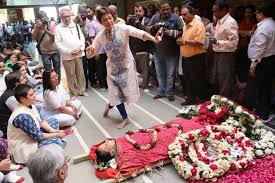
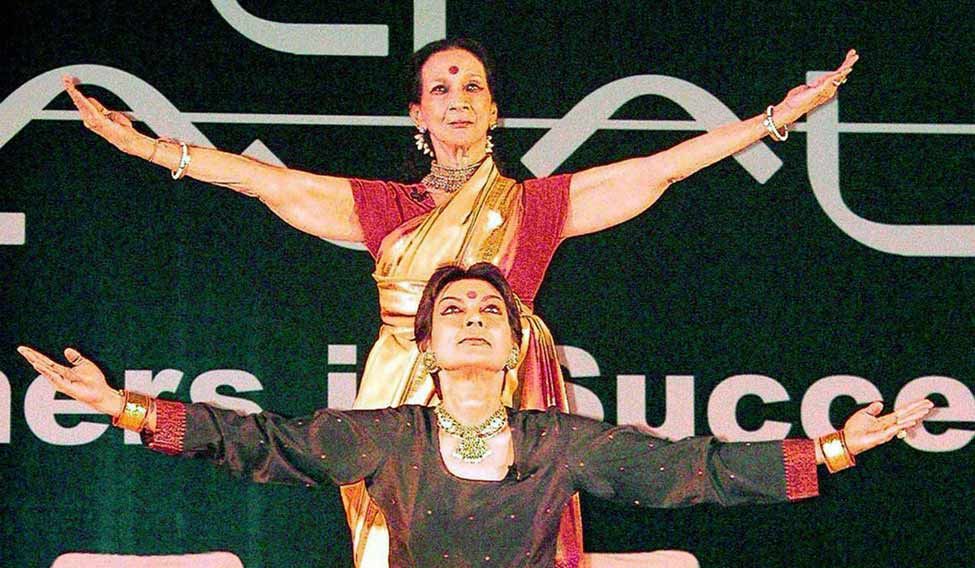
Take a look at this picture closely. This is no ordinary dance recital. This is an image people won’t forget for a long time to come. I have seen girls dancing at weddings, but never seen a daughter dancing at her mother’s final farewell – that too with so much poise and grace.
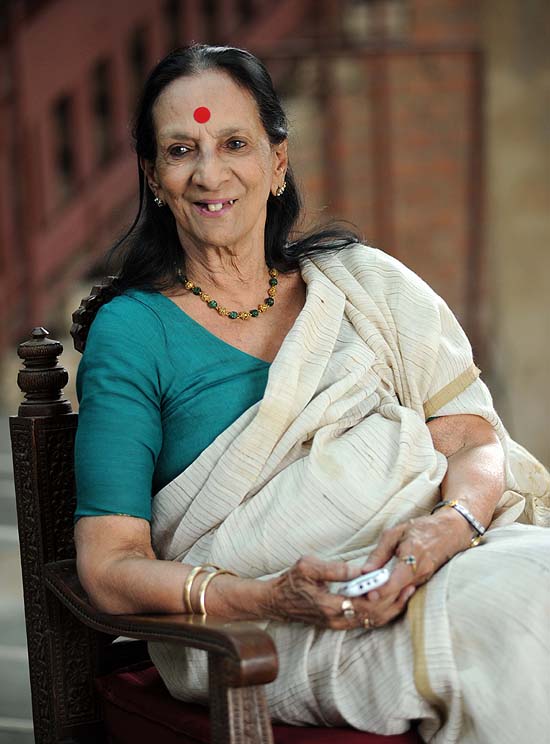
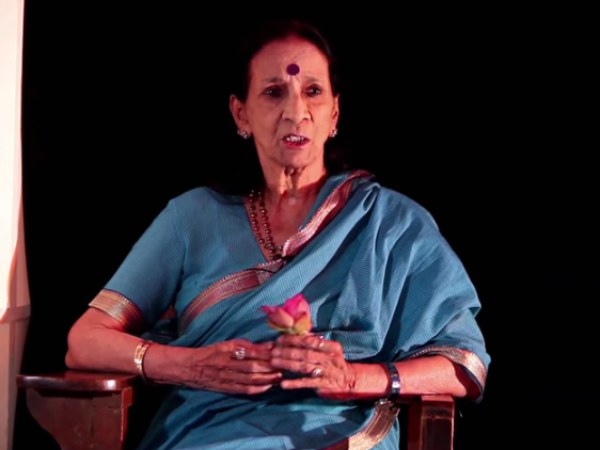
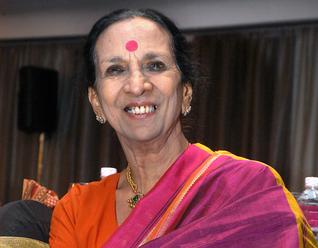
This is class personified, a fitting tribute by danseuse Mallika Sarabhai to her mother Mrinalini Sarabhai – the ‘Amma’ of all dancers – who passed away in Ahmedabad on January 21 at the age of 97.
She died of old age-related complications.
The sad news was broken by Mallika on her Facebook post, saying, “My mother Mrinalini has just left for her eternal dance.”
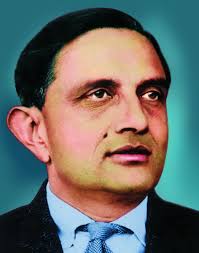
Hearing the news the world came to a standstill for thousands of dancers who studied under her tutelage at the Darpana Academy of Performing Arts, on the banks of Sabarmati River in Ahmedabad, which Mrinalini and her late husband Vikram Sarabhai, father of India’s space programme, set up in 1948.
Mrinalini was fondly called “Amma” (mother) by her students.
I met her once, accidentally. This was in 2004-05. With my family I was shopping at Adani Supermarket at Vijay Char Rasta in Navrangpura (Ahmedabad). My son, who was 10 months old at the time, started crying. So I took him out and waited outside the shop for my wife to finish the shopping. While I was entertaining my son, there I saw a woman clad in a saree with a flower-bedecked bun and a large bindi on her forehead coming towards me. I was standing at the entrance of the shop. I knew she was Mrinalini Sarabhai and greeted her with a big smile. She reciprocated warmly, to my surprise and delight. I was a complete stranger to her. She asked me: “Is the little one yours?” I said: “Yes”. She gently patted on my son’s cheek and went inside the shop. My joy knew no bounds. She made my day. For me, she was the quintessential elite with a common touch.
Mrinalini was born in Kerala on May 11, 1918, to a famous family of freedom fighters. She belonged to Vadakath Tharavad family that has its roots in Anakkara village in Palakkad district of Kerala. Her mother Ammu Swaminadhan was a known Gandhian and a member of India’s first Parliament, while her father an illustrious lawyer. Her elder sister Lakshmi Sehgal became the commander of Subhash Chandra Bose’s Indian National Army.
Capt Lakshmi Sehgal died in 2012.
Mrinalini and her siblings had a very English upbringing and had nannies to look after them.
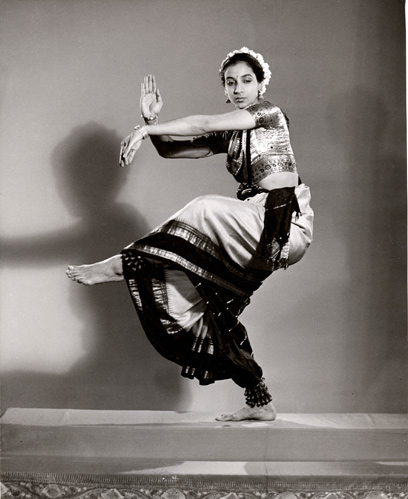
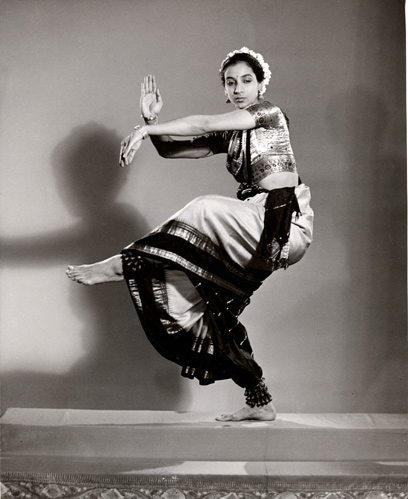
Mrinalini trained as a ballerina when she was at a school in Switzerland in the 1930s. She then went to Shantiniketan and learned music and painting under the tutelage of the great Rabindranath Tagore. She also spent time studying acting at the American Academy of Dramatic Arts.
Mrinalini moved to Ahmedabad after she married renowned physicist Vikram Sarabhai, one of the pioneering institution builders of science in India, in 1942. He belonged to the first family of Ahmedabad’s textile tycoons.
Mrinalini knew from almost the word-go that she was a dancer and her life was on stage.
In an interview to the Times of India in 1999, she said, “I knew I would be a dancer when I was four years old. I started seeing everything in images. While listening to music at age four, I would create my own movement.”
She with the help of Vikram established Darpana. But then there she had to take on the ‘conservative world’ which had this notion that being a dancer was not meant for ‘respectable women’.
Her legacy is she brought the dance form out of the Devadasi closet and made it acceptable as well as respectable.
In South India, a Devadasi is a girl “dedicated” to worship and service of a deity or a temple for the rest of her life.
“Papa said my mother broke the negative aura around Bharatnatyam at a time when women who danced were known as Devadasis,” Mallika told the Times of India in an interview.
Mrinalini also gave Bharatnatyam a space in Gujarat.
For me another vivid memory of hers was her inspiring interview with writer and documentary filmmaker Rajiv Mehrotra on Doordarshan in a programme called Mind Scapes. This was in the 1990s. What struck home with me was her reply.
On being asked how much of work is inspiration and perspiration, she said: “Inspiration is rarer than perspiration. It’s the perspiration that leads to inspiration. If you sit at something and think about it, inspiration does come. But the work and the effort that leads to invention or clarity is the main thing.”
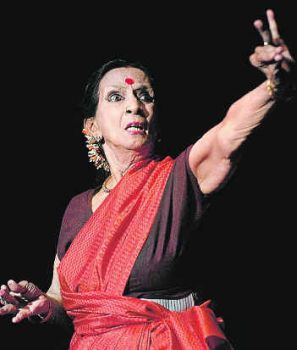
An exponent of Bharatnatyam, Kathakali and Mohiniyattam, Mrinalini was honoured with Padma Bhushan in 1992.
Besides dancing, choreographying and training hundreds of students in these various dance forms for more than 50 years, Mrinalini was also a writer, poet and environmentalist.
She was well-read and concerned about society at large and used dance to depict social evils like dowry deaths, untouchability, rise of concrete jungle, etc. and bring awareness in the society. And it created quite a sensation not only in India but all over the world.
She had choreographed more than 300 dances in a career spanning over five decades.
While she learnt Bharatnatyam from Meenakshi Sundaram Pillai, she mastered Kathakali under Guru Thakazhi Kunchu Kurup.
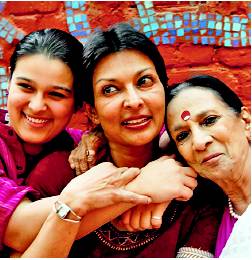
She is survived by her children Kartikeya Sarabhai, Mallika Sarabhai, four grand-children and three great-grandchildren.
Kartikeya is founder director of Centre for Environment Education (CEE).
In her blog she writes her connection with dance: “Continuously through the years, people ask me ‘What is dance to you?’. My reply usually is, ‘It is my breath, my passion, my self’. I am only ‘I’ when I dance. I am only that ‘I AM’ when I dance. I am only eternity when I dance. Silence is my response, movement my answer.”
Mrinalini also wrote an autobiography titled ‘Mrinalini Sarabhai: The Voice of the Heart’.
She was the first Indian classical performer to take Bharatnatyam and Kathakali abroad.
She was first noticed in the West when she did a solo Bharatnatyam in the traditional way and a small dance drama with Kathakali technique but without the costume. This was at Palais de Chaillot in Paris. There was no looking back after that. La Bombe Atomique Des Hindous (The Hindu Atomic Bomb), read a French newspaper review headline in 1949 – a day after her performance.
In the interview to Rajiv Mehrotra, she says: “When the manager of the theatre saw me, he said ‘Oh dear, you are so tiny and small, how will you ever be seen by the audience’. And then overnight everything fell into place, and that’s the power of the dance.”
One of her first major successes was the dance drama “Manushya” in which she stripped Kathakali dancers of their make-up and costumes so that audiences could focus on the beauty of the movement.
When asked: Is it possible for an artiste to be a bad person and be a good performer? She said: “If you are not a good person, dance will help you become what you really should be.”
On being asked would she like to be reborn as a dancer, surprisingly, she said: “No, not a dancer. It’s lot of hard work. I would like to be reborn as an artiste. I would like to be a writer or a singer. Next to dancing, I like writing. Words move me more than anything else. I like the sound of words.”
Mrinalini’s dance legacy is now in its third generation. She is survived by her daughter, Mallika, a dancer and political activist; grandson Revanta, an emerging choreographer; and granddaughter Anahita, who is into dance, choreography and poetry.