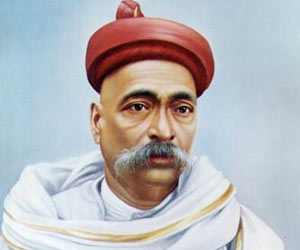
On the occasion of Indian National Hero’s 342nd Coronation Chhatrapati Shivaji (19 February 1630- 3 April 1680), the most beloved Maratha King is a Hero of the countrymen in India even today. Occasional controversies do erupt regarding him but he continues to be a National Hero. Some political, cultural and social groups try to brand Shivaji as a Hindu King but that would not be his real introduction, as he was above any caste, creed or religion and a foresighted personality in real sense. Precisely that was the reason why Lokmanya Bal Gangadhar Tilak – the firebrand Editor of “Kesari” and “Marhatta” and the first Leader of Indian Independence Movement – thought of celebrating the birth-date of the Founder of Maratha Empire, 19th February, as Shiv Jayanti on a grand scale since 1895-96 to create a national spirit among the colonised people at that time.
Sometimes the history is being coloured when Shivaji Maharaj is branded as a mere Hindu King who fought for Hindu Swaraj. The layman hardly differentiates between Hindu Swaraj and Hindavi Swaraj, though there is a vast difference. To brand Shivaji as a Hindu King is like undermining his national and inclusive character. Of course he followed Hindu religion, but he was not a fundamentalist like his counterpart i.e. Mughal Emperor Aurangzeb. At one time he fought for Mughal Emperor Aurangzeb who gave him the title of Raja (King), but throughout his life Shivaji fought for Hindavi Swaraj, the rule of natives irrespective of any particular religion, caste or creed. He preferred to use the phrase Hindavi Swaraj and not Hindu Swaraj. His father, Shahaji Bhonsle, served Deccan Sultanate as a General. His mother Jijabai, a pious lady, was mainly responsible for Shiva’s upbringing.
While he carved out his Maratha Empire by his military tactics, especially guerrilla warfare methods, most of his enemy states were Muslim, but his Muslim subjects were treated with tolerance for their religion. He was formally crowned at Raigad Fort in May 1674 and the very next month his mother Jijabai died. Considering it as a bad omen, he had a second Coronation on 24th September 1674. In spite of this, the Chhatrapati (Monarch) could rule over his Empire for a brief period of only 6 years since he died in 1680 vomiting blood. His death too was a mystery as one of his eight wives, Soirabai, is said to have given poison to him. Since most Muslim rulers in those days were running the administration in Persian, Shivaji introduced Marathi and Sanskrit as the media in his court. His Eight-Member Council of Ministers (Ashtapradhan) was unique and was instructed to serve the subjects without any discrimination.
Shivaji was a devout Hindu but he respected all religions within the region, allowed his subjects freedom of religion and opposed forced conversions. He condemned slavery, respected women of even those who were defeated in war. Mughal historian Kafi Khan and French traveller Francois Bernier also speak highly of his religious policy.
One of Shivaji’s Generals, Netaji Palkar, not only defected to Mughals but also converted to Islam. Ten years after his service in Aurangzeb’s Army as General in Kabul, he wanted to return and adopt Hinduism again. Shivaji was generous to accept him back into Hindu fold and he got his daughter married to Netaji’s son. According to Hindu traditions, the family where one gets the daughter married is considered socially superior.
During Chhatrapati’s conflict with Adilshahi of Bijapur, his meeting with Bijapur’s General Afzal Khan at Pratapgad is sometimes described as Hindu vs. Muslim conflict. But that is not so. History is full of such conflicts where the rulers or their Generals may be of different religions but the fight is for the interests of the warring states. Afzal Khan had plans to kill Shiva and was all set to fulfil his ulterior motive. Shivaji was also not naïve. Both were to meet alone at a particular place and their bodyguards were to be left at a distance. It was on 10th November 1659 that they met. Shivaji had both Hindu as well as Muslim bodyguards, including Gaikwad, Siddi Ibrahim, Jiwaji Mahale (Sakpal), with him and Afzal Khan had Sayed Banda, Shankaraji Mohite, Pilaji Mohite and others with him. Both Shivaji and Afzal Khan were to meet on a diplomatic mission. Hence they had their representatives Pantaji Gopinath and Krishnaji Bhaskar respectively. Both Afzal and Shivaji embraced and the tall Khan was to kill the Maratha warrior, but was unaware that Shiva had also come prepared. Chhatrapati killed Afzal with his hidden Vaghnakh (Tiger Claws). It was tit for tat.
The Maratha King was a self-made man. He established his army of Mavalas (Maratha Warriors). His intelligence wing was equally powerful. His chief of the artillery was Siddi Ibrahim, his trustworthy Muslim whom he preferred to take with him as his bodyguard when he went to meet Afzal Khan. Several other noteworthy Muslims were in his Army and Navy like Siddi Sanbal, Noor Khan, Daulat Khan and Siddi Misri. Shivaji’s Admiral Kanhoji Angre is also referred to as the Father of Indian Navy who had many Muslims in the Navy. Hence calling Shivaji a Hindu King is like undermining him since he was a national level ruler who never discriminated among his subjects. Even when Mughal Emperor Aurangzeb wanted to have peace with this Maratha King, he had deputed his Chief of the Army, Mirza Raja Jai Singh, to negotiate with him. Jai Singh’s father was the Chief of the Army of Mughal Emperor Akbar who was sent to first negotiate with Maharana Pratap of Mewar and then to fight the Haldighati war with Maharana. Man Singh and Jai Singh were the Kings of Jaipur i.e. Amber. It was never seen as a Muslim Emperor fighting a Hindu King since among the most trustworthy Generals of Pratap were Muslims also. Unfortunately the historians have given it a religious branding.
(The writer is a socio-political historian. He was the Editor with the Indian Express Group in Mumbai and Founder Director of Sardar Patel Research Institute-CERLIP running M. Phil. and Ph.D. programmes.)
Next Column : “ Mewar :The Pride of India”