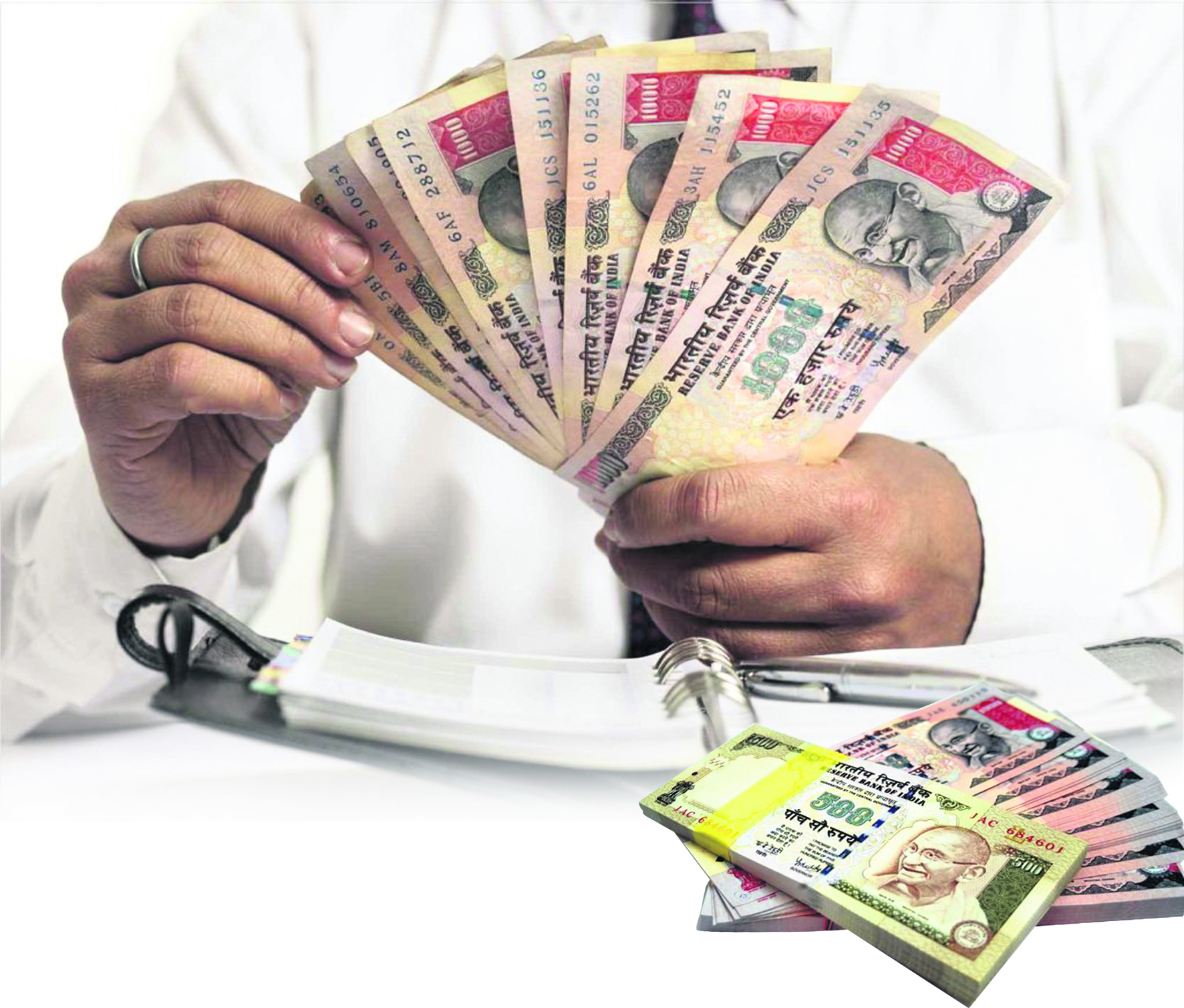
"Any PIO and members of his family, who regularly visit India would easily have Rs 50,000 to Rs 100,000 worth of Indian currency, and I challenge the government to prove this as black money and forfeit this from us," claimed Dharamveer, a US national who stood at one of the 5 designated RBI branches across the country to exchange the banned 500/1000 currency notes.
"This money, we don't spend in the country where we live, but the country of our origin. It is by chance that we are here at this time and wanted to exchange few currency but are not allowed to do so. It is very frustrating," he said. Dharam is just one of the many NRIs and people of India origin who are now braving long queues to exchange their currency. Several people blew their fuses outside RBI branches as those who came from long distances were being denied entry by guards who said they didn't have proper documents on them.
"Though I have a foreign passport, I still have roots in India. Our family comes to India every year. We have few Indian currency notes and we want to exchange them, but aren't allowed to enter RBI. Mr Prime Minister, are we supposed to burn the Indian currency that we have?" asked a visibly agitated US national, Ritu Diwan. She added that the unnecessary harassment indicates PIOs are no more welcome to the country of their birth.
We all agree the what-once-seemed-spontaneous banning of the high denomination currency notes, despite coming from the best of interests for the country, severely lacked management. There was the opposition holding on to the pettiest of straws, the government that steadily came up with different notifications to ease the discomfort, the RBI that tried to mop up the mess, and the aam janta that cribbed and protested as it stood in tediously long lines outside banks and ATMs. While the whole charade made for the best of media fodder, it did leave behind an uncertainty in the minds of people- hurting Modi's fan base.
In one of the recent announcements made by the RBI and the government, it was declared that Indian citizens who are not resident of India will be able to exchange old Rs 500 and Rs 1,000 notes at RBI offices till June 30. The External Affairs Ministry said the provision to exchange the notes would be subject to the regulations of the notification - Foreign Exchange Management Regulations, 2015, which put the limit of bringing back currency into the country at Rs 25,000 per person. "For those citizens of India, who are not resident in India, this facility would be available till June 30, 2017 in order to allow them adequate time to plan a visit as per their convenience," the MEA said in a statement. It said separate FEMA provisions will also be applicable to persons in Nepal and Bhutan which would continue to apply.
"The facility would be subject to the regulations of the notification 'Foreign Exchange Management (Export and Import of Currency) Regulations, 2015'. As per these regulations bringing back such currency into the country is restricted to Rs 25,000 per person. Separate FEMA provisions are applicable to persons in Nepal and Bhutan which would continue to apply," the MEA said.
The facility can be availed by citizens in their individual capacity, on submission of documentary evidence showing they were abroad during the period and that they have not availed the exchange facility earlier, the RBI said in a statement. It added that no third party tender will be accepted under the facility. It can, however, not be availed by Indian citizens from Nepal, Bhutan, Pakistan, and Bangladesh.
This facility will be available through Reserve Bank offices at Mumbai, New Delhi, Chennai, Kolkata and Nagpur. The statement also said, "Any person, aggrieved by the decision of the Reserve Bank may prefer an appeal to the Central Board of the Reserve Bank within 14 days of the communication of such refusal to him."
Most recently affected were NRIs who came down to Gujarat to attend the Vibrant Gujarat Summit. They were left shocked and hurt with the fact that they had to go to other places to exchange their hard earned money. Well, grievances are many. The massive NRI community is openly displeased with the lack of proper provisions and have raised questions over the country's responsibility towards them. Given the situation, Asian Voice and Gujarat Samachar (UK) decided to get an unmediated account of what they had to say.
Settled in Dallas, Texas, in the United States, for the last three years, Vishruti Vyas said, "I had brought with me approximately Rs 25,000 in banned notes. While I could easily exchange the currency, the money exchange gave me new cash in Rs 2000 notes. The notification has pulled a plug on our spending capacity. We have to be more cautious with the cash we have. The existing inflation has not helped either. When people are not spending, how do you expect businesses to flourish?"
An IT expert from Texas, Ashutosh Bhatt is in Ahmedabad on a holiday. Submitting old notes in Mumbai was no trouble, but it is the use of the new currency where the problem lies. "We have to keep our purse strings tight as any kind of over expenditure means having to arrange for more cash, which is evidently not a simple task to do. I use my American credit cards wherever possible. The RBI has of course given us (NRIs) a new deadline to exchange old currencies, but the rules are messed up amongst themselves, and are creating confusion."
Britain-based Shellina Rahemtullah had a turbulent experience visiting her country of origin. She shared her plight with us saying, "I was in Goa during my visit to India and needed to exchange Rs 30,000 worth of old notes. I went to Goa Indian Currency Exchange branch with the RBI circular in hand. None of the officials in the office had a clear idea of the notification. I showed them the circular I had in hand and asked them to inquire about it or help me contact higher authorities at the central bank- only receiving excuses in response. If there is no usable cash on us, what does the government expect us to spend? It wasn't just NRIs. Plight of the locals in Goa was just as worse. Most affected were small-scale businesses."
One of the worst-affected was Wembley, UK's Kaushik Modi. An employee of the British Royal Mail, Modi said, "My wife Jayna and I came back to Wembley on 17th January. During our stay, we had inquired in banks in Ahmedabad, and South Gujarat, regarding the process for people like us to exchange old notes. The process seemed long and rather tedious. We even tried exchanging as per the rules set by the RBI, but had to return with old banned Indian currency in hand. We were majorly dependent on our relatives for the pettiest of expenditures. I believe, November, December, and January is called the NRI season for a reason. Businesses would have certainly taken a hit given we had no money to lavish."
South London's Pravina Patel, 75, visits Vadodara, Gujarat every year. However, this year's note ban move made it difficult for her to enjoy stay in a country she calls home. "This entire situation has put me on the verge of depression. The government asked us to open new bank accounts. But what about the unavoidable inconvenience of doing so? The amount of times a single person is sent back by the bank citing lack of proper documents, is in itself a testimony of the struggles the government put us through. We wait for hours in a line, waiting for our turn, only to be sent to another in the name of documents and legality. It took a stern warning and creating of a scene from me for an account to be finally opened in a bank." She said bank employees neither empathised the situation of the customers, nor had enough knowledge of the guidelines given by the RBI.
"This is just me, speaking of my experiences as a senior citizen." She said that she understands the government made the move for the better, but its foul management and execution is disheartening. "The NRI community has a major stake in the growing prosperity of the country. Somebody needs to inform PM Modi of the troubles we are being put through."
We also spoke to Ahmedabad-based jeweller Dhaval Soni, who testified that business has indeed taken a serious hit. "November, December, January, and February, we get abundant orders for jewellery from NRIs. However, this year, despite the dip in gold prices, there has been a noticeable hit in trade. Just recently there was a wedding occasion at one of our NRI customers. Due to a limited source of Indian currency, they had to settle on the amount of gold jewellery they wanted to buy. They did not want to go back abroad with pending loans here, and decided to buy gold with the Indian money they had."
Former chief secretary of Gujarat, and current Somnath Trust vice-chairman, PK Lahiri believes, "Demonetisation affected the entire economy for a while, but things are slowly making their way back to normalcy. NRIs had initially inquired if they can deposit money abroad. I believe, if they could be provided with a facility where big NRI group - UK, Canada, USA, Australia, Dubai, then it would have been more helpful. If it were taken care this way, they wouldn't have had to face such issues. Since NRIs are an integrated part of our economy, they should be given some facility." He also added, "Demonetisation is a single time transaction. Every day it is not going to take place. But if it is causing convenience, the government needs to take sufficient measures."
Former MP Harin Pathak openly voiced his displeasure. He asked, "Why would NRIs travel across states to exchange mere Rs 25,000? The Reserve Bank of India could have authorised all their state branches to accept money exchange and eased the process. I had personally written a letter to the Finance Minister 10 days back, asking for strict action to be taken and was promised that the government is looking into it. The RBI should give back the money taken from the NRI community. If they think the amount is collected illegally or is 'black', by all means issue an inquiry. But release money otherwise. How do they expect senior people and women to travel to one of the five centres to exchange old notes?"