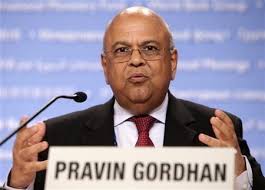
Newly reappointed South Africa's Minister of Finance Pravin Gordhan is an Indian-origin former pharmacist with an anti-apartheid struggle record dating back to the 1960s. He was Minister of Finance of the Republic of South Africa from 11 May 2009 to 23 May 2014.
Pravinbhai was born on 12th April 1949 to Rumbaben and Jamnadasbhai Gordhan and is married to Vanitha Raj and has two children. He graduated as a pharmacist from the University of Durban Westville in 1973 and became involved in politics as a student, helping organize opposition to all-white rule for the African National Congress (ANC) and the South African Communist Party.
Pravinbhai played a key role in negotiations between the ANC and the National Party government (the white supremacist government) leading to South Africa’s first all-race elections in 1994. He was instrumental in negotiations with the Western governments as well.
He was a Member of Parliament between 1994 and 1998 for the African National Congress. He was elected as Chairperson of the Parliamentary Constitutional Committee (1996), which oversaw the implementation of the new constitutional order. At the same time, he played a leading role in drafting the present Constitution. After the ANC took power under Nelson Mandela, he was appointed a lawmaker and chairman of a committee overseeing the implementation of a new Constitution. During the period of apartheid era of the white ruling government, Pravinbhai was detained several times by the then South African police for his revolutionary activities incorporating the African National Congress. He was Deputy Commissioner for the South African Revenue Service from March 1998 and was Commissioner for the South African Revenue Service from November 1999. He was Minister of Cooperative Governance and Traditional Affairs from 23 May 2014 to 13 December 2015.
Pravinbhai organised and led the student movement and civic structures during the 1970s and 1980s. He took part in the Natal Indian Congress call to boycott elections in the 1980s and was detained three times by the apartheid government. He spent four years in the underground structures. He was also involved in the South African Communist Party (SACP) and African National Congress (ANC). He worked as a pharmacist at the King Edward VII hospital in Durban until he was expelled after his detention by the police.
Pravinbhai is also the former Commissioner of the South African Revenue Service as well as the former Chair of the World Customs Organisation (WCO). He was presented with “Commander of the Order of the Crown” award in recognition of his leadership as the Chairperson of the Council for the WCO and for his relentless efforts, internationally and domestically, to promote Customs integrity. Mr Gordhan was re-elected during the June 2002 WCO Council meeting held in June at Brussels, Belgium. He is a doctorate in both law and commerce.
This widely respected Indian-origin politician was appointed South Africa's new finance minister by President Jacob Zuma, becoming the third finance chief of the country in a week amid a raging economic turmoil.
Zuma sacked Nhlanhla Nene as finance minister on December 9 and replaced him with a relatively unknown lawmaker David Rooyen, sparking a wave of criticism and financial turmoil. The removal of Nene sent the rand currency to record lows, sparked a sell-off in bank stocks and sent yields in local and dollar-denominated debt soaring. Credit agency Fitch downgraded South Africa on December 4, leaving the continent's most sophisticated economy just one notch above junk status. Under pressure, Zuma removed Rooyen after 4 days and on December 14 appointed Pravinbhai as the new FM. The markets cheered Gordhan's appointment, the rand bounced back 5% against the dollar and the Johannesburg stock exchange also recovered some of last week's losses.
Pravinbhai now plans to stabilise South Africa's economy after the Nene debacle. He has the absolute backing of the leadership. “As far as I’m concerned, otherwise I wouldn’t be sitting in that chair. I’ve been given a responsibility to both direct and stabilise our ship,” he was quoted as saying to the Financial Times.
Pravinbhai indicated his intention to tackle the economic problem through structural reforms and said he would try to boost inclusive growth with “a more extensive and intensive reaching out to the private sector”.
“The fact the majority of black professionals and the black middle class feel excluded from the economic benefits is a problem that both the established private sector and government have to give more serious attention to,” he was quoted as saying to the UK's leading financial daily. “We have a particular historical legacy in terms of the structure of the economy and the time has come to start discussing how we reform that structure.”
A peek into Parajiya Soni history
Pravin Gordhan is a Dhanak (Soni community). Around 1152 AD, there was a Parajiya Soni named Jam Kesarji. He was appointed by King Dhalurasha of Bambhanasur in the Sindh province (now in Pakistan) to take charge of his mint, manufacturing of gold coins and the finances of the kingdom.
Jam Kesarji's effective leadership and efficient operations to manage kingdom’s finances impressed the King. In order to acknowledge his services for looking after the kingdom’s wealth (‘dhan’ in Gujarati), the King awarded Jam Kesarji to be called Dhanik (keeper of ‘dhan’). Dhanik later came to be called Dhanak. Thus, Jam Kesarji Dhanak became the first ancestor of the Dhanak pariwar. The lineal ancestors of the Dhanak families, all of whom can be traced back generation by generation to the founding ancestor Jam Kesarji.
As they say history repeats itself. After more than 850 years, Mr Pravin Gordhan – another Dhanak – will be looking after South Africa’s ‘dhan’ as the finance minister.