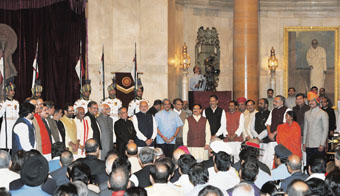
Indian Prime Minister Narendra Modi on Sunday expanded his union council of ministers, inducting 21 new faces, including four with cabinet rank, giving wide representation to several northern and central states and keeping the age limit well under 68.
The much-anticipated first ministry expansion was marred with ally Shiv Sena calling off participation in the government at the last minute - exacerbating their already strained ties.
Former Shiv Sena leader Suresh Prabhu was sworn-in as a cabinet minister. Prabhu, who is the prime minister's interlocutor for the G20, has joined the Bharatiya Janata Party (BJP) and is expected to become a Rajya Sabha member.
The Sena at the last minute recalled Anil Desai, who it had nominated for induction in the union ministry. According to reports, Desai arrived in Delhi for the oath-taking ceremony but was ordered to return.
With the new induction, Modi's 45-member ministry now totals 66. He inducted four cabinet ministers, three ministers of state with independent charge, and 14 ministers of state (MoS).
Former Goa chief minister Manohar Parrikar was the first to take oath at the Durbar Hall of Rashtrapati Bhavan. BJP general secretary J.P. Nadda, who is known to be close to Modi and party chief Amit Shah, and Birender Singh, who left the Congress ahead of the recent Haryana assembly elections to join the BJP, were administered oath as cabinet ministers by President Pranab Mukherjee.
Modi also brought into his ministry the party's known Muslim face in Mukhtar Abbas Naqvi, adding to Najma Heptullah, who is minority affairs minister. Naqvi is an MoS. He also added to the representation of women by inducting Sadhvi Niranjan Jyoti, BJP MP from Fatehpur in Uttar Pradesh, taking the number to eight.
Giriraj Singh, 61, who courted controversy with his comment while campaigning for the national elections that "those who oppose Narendra Modi should go to Pakistan" and was also booked for the hate speech, also got a place as minister of state.
The new ministry has most people in their 50s, with the oldest being Bandaru Dattatreya, MoS independent charge, at 68.
The youngest is well-known singer Babul Supriyo, the only face in the ministry from West Bengal. The Asansol MP, who was inducted as MoS, is 43, while Olympian shooter Col. Rajyavardhan Singh Rathore is 44.
The only National Democratic Alliance (NDA) ally to get a berth in Sunday's expansion was Telugu Desam Party (TDP) Rajya Sabha MP, Y.S. Chowdary as an MoS.
Among those who were widely tipped to get a berth and were inducted are Rajiv Pratap Rudy, MoS independent charge, Ram Kirpal Yadav, a former Lalu Prasad aide who quit the Rashtriya Janata Dal, Jayant Sinha, son of BJP veteran Yashwant Sinha, and Vijay Sampla, BJP Hoshiarpur MP.
Sinha's entry into the government marks the coming in of the second generation of BJP politicians. The IIT-Delhi and Harvard-educated Hazaribagh MP is an investment fund manager and management consultant. His entry is likely to give a fillip to the BJP's chances in Jharkhand which goes to the polls in November-December.
Another new face is Hansraj Ahir, BJP MP from Maharashtra. Ahir is well-known for having unearthed the coal mining scam. He took oath as an MoS.
The states to get wide representation are Maharashtra, where the BJP has formed government for the first time, with two ministers - Suresh Prabhu and Ahir, adding to the prominent names already in the cabinet, including Nitin Gadkari and Prakash Javadekar.
In Haryana, where it won in the recent assembly elections and formed the government, has a new minister in Birender Singh.
Keeping in mind the forthcoming elections in Bihar, the council has three new faces from the state - Rajiv Pratap Rudy, Ram Kirpal Yadav and Giriraj Singh. Union ministers Ram Vilas Paswan and Ravi Shankar Prasad are from Bihar.
Uttar Pradesh got the largest representation, with four new faces - Mahesh Sharma, a doctor who owns Kailash Hospital and is an MP from Gautam Buddh Nagar (Noida); Naqvi, who is a Rajya Sabha member; Ram Shankar Katheria, Agra MP; and Sadhvi Niranjan Jyoti.
Gujarat, where Modi was the chief minister for three terms, got two new faces in Haribhai Parthibhai Chaudhary, and Mohanbhai Kalyanjibhai Kundarya.
Portfolios of ministers
Prime Minister Narendra Modi: Personnel, Public Grievances and Pensions; Department of Atomic Energy Department of Space; All important policy issues and all other portfolios not allocated to any Minister.
Cabinet ministers
Rajnath Singh: Home Affairs
Sushma Swaraj: External Affairs, Overseas Indian Affairs
Arun Jaitley: Finance, Corporate Affairs, Information & Broadcasting
M. Venkaiah Naidu: Urban Development, Housing and Urban Poverty Alleviation, Parliamentary Affairs
Nitin Jairam Gadkari: Road Transport, Highways and Shipping
Manohar Parrikar: Defence
Suresh Prabhu: Railways
D.V. Sadananda Gowda: Law & Justice
Uma Bharati: Water Resources, River Development and Ganga Rejuvenation
Dr. Najma A. Heptulla: Minority Affairs
Ramvilas Paswan: Consumer Affairs, Food and Public Distribution
Kalraj Mishra: Micro, Small and Medium Enterprises
Maneka Sanjay Gandhi: Women and Child Development
Ananthkumar: Chemicals and Fertilizers
Ravi Shankar Prasad: Communications and Information Technology
Jagat Prakash Nadda: Health & Family Welfare
Ashok Gajapathi Raju Pusapati: Civil Aviation
Anant Geete: Heavy Industries and Public Enterprises
Harsimrat Kaur Badal: Food Processing Industries
Narendra Singh Tomar: Mines, Steel
Chaudhary Birender Singh: Rural Development, Panchayati Raj, Drinking Water and Sanitation
Jual Oram: Tribal Affairs
Radha Mohan Singh: Agriculture
Thaawar Chand Gehlot: Social Justice and Empowerment
Smriti Zubin Irani: Human Resource Development
Dr. Harsh Vardhan: Science and Technology, Earth Sciences
Ministers of state
General V.K. Singh: Statistics and Programme Implementation (Independent Charge), External Affairs, Overseas Indian Affairs
Inderjit Singh Rao: Planning (Independent Charge), Defence
Santosh Kumar Gangwar: Textiles (Independent Charge)
Bandaru Dattatreya: Labour and Employment (Independent Charge)
Rajiv Pratap Rudy: Skill Development & Entrepreneurship (Independent Charge), Parliamentary Affairs
Shripad Yesso Naik: AAYUSH (Independent Charge), Health & Family Welfare
Dharmendra Pradhan: Petroleum and Natural Gas (Independent Charge)
Sarbananda Sonowal: Youth Affairs and Sports (Independent Charge)
Prakash Javadekar: Environment, Forest and Climate Change (Independent Charge)
Piyush Goyal: Power (Independent Charge), Coal (Independent Charge), New and Renewable Energy (Independent Charge)
Dr. Jitendra Singh: Development of North Eastern Region (Independent Charge), Prime Minister’s Office, Personnel, Public Grievances & Pensions, Department of Atomic Energy, Department of Space
Nirmala Sitharaman: Commerce and Industry (Independent Charge)
Dr. Mahesh Sharma: Culture (Independent Charge), Tourism (Independent Charge), Civil Aviation
Mukhtar Abbas Naqvi: Minority Affairs, Parliamentary Affairs
Ram Kripal Yadav: Drinking Water & Sanitation
Haribhai Parthibhai Chaudhary: Home Affairs
Sanwar Lal Jat: Water Resources, River Development & Ganga Rejuvenation
Mohanbhai Kalyanjibhai Kundariya: Agriculture
Giriraj Singh: Micro, Small & Medium Enterprises
Hansraj Gangaram Ahir: Chemicals & Fertilizers
G.M. Siddeshwara: Heavy Industries & Public Enterprises
Manoj Sinha: Railways
Nihalchand: Panchayati Raj
Upendra Kushwaha: Human Resource Development
Radhakrishnan P.: Road Transport & Highways, Shipping
Kiren Rijiju: Home Affairs
Krishan Pal: Social Justice & Empowerment
Dr. Sanjeev Kumar Balyan: Agriculture
Manuskhbhai Dhanjibhai Vasava: Tribal Affairs
Raosaheb Dadarao Danve: Consumer Affairs, Food and Public Distribution
Vishnu Deo Sai: Mines, Steel
Sudarshan Bhagat: Rural Development
Prof. (Dr.) Ram Shankar Katheria: Human Resource Development
Y.S. Chowdary: Science and Technology, Earth Science
Jayant Sinha: Finance
Col. Rajyavardhan Singh Rathore: Information & Broadcasting
Babul Supria (Babul Supriyo) Baral: Urban Development, Housing and Urban Poverty Alleviation
Sadhvi Niranjan Jyoti: Food Processing Industries
- Vijay Sampla: Social Justice & Empowerment