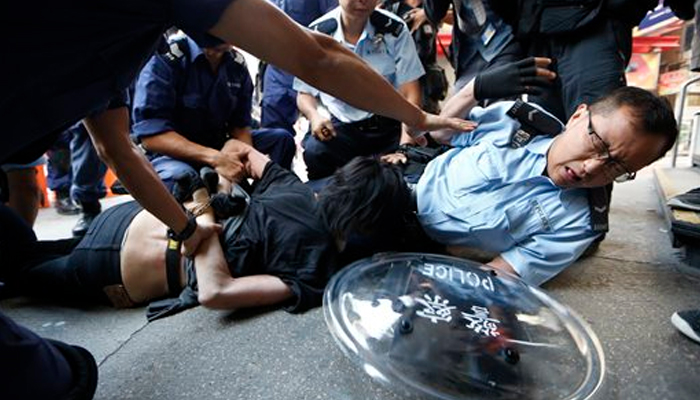
Hong Kong: Hundreds of Hong Kong police staged their biggest raid yet on a pro-democracy protest camp before dawn last week, charging down student-led activists who have held an intersection in one of their main protest zones for more than three weeks.
The operation in the gritty and congested Mong Kok district, across the harbour from the heart of the civil disobedience movement near government headquarters, came while many protesters were asleep in dozens of tents or beneath giant, blue-striped tarpaulin sheets.
The raid was a gamble for the 28,000-strong police force in the Chinese-controlled city who have come under criticism for aggressive clearance operations with tear gas and baton charges and for the beating of a handcuffed protester.
Storming into the intersection with helmets, riot shields and batons at the ready from four directions, the 800 officers caught the protesters by surprise. Many retreated without resisting.
"The Hong Kong government's despicable clearance here will cause another wave of citizen protests," said radio talk-show host and activist Wong Yeung-tat, who wore protective goggles over his white-rimmed glasses and sported a boxer's sparring pad as a shield.
The protesters, led by a restive generation of students, have been demanding China's Communist Party rulers live up to constitutional promises to grant full democracy to the former British colony which returned to Chinese rule in 1997.
The police sweep of the protest camp had been expected for several days. It reduced the number of protest sites that have paralysed parts of the Asian financial hub since September 28, but could rekindle defiance.
"We have urged protesters to maintain a kind of floating protest strategy to guard the streets," said Wong, flanked by protesters who stared down advancing lines of uniformed police. Police gave a short warning on loud hailers before moving in although no direct force was used, witnesses said.
Calm returned through the rest though the number of protesters was expected to swell at the main protest site, in the central Admiralty district, as students finish classes for the week.
"Here is the base of the resistance," media magnate Jimmy Lai said, referring to Admiralty. "If they want to quit here they have to arrest people. I think this will be the end game," said Lai, an outspoken critic of Beijing who has backed pro-democracy activists through his publications and donations.
In August, Beijing offered Hong Kong people the chance to vote for their own leader in 2017, but said only two to three candidates could run after getting backing from a 1,200-person "nominating committee" stacked with Beijing loyalists.
The protesters decry this as "fake" Chinese-style democracy and demand Beijing allow open nominations.