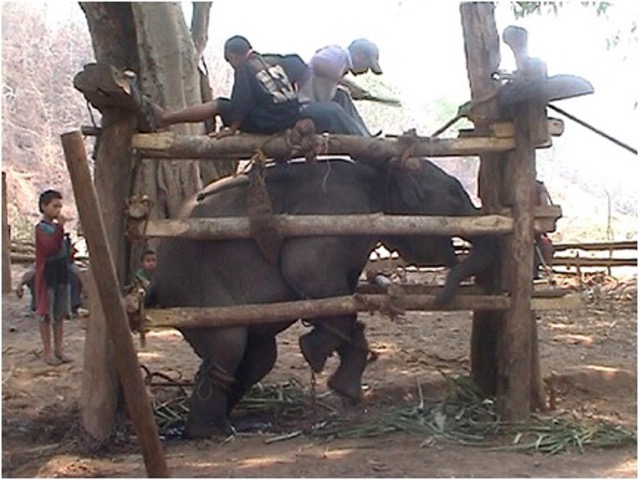
As Mr Modi departs these shores, for many the cheers ring hollow. Recent media coverage about India's wildlife portrays all as well. But for keystone species it is not. Recent Populus polling shows overwhelming outrage across all communities in Britain, Asian and otherwise, at the desecration of India’s wondrous elephants, whose wild population has collapsed from millions in the 19th century to barely 20,000 today.
The sufferings of this species are as hideous as anything imaginable in the animal kingdom, led by the brutal practice of pajan - the isolation, starvation and beating, often fatally, of baby and calf elephants to "break the spirits" - to facilitate their management. Anyone doubting the daily horrors for captive elephants tangled up in tourism, festivals and temples must read the output of distinguished Indian bodies such as the Animal Welfare Board of India, the careful deliberations of the Indian Supreme Court and the abundance of documentary and photographic evidence gathered by NGOs working in the field. Wild elephants too live increasingly precarious lives. Moves are currently threatened in India to strip elephants of established legal protection by declaring them "vermin". And this brutality is far from being a manifestation of Hinduism, as just a few still claim. It is indeed a repudiation of that peaceable and thoughtful belief system, represented often to the world by the elephant-headed God Ganesh, progeny of Shiva himself.
As it stands on the threshold of a new global presence, India risks enormous tourism, trade and reputational damage if these horrors persist. But responsibility for the situation is not India’s alone; it is all mankind’s. India reaps now a long history of plunder of its flora and fauna, and a recent legacy of intensive commercialisation and brutal abuse of these gentle creatures for human entertainment, predicated overwhelmingly from the West.
Far greater public awareness is urgently needed, to drive a new political will. Save The Asian Elephants (www.stae.org) is discussing its proposals with the British Foreign Office and DEFRA , following an invitation to STAE from the Indian High Commission in London to offer proposals for India's collaboration with the British government. This builds on David Cameron's election manifesto pledge to the British people to "support the Indian government in its efforts to protect the Asian elephant."Motions in the Westminster Parliament show wide all-party support, as can be expected for a Written Declaration 62/2015 just tabled in Strasbourg.
It is Man’s collective duty to save this ancient species, loved across the world perhaps above all creatures before it is brought, in our lifetime, to its final stand. India must act now and the West must help.
Duncan McNair is a lawyer and CEO of Save The Asian Elephants, a not for profit association of academics, conservationists, lawyers and campaigners dedicated to the protection of the Asian elephant.