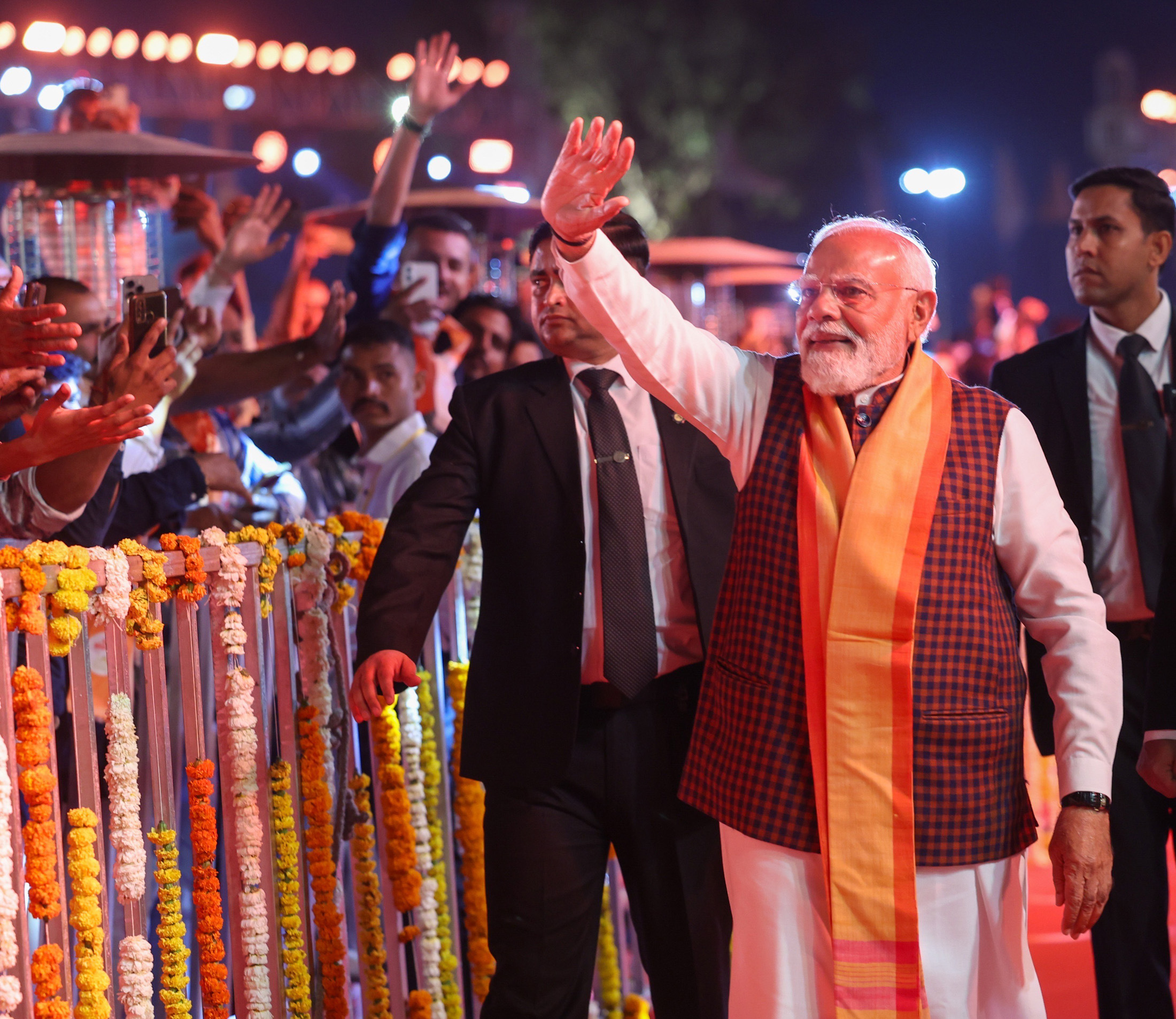
The Somnath Swabhiman Parv, held at the first Jyotirlinga in Gujarat, marks one thousand years since the first attack on the Somnath Temple in 1026.
This national event, instead of focusing on destruction, celebrates India’s resilience, faith, and civilisational pride. Somnath has been repeatedly targeted by invaders, but each time, it was rebuilt through collective devotion, making it a symbol of India’s enduring spirit.
The event also celebrates 75 years since the Somnath Temple was reopened to devotees in 1951. Prime Minister Narendra Modi visited Somnath during the Parv, where he participated in the Omkar Mantra chanting, had darshan, and watched a spectacular 3,000-drone show. He also paid tribute to past warriors, including Veer Hamirji Gohil, who defended the temple, and Sardar Vallabhbhai Patel, for their roles in restoring it.
On the second day, Modi led the Shaurya Yatra, a procession of 108 horses honouring those who sacrificed their lives for the temple. Crowds of locals and devotees gathered to greet the PM, who also performed puja at the temple.
PM Modi highlighted Somnath's significance in India’s history, recalling how invaders like Ghazni and Aurangzeb tried to destroy the temple but failed. "The flag hoisting at Somnath today shows India's power and resilience to the world," he said.
He also criticised past governments for "whitewashing" the true history of the temple’s repeated attacks and emphasised that the assaults weren’t just about looting wealth but an attempt to destroy India’s spiritual identity. Modi reaffirmed that Somnath is not just a structure but a living symbol of India's faith and pride.
PM Modi inaugurates Vibrant Gujarat Regional Conference in Rajkot
After Somnath Swabhiman Parv, Prime Minister Narendra Modi inaugurated the Vibrant Gujarat Regional Conference for Kutch and Saurashtra in Rajkot. This was his first visit to Gujarat in 2026, following a visit to Somnath earlier that morning.
In his address, Modi highlighted the "Vikas bhi, Virasat bhi" mantra, emphasising that the Vibrant Gujarat Summit had evolved from merely an investment platform to a symbol of global growth, international cooperation, and partnerships.
Modi spoke about Gujarat’s evolution and the focus of the regional summit on transforming Gujarat’s untapped regional potential into performance. He acknowledged the importance of local strengths such as coastal lines, tribal belts, industrial clusters, and farming traditions.
India, as the fastest-growing large economy, is progressing towards becoming the world’s third-largest economy, according to Modi, who cited several key achievements in India’s growth, such as the rise in mobile data consumption, manufacturing, solar power, and more. The country’s global trust has grown, with institutions such as IMF and S&P praising India’s stability.
Modi also emphasised the importance of Saurashtra and Kutch in India's growth story, pointing to Kutch's recovery from the 2001 earthquake and Saurashtra’s overcoming of droughts. He noted how these regions, with their vast industrial clusters, renewable energy projects, ports, and emerging technologies, are driving India's green growth and manufacturing efforts.
The Prime Minister mentioned key infrastructure projects such as the Dholera Special Investment Region, the 30GW renewable energy park in Kutch, and developments in green hydrogen and battery storage systems.
The summit also attracted global leaders and dignitaries, including Rwanda's High Commissioner Ms Jacqueline Mukangira and Ukraine's Ambassador Dr Oleksandr Polishchuk. Both spoke about strengthening bilateral ties and expanding cooperation with India, particularly in trade, agriculture, defense, and skills development.
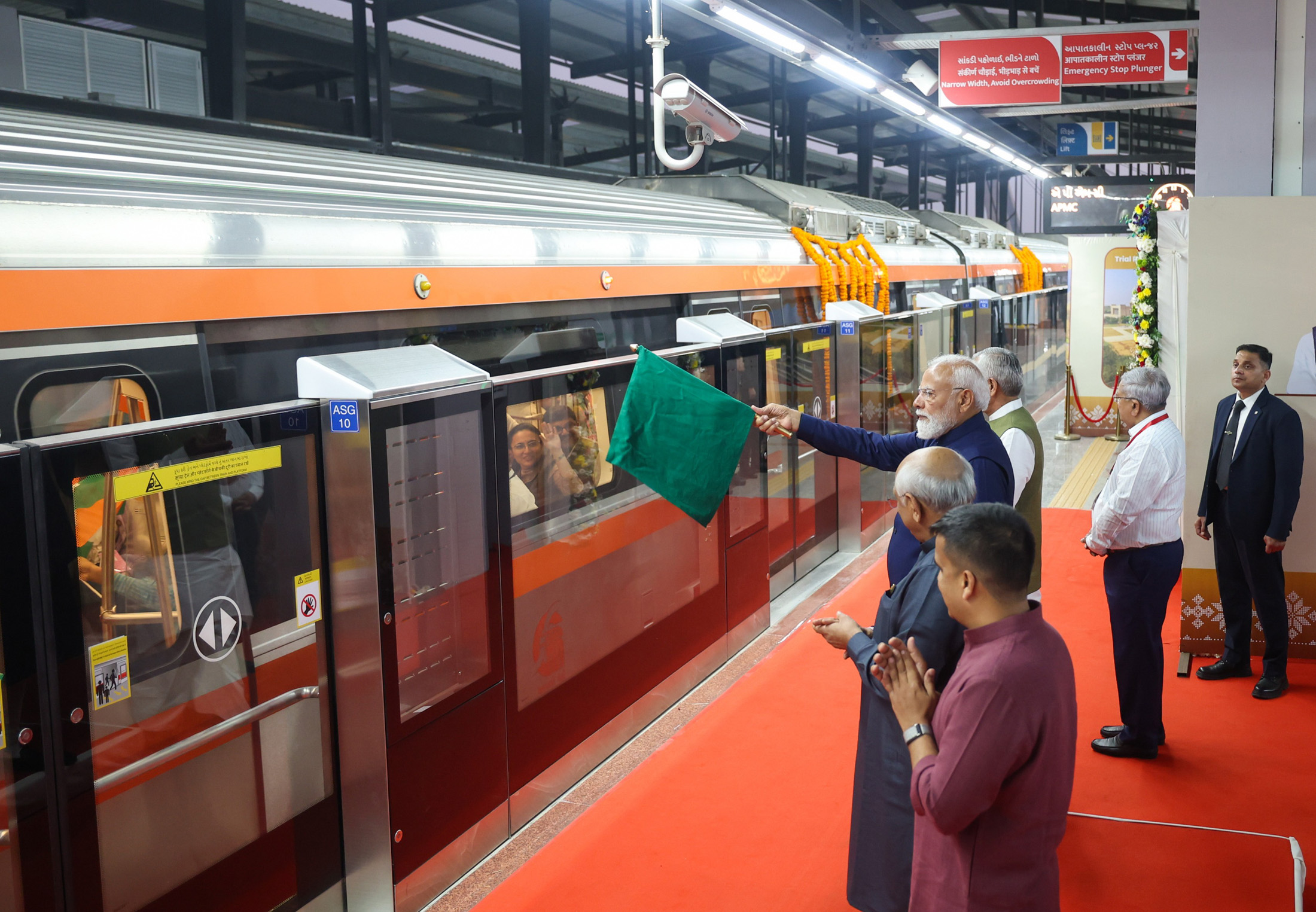
Modi flags off Ahmedabad metro phase 2 services
Prime Minister Narendra Modi inaugurated Phase 2 of the Ahmedabad Metro, flagging off services from Mahatma Mandir Metro Station in Gandhinagar. This marks a significant enhancement in urban connectivity for Gujarat.
The Prime Minister shared the milestone on X, highlighting the government’s commitment to boosting Ahmedabad's infrastructure. He noted that the newly inaugurated 7.8-km stretch from Sector 10A to Mahatma Mandir will improve the 'Ease of Living' for residents of Ahmedabad and Gandhinagar.
The new section, which includes seven operational stations, Mahatma Mandir, Sector-24, Sector-16, Old Secretariat, Akshardham, Secretariat, and Sector-10, expands the metro route to 28.25 km, linking Motera in Ahmedabad to Mahatma Mandir in Gandhinagar. The new connectivity promises faster, safer, and more comfortable travel, easing traffic congestion between the twin cities.