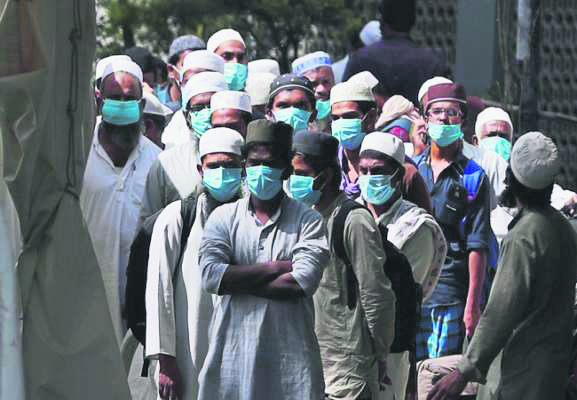
The death toll from the Covid-19 outbreak in India has reached 114 while the total number of positive cases touched 4,421 on Tuesday. The three- day Tablighi Jamaat congregation in New Delhi is responsible for causing over 1,000 positive cases in India. Government authorities are tackling a logistical nightmare as they try to map the movements of nearly four thousand people who attended the congregation in February-end and early March and then dispersed, many carrying the coronavirus to states across the length and breadth of India. While most of the attendees were identified, some are still hiding.
Authorities believe several clerics from Malaysia, Indonesia and Thailand, who transited through the Tablighi Jamaat markaz (centre) in New Delhi’s Nizamuddin West, may have been the original source of the infections in the cluster. The Centre released data that showed how the recent surge in cases are significantly linked to the infections spread through the Jamaat congregations. Minus the cases linked to the event, India’s Covid-19 cases would have doubled in 7.4 days, whereas it is doubling in 4.1 days at present because several infected members of the Jamaat dispersed across the country to spread the virus multiple times.
“The doubling rate, which means in how many days the number of Covid-19 cases double, at present is 4.1 days. But if cases reported due to the Jamaat event, had not come, then the doubling rate would have been 7.4 days,” health ministry joint secretary Lav Agarwal said. The ministry had said 30% of the total cases reported in the country so far were linked to Jamaat.
Around 274 districts across the country have reported Covid-19 cases so far. With increasing transmission of the disease to wider geographies, the cabinet secretary had asked district magistrates and collectors of different districts with larger number of cases to share their experience with other districts. In a meeting, district administrations from such districts including Bhilwara, Agra, Gautam Buddh Nagar, East Delhi and Mumbai shared their observations.
“The two key observations about strategies that worked were – one, proactive and ruthless implementation of containment measures at field level, and preparedness to the extent of being over-prepared,” Agarwal said. Besides, the government has decided to have a crisis management plan for Covid-19 in every district.
The government also allayed concerns over the spread of the virus through air, clarifying that the infection only transmits via droplets released due to coughing, sneezing and from the breath of a Covid-19 patient.
“The coronavirus infection is not airborne but a droplet infection. Had it been an airborne infection, every person in a family of an infected person would have caught the virus,” said Dr R R Gangakhedkar, head of epidemiology and communicable diseases at Indian Council of Medical Research (ICMR).
Meanwhile, to ease the burden of the affected, the government has offered free tests and treatment to beneficiaries of Ayushman Bharat (AB-PMJAY). "Testing and treatment of Covid-19 is already available for free in public facilities. Now, more than 500 million people, eligible under the health assurance scheme will be able to avail free testing through private labs and treatment for the virus in empanelled hospitals," said National Health Authority (NHA) in a statement.
Additionally, officials said that 22,000 people linked to the Jamat congregation have been quarantined as of April 5. They added that at least 1,023 confirmed cases have been linked to the Nizamuddin event. The Tablighi-linked infections spread across 17 states.