Back in 2001, when then chief minister Keshubhai Patel's health began to fail and the Bharatiya Janta Party seemed on the verge of losing control of Gujarat, national BJP leaders sought a new candidate for the post. Narendra Modi was chosen as a replacement. BJP veteran LK Advani, concerned with his lack of experience running a government and also shutting out Patel, offered to make Modi the deputy chief minister. The current Prime Minister however, declined the offer stating that he would either be fully responsible for the state, or not at all.
Modi replaced Keshubhai on October 3, 2001. The time was crucial as the BJP was marred with allegations of abuse of power, corruption, and poor administration following the Bhuj earthquake in the year. Modi was administered the oath of office on October 7, 2001, and he entered the Gujarat state legislature on February 24, 2002, by winning a by-election to the Rajkot II constituency. The show hasn't stopped for Modi since then. The best part about humble beginnings is the fact that up, is the only way to go. After 12 successful years as the CM of Gujarat, Modi went on to become the Indian Prime Minister in his first national elections. Even as the state deliberated over a government without Modi at its helms, it was grateful for the development and growth the leader had brought over the years.
Godhra Riots 2002
The first and by far the biggest hiccup on Modi's road was the 2002 Gujarat riots, that brought the state to the world's attention. A train carrying a large number of Hindu pilgrims returning from Ayodhya after a religious ceremony at the site of the demolished Babri Masjid was burned, killing at least 60 people. The incident prompted a set of riots, following a bandh call by the Vishwa Hindu Parishad. Anti-Muslim violence spread through out Gujarat, with several cases still running in courts.
Later, the government's decision to move the bodies of the train victims from Godhra to Ahmedabad further inflamed the violence. In a later toll, the Gujarat government informed that 790 Muslims and 254 Hindus were killed. CM at the time, Modi said the initial attack had been a terror attack planned by local Muslims. Several women and children fell victims to what ensued. The violence shockingly involved mass rapes and mutilations of women. The state administration back then was blamed of having been complicit with the riots. Many criticised Modi for his handling of the situation. The former RSS pracharak was accused of an “ethnic cleansing”. Even though the SIT did not find any evidence of his involvement, it is still a subject of debates today.
In true Modi style, as he was being widely blamed for his role in the riots, including him turning a blind eye, Modi later threw a challenge to all saying that he should be hanged if he is guilty of collusion. He also added that if he was proved innocent, the media should apologise for ruining his image. The leader said the way he handled the media was his only regret of the incident.
Surat Floods 2006
The Diamond Capital of India, Surat saw mass destruction 12 years back, when the city saw its most destructive flooding. Over the years, Surat has faces approximately 20 floods, but 2006 almost brought its doom, as it killed over 120 people, stranded tens of thousands in their homes without food or electricity, and closed schools and businesses for weeks. Analysts said the disaster was largely preventable, and while the government called it a “natural” disaster, it was more or less imposed by a lack of knowledge on the administration's part.
Heavy rainfall built up behind the Ukai Dam, approximately 100 kilometres upstream from the city. Dam managers, instead of releasing the water gradually, unleashed a deluge all at once, submerging large areas of Surat underwater with little notice. Committees concluded that the situation was created by a mismanagement of the dam operations. Destruction caused by flood waters had shaken the core of the rich city. Aid poured in from all around the world, and analysts were sure that Surat was devastated economically and would take 30 years to stand up. However, Surat sprung back into action within 6 years, shinier than before.
Cyclone 2015
Deep Depression ARB 02, or the 2015 Gujarat cyclone brought heavy rains to the Indian state in June 2015. Following a bout of heavy rains, the state was affected by floods, resulting in at least 80 deaths. The worst affected was Amreli district in Saurashtra, facing its worst flood in ninety years. Around 600 of the 838 villages in the district were flooded, over 400 villages were inaccessible with road and rail connections washed away due to flash floods, and there was no electricity. Heavy rains were experienced across the state with Saurastra and south Gujarat receiving 65.99 per cent and 37.82 per cent rainfall respectively.
Torrential rains at peak accumulations of 636 mm were experienced in Bagasara, 511 mm in Dhari, and 400 mm in Variyav. Crops faced severe damage and a large number of cattle died. The Gir Forest National Park and adjoining area housing Asiatic lions was severely affected. The carcasses of 10 lions, 1670 Black Bulls, 87 Spotted Deer, nine Black Bucks, six Wild Boars, and several porcupines were recovered. 112,217 farmers suffered major or minor damages with an erosion in 134,007 hectares of land.
The Gujarat State Government deployed the Indian Air Force and National Disaster Response Force for rescue and relief operation. IAF helicopters delivered over 200,000 food packets to villages, and evacuated around 4000 people from 17 villages. The government of Gujarat announced a Rs 3 billion relief package that included Rs 1.5 billion from the National Calamity Relief Fund.
Other than the stated disasters, the state faced droughts, floods, a Hepatitis outbreak, and other calamities. However, Gujarat today, stands as a testimony of what Narendra Modi envisioned for his home state, and what sheer grit, determination, and strength is capable of achieving.
Vibrant Gujarat 2003
A biennial investors' summit held by the government of Gujarat in the state since 2003, Vibrant Gujarat aims at bringing together business leaders, investors, corporations, thought leaders, policy and opinion makers. The two-day summit was first held during Navratri festival, in major cities of Ahmedabad and Surat. Then deputy prime minister of India, Lal Krishna Advani inaugurated the summit.
Over the years, the global investor's meet has only grown by size, with leading foreign agencies and companies extending their involvement in the meet. Also, public and private banks continue to forward financial support to the large-scale project.
Sabarmati Riverfront Project 2005
A waterfront project in Ahmedabad that was proposed in the 1960s, development along the banks of the river Sabarmati only began in 2005, and became one of Modi's pet projects. The major objectives of the project is environment improvement, social infrastructure and sustainable development. The riverfront helped the city restore its relationship with the river. A two-level promenade situated on both sides of the river, with the lower level only for pedestrians and cyclists, it was made open to the public in 2012 and is today, one of the star attractions of Ahmedabad. The upper level of the promenade is used to host several cultural events, hosts large public parks, plazas, and areas for commercial and retail development.
There is a lawn spanned across 40,000 square metres capable of hosting over 50,000 people. Also, the Sabarmati Ashram is connected to the lower existing steps and will be developed as an amphitheater. The Heritage Plaza along the city walls between Ellis Bridge and Nehru Bridge is designed as an open space showcasing heritage, history, and culture of the city. Activities along the are include boating, and zipline, Sunday markets, and fairs.
Kankaria Project 2008
One of the most-visited spots in Ahmedabad, Kankaria Lake is located in the heart of Ahmedabad, and has been a part of the city's history since the 15th century. Today, the lake is a hub for family events, and various activities. One would find it surprising to know that the world-class spot that attracts hundreds of people each day, once stood in a depleted, sorry state. Things changed when Modi took charge of the state. Kankaria Lake area was one of the first projects he undertook, as he was firm on wanting to alter the lake's image.
The lake was a scene of complete chaos, with unclean ghats, traffic, unorganised street life, and a congested eating area with street food vendors. The lake was unclean and its precincts were abominable. The Ahmedabad Municipal Corporation adopted a model of service delivery of various recreational activities through in-house planning and capacity building, along with a use of capable and experienced private sector agencies. The whole project was completed in 2008 at the cost of Rs 360 million. Kankaria was transformed into a complete entertainment centre. Facilities along the area include food courts, walkways, linear gardens, musical fountains, water activities, mini train, and a permanent fair.
BRTS 2009
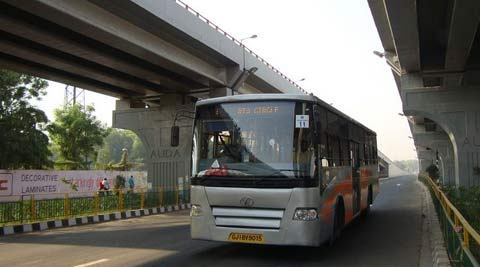
Janmarg, or Ahmedabad BRTS, which was designed by CEPT University, was inaugurated in October 2009. A bus rapid transit system with a network covering 89 kilometres and a daily ridership of 2,48,000 passengers, it has won several national and international awards for design, implementation, and operation. The BRTS has 17 lines, and 150 bus stops. Initiation of the service was implemented in three different phases, with the first inaugurated by then chief minister Narendra Modi. The network expanded to 89 km by 2015. Dedicated buses for women were introduced in January 2016, all at a total cost of Rs 1200 Crore.
Sardar Sarovar Dam 2017
Perhaps one of the most controversial constructions in the country, the Sardar Sarovar Dam is a gravity dam on Narmada river near Navagam. Four Indian states of Gujarat, Madhya Pradesh, Maharashtra, and Rajasthan receive water and electricity supplied from the dam. The project had begun in 1961, with the foundation stone laid out by then prime minister Jawaharlal Nehru. The second biggest dam in the world after the Grand Coulee Dam in the United States, its environmental impact and net costs and benefits are widely debated.
Several documentaries have been made protesting the harms of building the major project. Modi, even after taking office of the Prime Minister, continued to fight for the dam, finally making it happen. He inaugurated the Sardar Sarovar Dam in September last year.