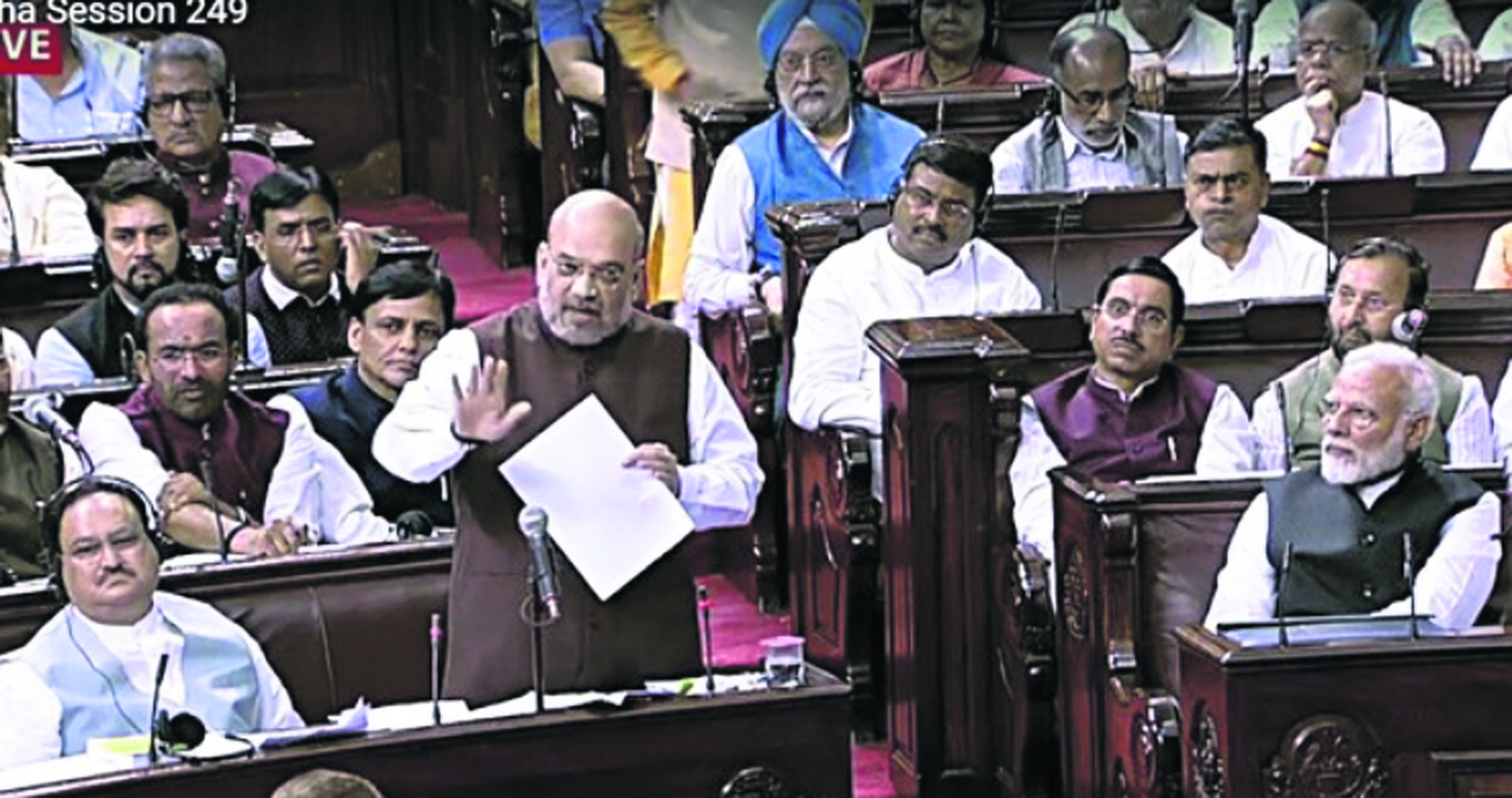
The BJP-led NDA government Monday revoked the special status granted to Jammu and Kashmir under Article 370 and secured Rajya Sabha’s approval for a Bill to bifurcate the state into two Union Territories - Jammu and Kashmir with a legislature, and Ladakh without one. The Bill was passed with a two-thirds majority of the members present in Rajya Sabha. In Lok Sabha, the Bill was taken up on Tuesday and passed by a voice vote with 351 members voting in its support and 72 against it, while one member abstained. With special provisions gone, Indian laws will now apply to the newly created Union Territories.
Union Home Minister Amit Shah, who tabled the Jammu and Kashmir Reorganisation Bill, 2019 and the statutory resolution in Rajya Sabha after the Union Cabinet met at Prime Minister Narendra Modi’s residence to give the go-ahead, said: “Article 370 was a temporary provision… how long can a temporary provision be allowed to continue… After abrogation of Article 370, Jammu and Kashmir will truly become an integral part of India.”
Saying Article 370 was at the root of terrorism, Shah told the House that full state status will be restored to Jammu and Kashmir at an appropriate time when normalcy returns. In a bid to assuage fears of violence, Shah told the House: “nothing will happen” and the region will not be allowed to turn into another Kosovo. “It was heaven on earth and will remain so… Give us five years, and we will make Jammu and Kashmir the most developed state in the country… I want to tell the youth of Kashmir Valley that have faith in Narendra Modi government. Nothing negative will happen.”
The decision of the government to do away with the special status to J&K and bifurcate the state into two UTs took the nation by surprise, and came after the state was placed under a lockdown with security forces imposing prohibitory orders, and communication lines being downed. Rajya Sabha saw uproarious scenes in the morning with the Opposition protesting the announcement by Shah but many in the Opposition ranks backed the government decision. By evening, the Bill had cleared Rajya Sabha - 125 votes in favour, 61 opposed and one abstention. Opposition BSP, BJD, AIADMK and YSR Congress voted in favour of the Bill. NDA partner JD(U) staged a walkout as did the TMC which, earlier in the day, opposed abrogation of Article 370. The TMC walked out before Shah began his reply to the debate. Two PDP members were evicted after one of them tore a copy of the Constitution, and the other his shirt. While the resolution was passed by voice vote, the Opposition BSP, BJD, AIADMK, TDP, AAP and YSRCP voted in favour of the Bill and the NCP said it abstained.
Cong split wide open
Congress leader and former MP Jyotiraditya Scindia tweeted in support of the government's move on revoking Article 370 and Kashmir's bifurcation. Another senior Congress leader Janardan Dwivedi also differed with his party on the abrogation of Article 370, saying a "historical mistake" has been corrected by the government. Dwivedi said that it is a matter of national satisfaction that a "mistake" done at the time of independence has been corrected. He personally addressed the issue as matter of satisfaction for the nation.
Former Congress MP Deepender S Hooda defied their party's stand on the issue in a tweet, "My personal view is that there isn't a need to have Article 370 in the 21st century. The move is not only in the interest of the country but also for the benefit of Jammu and Kashmir, which is an integral part of India. It is the responsibility of the government to implement the move in a peaceful environment."
In another setback for the Congress, its Rajya Sabha MP and chief whip Bhubaneshwar Kalita resigned from the membership of the House opposing the party's stand on the abrogation of Article 370. Rajya Sabha Chairman M Venkaih Naidu announced in the House that he has accepted Kalita's resignation. Amid opposition from Congress and Trinamool Congress, BJP found support in BSP and Aam Aadmi Party. Explaining the BSP’s call, Satish Mishra said: "It's not just Jammu and Kashmir that has minority Muslim community. The Muslims from there can go to other parts of the country and buy property there. But the minority communities from around the country can't do the same. This is why we have decided to support the Bill." Delhi Chief Minister Arvind Kejriwal also showed his support to the government's move.
The first resolution regarding the Bill said Article 370 will survive on paper but will now read “All provisions of this Constitution, as amended from time to time, without any modifications or exceptions, shall apply to the State of Jammu and Kashmir notwithstanding anything contrary contained in Article 152 or Article 308 or any other article of this Constitution or any other provision of the Constitution of Jammu and Kashmir or any law, document, judgment, ordinance, order, bye-law, rule, regulation, notification, custom or usage having the force of law in the territory of India, or any other instrument, treaty or agreement as envisaged under Article 363 or otherwise’.”
The second resolution regarding the Bill said the President has referred the Jammu and Kashmir Reorganisation Bill, 2019 to the House “under the proviso to Article 3 of the Constitution of India for its views as this House is vested with the powers of the State Legislature of Jammu and Kashmir, as per proclamation of the President of India dated 19th December, 2018.”
“All the provisions of the Constitution, as amended from time to time, shall apply in relation to the state of Jammu and Kashmir…” the notification said. The government has added in Article 367 of the Constitution a clause 4 which makes four changes. The order said references to Sadar-i-Riyasat of Jammu and Kashmir shall be construed as references to the Governor of J&K. Similarly, references to the Government of J&K shall be construed as references to the Governor of J&K acting on the advice of the Council of Ministers.
Leader of Opposition Ghulam Nabi Azad said millions of civilians and scores of security personnel had made supreme sacrifices to keep J&K with India. He condemned the tearing of the Constitution, but said the BJP has “murdered the same Constitution and democracy…The Article 370 through which we had given Jammu and Kashmir to India… today the Modi government has torn it to pieces.”
Hitting back, Shah said the Bill he has tabled is historic. “Because of Article 370, people of Kashmir are living in poverty. They don’t get the benefit of reservation… Corruption is rampant. Three families have looted Jammu and Kashmir all these years. The Leader of the Opposition has said Article 370 attached J&K to India. That is not true. Maharaja Hari Singh signed the Instrument of Accession on October 27, 1947. And Article 370 came into existence in 1949, two years later. It is not true that Article 370 attached J&K to India.”
He said Article 370 was always considered temporary because it had to go one day. “But no one had the political will… then there was vote bank politics… they wanted to make a vote bank out of it. We don’t want to make a vote bank and neither do we lack political will,” he said.