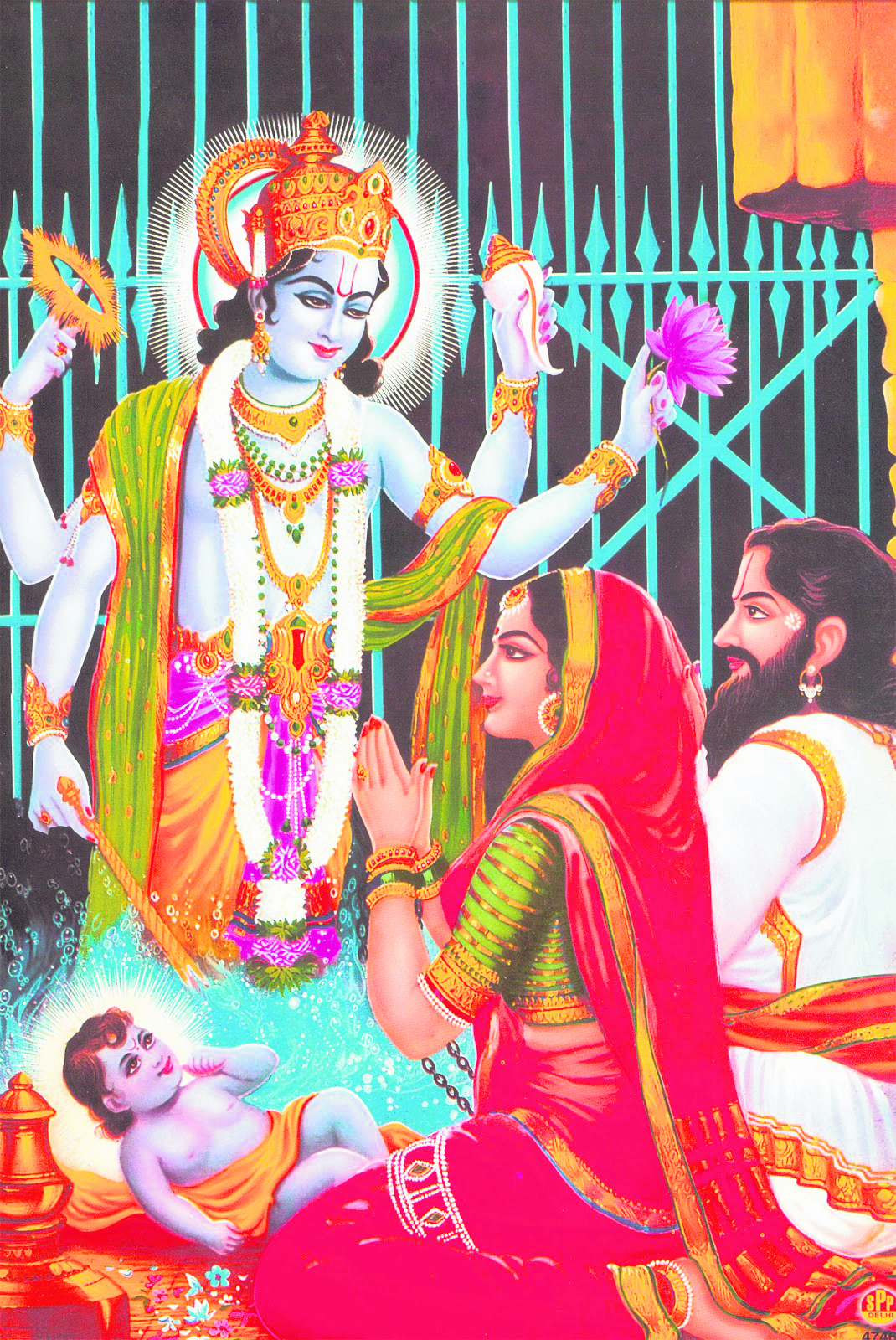
Every year, on Janmashtami, Hindus all over the world celebrate the birth of Lord Krishna. He was born on 'Ashtami', the eight day of the holy month of Shravana. The eighth avatar of Vishnu, Krishna's birth is an annual Hindu festival during which, idols of baby Krishna are bathed in milk, honey, and water, and dressed in new clothes. Dance, drama, enactments of the life of Krishna- Ras Lila, and devotional singing is held through midnight when Krishna is believed to have been born. People also observe a fast, a night vigil and the next day a festival is held as part of Janmashtami celebrations.
Janmashtami or Gokulashtami is celebrated particularly in Mathura and Vrindavan, and being a major Vaishnava-Hindu festival, it is also celebrated in Gujarat, Maharashtra, Karnataka, Kerala, and other regions.
Said to have been arrived in an era of chaos, when freedom was a luxury and evil was everywhere, Krishna was born in a prison cell to Devaki and Vasudeva. Prisoners to evil King Kansa, who was determined to kill any child born to his sister because of a diving prophecy, Vasudeva rushed Krishna across the river Yamuna to foster parents Nanda and Yashoda, in Gokul.
How it is celebrated?
Every Hindu household witnesses the festival in their personal way. While several customs and rituals are duly associated with the celebrations, but variations do prevail in all these customs. For some rituals might be common to all while others are unique and restricted to a particular region or city. What remains identical, is the vigor and passion with which the devotees of Lord Krishna observe the festival.
After Krishna's midnight hour birth, statues of baby Krishna are washed and clothed, then placed in a cradle. Devotees then break their fast, by sharing food and sweets. Women draw tiny foot prints outside their house doors and kitchen, walking towards their house, a symbolism for Krishna's journey into their homes.
Observance of a day-long fast is a common tradition in India. Devotees break their fast only once with the birth of Lord Krishna at midnight. However, many people prefer to have only milk and milk products as these are considered to be the favourite of Lord Krishna. There are also ardent devotees who go to the extent of keeping 'Nirjal' fast, in which they go through the entire day without even a drop of water. Devotional songs are sung all day in the celebration of Janmashtami. Devotees chant special shlokas and mantras so they could please the Lord and seek his blessings. Singing of bhajans along with aarti is a prevalent norm in the celebration.
Along with the chanting of mantras, a ritual is also undertaken in which 108 names of Krishna are chanted and then his idol is showered with flowers.
The most important ritual however, is the swinging of the child god. Swings are tied or constructed, and idols of baby Krishna are placed inside. Devotees swing the Lord as it is considered to be auspicious. In cities like Mathura, Dwarka, Vrindavan, and Mumbai, the ritual of Dahi-Handi is observed, which is an enactment of Lord Krishna trying to grab butter from the pot. Lord Krishna's love for maakhan is well-known, and this tradition is an ode to the child's notoriety.
An earthen pot filled with milk mixed with ghee and dry fruits is suspended on a height of approximately 20 feet. Then as per customs, a group of boys form a pyramid and try to break the pot in an organised manner. Crowds gathere around throw water on them in a goofy gesture of stopping them from getting hold of the pot. The act of Dahi-Handi is believed to throw away negativity and bad omens away, and bring in prosperity and happiness.
One of the star attractions of the festival, the Raslila is held, in which the love of Gopis (cow-hoarding girls) for Krishna is performed. The traditional depiction of their love is only enacted as a play. It is said that as Krishna wanted to give every Gopi equal importance, he always stood in the middle of a circle surrounded by the girls. There are several types of Raslila that are performed. There is the Janamleela, Shankarleela, and the Putanaleela.
Celebration in Gujarat
Gujarat celebrates the festival with certain peculiarity. All rituals are mainly performed by folk women. They give up all their household chores in order to play cards. Though the exact history of this peculiar tradition is not know, it is believed that as the women observed fasting all day long, and kept awake the entire night, they engaged themselves in playing cards.
Rituals in South India
The houses in South India are beautifully decorated by women on the occasion. Various sweet dishes are prepared and offered to the Lord. Butter is offered so that the Lord remains at peace and showers his blessings over everyone. Apart from preparing sweet dishes, every one draws footprints of a child across their homes, thus epitomising the birth of the Lord. These footprints are drawn with the mixture of water and flour. The custom creates a feeling of joy among people as they feel that the Lord himself has entered their house to shower his blessings upon his devotees. The day is marked with the ritual of chanting of the holy Bhagavatam, accompanied by singing of devotional songs and dances.
Prasad
Amongst an array of sweets and other delicacies, one prasad synonymous to Janmashtami is the Panchamrit. 'Panch' meaning five and 'Amrit' meaning nectar, it is the mixture of milk, honey, ghee, curd, and Tulsi.
Teachings of Krishna that we can apply to our daily lives
One of the most revered Gods in Hindu religion, Krishna's teachings on various aspects of human life during the epic battle of Mahabharata are famous and widely accepted. The holy Bhagwad Gita consists only of his teachings and forms as a guide for Hindus and others who follow it.
Four Kinds of Actions:
Lord Krishna says there are four kinds of actions or karma that a human can perform. They are Kamya Karma (actions performed for selfish gains), Nishiddha Karma (actions that are forbidden in holy texts and scriptures), Nitya Karma (actions that must be performed daily) and finally Naimittika Karma (actions that must be performed on certain special occasions).
Lord Krishna clearly prohibited his devotees to perform the first two kinds of Karmas as they lead to rebirth and laid stress on the performance of the latter two as they help in getting Moksha or Nirvana or salvation.
Liberation and Bondage
He emphasised on being free from all kinds of negative and positive emotions like that of joy, grief, sorrow, happiness, jealousy for they are considered to be illusions or maya. These emotions are transient and thus, bound to fade away. All the beings are thus bonded but one can set oneself free and achieve liberation once they realize that the world is nothing but an illusion. All the souls taking birth on the Earth must thus surrender to Lord, be free from attachments to living and non-living objects. One should not become conditioned by body or any other worldly things around.
Satsanga
Satsanga means being in the company of Sadhus or the knowledgeable one, if one is in the company of such persons one is sure to reduce as well put an end to attachment of all kinds. According to the famous teachings of Lord Krishna, satsanga is described as the fastest way to be closer to him and be sheltered in his company.
Stories of Lord Krishna
====>
Krishna defeated Arishtasura
Krishna’s uncle, the evil King Kamsa was always insecure as he knew that he will meet his end only because of Krishna. In one of his many attempts to kill the young God, he once sent a wild bull demon Arishtasura to Vrindavan. It created massive havoc by uprooting trees and destroyed all houses. The people in Vrindavan began to run for their safety. All villagers went to Krishna and asked his help. Just a kid who was busy playing with his friends on the banks of Yamuna River, Krishna observed that the bull is not ordinary, but a demon in disguise. He took the bull by its horns and flung him around, shattering his horns. When the bull collapsed on the ground, a spirit left the body and transformed into a human. The man bowed before Krishna and told his story, how he was a disciple of Brihaspati, and because of his disrespect towards his Guru , he was cursed to be a demon. He thanked Krishna as because of him, he got relief from the curse.
====>
Young Krishna lifts Govardhan Hill on one finger
The people of Vrindavana were preparing for a great puja for Lord Indra to please him for giving them abundant rainfall when required. When Krishna (a young boy at that time) came to know of this, he went to his father Nanda who was the leader of that village and said that Govardhan Hill deserved their worship and thanks more than Indra. He argued that Govardhan was the one to provide them with clean water and air as well as herbs that had healing properties. He was able to convince Nanda and the village elders. So they offered their worship to Govardhan instead. Lord Indra saw everything that had happened and got angry by the fact that the people of Vrindavana had listened to a mere child and believed in what he had said. So in order to teach the people a lesson, he sent a huge storm to destroy the village. Krishna protected all the animals and the people from this storm by lifting the Govardhan Hill with one finger. Everyone remained safe there till the rain stopped. Indra realized who the boy was and apologized for what he had done.
====>
Krishna stops Duryodhana's yagna
Before the great Mahabharata war, Duryodhana wanted to do a yagna to ensure his victory in the war. So he asked Sahdev to give him the best date. Sahdev was a great astrologer and did his profession with great dedication. So even though Duryodhana was an enemy he helped him. He told him to conduct the Yagna on New moon day. This upset the Pandavas and Krishna because a yagna on the new moon day would guarantee Duryodhana’s victory. In order to stop this Krishna started doing Pitru tarpana a day before the new moon. When the sun and the moon heard of this, they came to Lord Krishna for an explanation as to why he was doing the tarpana today instead of the next day. To this Krishna said that the new moon day was the day the sun and the moon came together and they were together now in front of him. So this was the new moon day. Due to this Duryodhana was unable to perform the yagna on the right day and Krishna ensured that he wouldn’t win.
BOX
VHP Ilford Committee to hold Janmashtami celebratons at Ilford Hindu Centre
7.00 PM till midnight. Hosted by Anand Kumar Sahi and family, the celebration will be carried on till midnight, when an Aarti will be conducted. Bhojan Prasad will be served.
Watford Temple Hosts Biggest International Festival For Janmashtami
Bhaktivedanta Manor Hare Krishna Temple will host over 50,000 people for the largest ever celebration of the advent of Lord Krishna on Sunday 2nd September and Monday 3rd September 2018. The joyous festivities are welcome to all and transform the usually serene temple grounds into a resplendent festival site of colourful marquees showcasing dance, drama, multimedia and music both contemporary and traditional.
Srutidharma Das, Temple President of Bhaktivedanta Manor said, “The manor was gifted to us by George Harrison in 1973 and it carries on his legacy of sharing ancient wisdom and cultural richness of the east. The festival message is simple and universal, through love we connect, we belong and we transcend.”
Visitors and pilgrims will enjoy complimentary vegetarian food and can browse bazaars selling an eclectic array of delicatessens, books, handmade jewellery, music and organic produce. A family event, there is something for everyone including a designated children’s area full of fun-filled activities like face painting, henna, arts and crafts, and games. Visitors are also welcome to visit the New Gokul Farm, which provides sustainable living and cow protection sheltering sixty cows, oxen and bulls.
One of the highlights amidst the festivities is a walk through the recreation of the beautiful Vrindavan forests, where Krishan played as a young boy, on the way to the temple's exquisitely decorated deity altar. One of their new exhibits this year is Om Nom, a happening new yoga and food initiative. The festival promotes the importance of love and community in what is today a very diverse society.