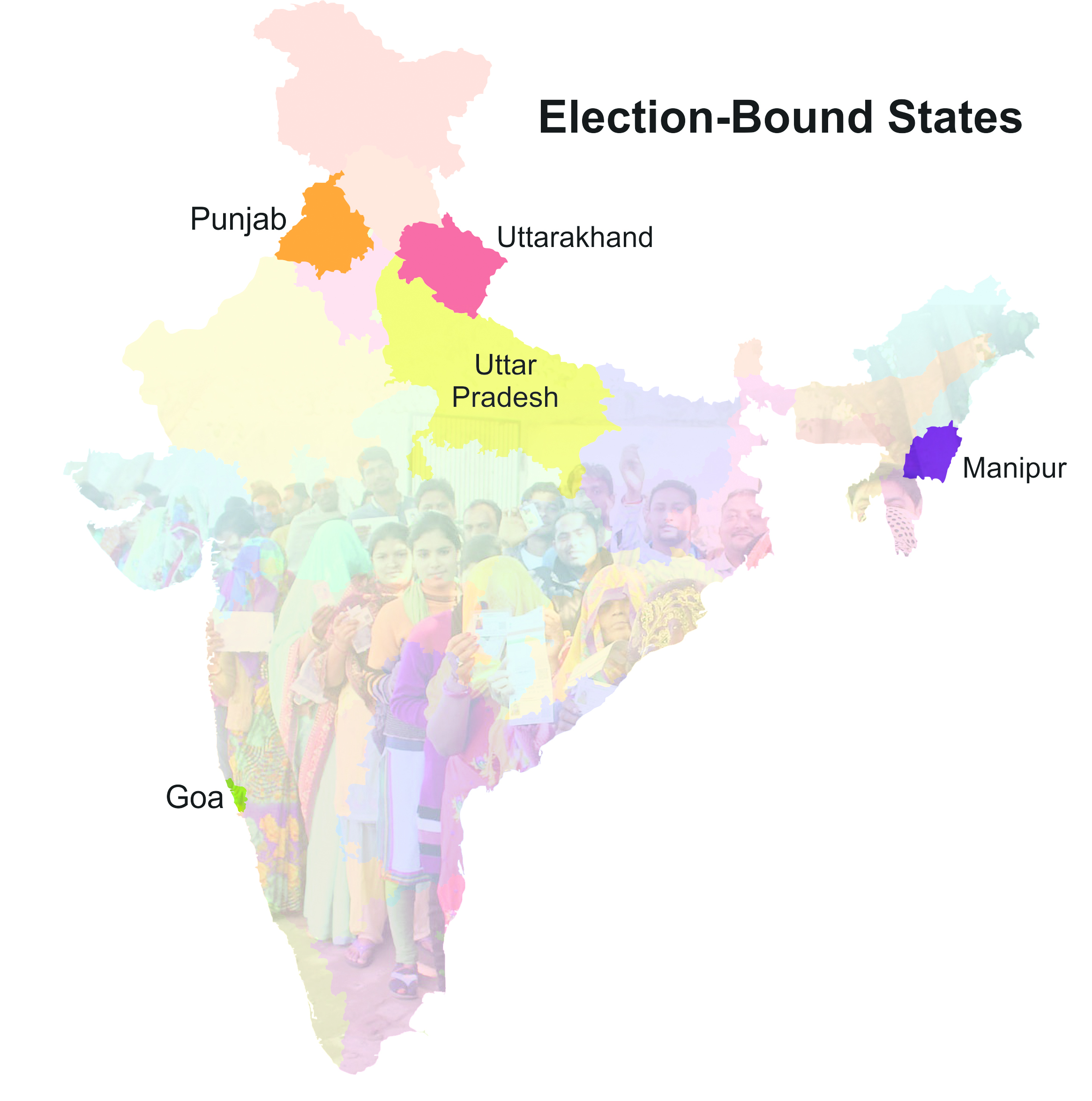
Fight for power commenced early February, as five major states in India began to vote. National parties, PM Narendra Modi's BJP, Sonia Gandhi's Congress, and Arvind Kejriwal's AAP find themselves in a headlock, trying to clinch as many states as possible. As the major parties fight for votes, what they failed to comprehend is the role of regional parties, and their influence on their respective regions.
Regional parties, and independent candidates often serve as a trump card for the winning party. However, there are states like Uttar Pradesh, where the Yadav rule is so strong, not even Akhilesh's 'gundaraj' could prevent his loyal voters from choosing him yet again. Punjab has AAP written all over it, as the northern state strikes as having lost tolerance for the ruling Badal family. The year 2017 seems to be the year for state parties, as the BJP and Congress play second fiddle in their own orchestrated drama.
The thing worth noticing is that Punjab, Goa, Uttarakhand, and Manipur, put together do not even account for half of Uttar Pradesh's population. Some pundits believe that BJP could put up a good show in Rajya Sabha after the elections. Meanwhile, if the Samajwadi Party and Congress doesn't fare well, it may become difficult for them to survive.
Punjab
Turning Punjab Assembly elections upside down, Delhi Chief Minister Arvind Kejriwal's Aam Aadmi Party is giving ruling Shiromani Akali Dal-Bharatiya Janta Party and the Congress, a run for their money. With an almost lethal combination of a political campaign riding on the incessant drug abuse issue in the state, and people's disenchantment with the Badals, Kejriwal seems to have finally found the recipe to success. Political analysts and election surveys have bet their money on AAP, after the February 4 voting, vote banks seemed to lean their preferences towards the party.
If the HuffPost-C Voter pre-poll survey is to be believed, AAP is all set to take over Parkash Singh Badal's Punjab. It had predicted that the AAP is poised to win 63 of the 117 seats in Punjab Assembly elections, with Congress maintaining the second place with 43 seats, and SAD-BJP alliance with a petty 11. It expects the Akali-BJP vote-share to halve, with the AAP's victory in the state to be bigger than the combine's last victory tally. But such predictions have proved to be wrong in the past.
Uttar Pradesh
Phase 1 of the UP Assembly elections is over, and it appears that the state has locked down in a triangular contest. With Mayawati's Bahujan Samaj Party, Narendra Modi's Bharatiya Janta Party, and UP Chief Minister Akhilesh Yadav's Samajwadi Party in alliance with Congress. Not only do the two regional parties make BJP's chance of winning very problematical, Modi's November 8 cash ban did nothing to boost his prospects.
To break it down in percentage, Mayawati's BSP can smoothly finish the ride with 20 per cent of the state's Dalits and half of the Muslim population which accounts for 19.3 per cent of the overall population of the state. Add to it 2 per cent Brahmin vote banks and Maya can install yet another statue of herself right in front of Akhilesh's house. Meanwhile, the SP finds support with 10 per cent of UP's Yadavs, 12 per cent of the Muslim vote, 2-3 per cent of the Thakur vote bank, and 5 per cent of other backward classes. Muslim vote is anticipated in lieu of Akhilesh and Congress alliance. Either ways, national BJP finds itself on its way back to the Capital.
Goa
The state registered a record turnout of 83 per cent in the elections held on February 4. This year, the ruling BJP finds itself in a fight with Opposition Congress, AAP, and a Goa Suraksha Manch-Maharashtrawadi Gomantak Party-Shiv Sena alliance, for the 40 member House. It is expected that several BJP loyalists to swing towards MGP-GSM-Shiv Sena alliance, while AAP is believed to have found support from Catholics, who have until now, remained Congress supporters. Former bureaucrat and AAP's CM candidate, Elvis Gomes said, "Our chances are improving by the day. We declared 36 candidates 15 days before the election dates were announced but the other parties are still struggling with their candidates." This year, Goa election finds itself in a four-cornered fight, with regional parties riding high.
Uttarakhand
Polling for 69 Uttarakhand Assembly seats will be conducted on February 15. The last couple of months have been dramatic, with the BJP calling Congress Chief Minister Harish Rawat of turning the 'Devbhoomi' into 'Lootbhoomi', and the Congress claiming that the Central party makes tall promises which the people of Uttarakhand will reject.
Manipur
The upcoming Manipur election, as Uttarakhand, will be a close and straight fight between the Congress and the BJP. Having won more than a two-third majority in the 2012 assembly elections, and staying in power for three consecutive terms, Congress appears to have higher stakes. On-hand state issues are - formation of new districts, a 79 day old economic blockade by the United Naga Council, and territorial integrity of the state in view of ongoing talks between the Centre and insurgent group NSCN. Given the problems, people's sentiments remain with the Congress.