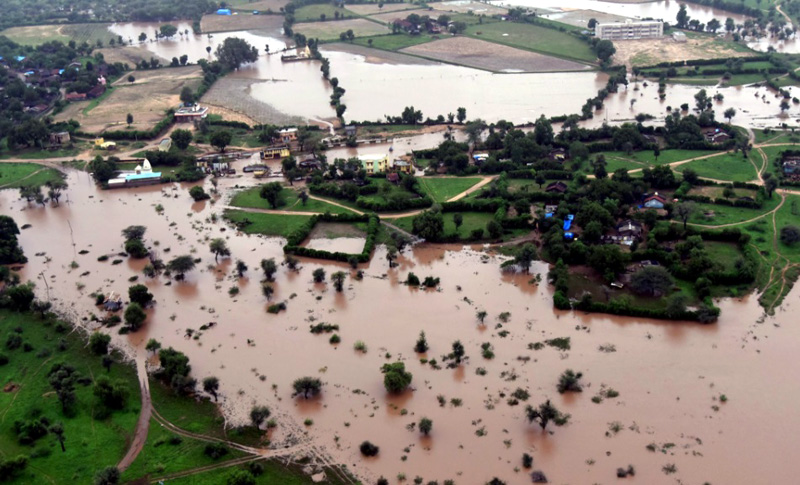
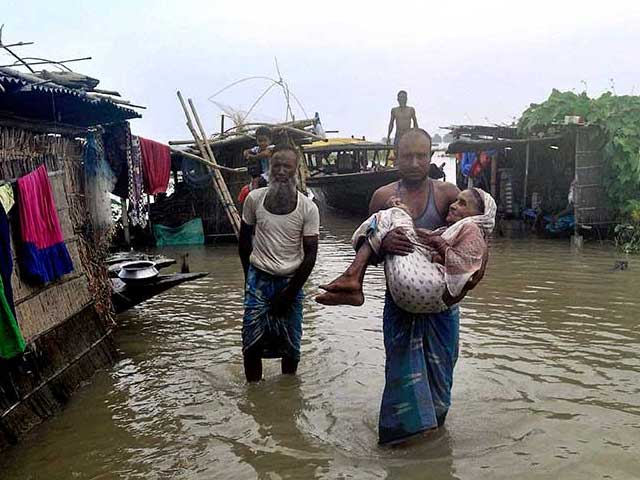
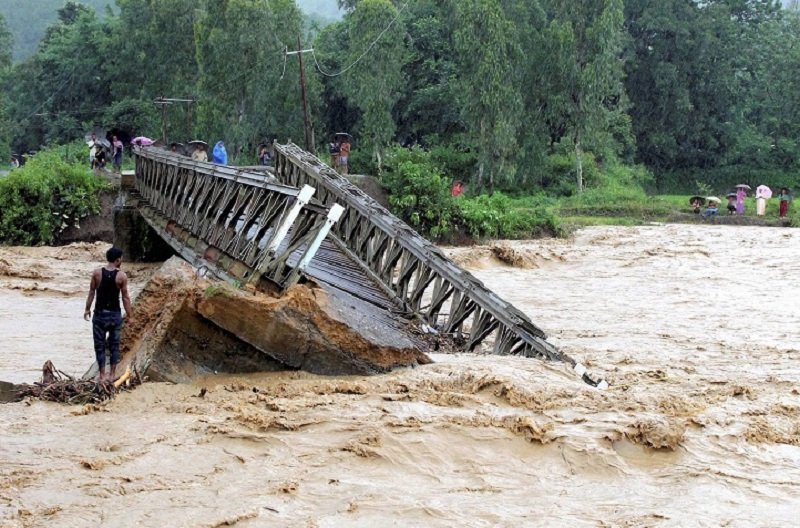
Floods have ravaged parts of eastern and western India this year, leaving at least 600 people dead and displacing thousands. The government has announced aid packages for affected areas and Prime Minister Narendra Modi visited Assam this week, reviewing the damage done by the glaring monsoon. Modi said he aims to find a “permanent solution” to the flooding the state faces every year. Rains also damaged tracts of agricultural land and infrastructure in the northern states of Bihar and Himachal Pradesh, as well as West Bengal. The country's meteorological department, meanwhile, has said that heavy rains are likely to continue.
Modi has been accused of bias in its offering of financial assistance, after he announced to give Gujarat £50 million. However, minister of state in the home ministry Kiren Rijiju announced that several state governments are yet to fully utilise funds meant for relief and rehabilitation. Rajasthan, Arunachal Pradesh, Odisha are among troubled states. While leaders in several of these states are seeking more funds, the Centre claims that many are yet to use the money they already have.
“Assam, for instance, has over £50 million which has not been used, even as it wants around £300 million as interim relief. Similarly, Odisha has £82.4 million. Many other states have enough money lying with them. An inter-ministerial group is now visiting Assam to take stock of the situation. If it finds the requirement of more money, we will provide it,” a government official said
Rijiju said that primary responsibility to deal with natural calamities lies with state governments and the Centre only supplements their efforts by offering financial and logistical support. He asserted that states have adequate funds to tackle disasters, that are replenished with additional relief amount when exhausted. “I can assure this House that the government is fully committed to ensure that nobody suffers due to want of the action from the Government of India. We are fully committed. We reassure state governments that we will be there whenever you require us,” he said.
Gujarat
Western Indian state of Gujarat saw rains in bounty this year as floods claimed 213 lives. Officials said that death toll doubled over the last two days as over a 100 bodies were found once waters began receding. As many as 450,000 people are known to have been affected in the state. An officials said that many affected people in Gujarat had begun returning to their villages.
"The death toll in Gujarat this monsoon has risen to 213," A J Shah, director of relief operations with the Gujarat government said. Overwhelmed authorities described their struggle to cope with the number of bodies needing identification and post-mortems. An official at the state's emergency control room explained that “only after a post-mortem is conducted we can officially confirm death of a person. Since many bodies were found, postmortem took time hence the sudden jump in numbers.”
Over two villages were submerged in water in hard-hit Banaskantha district. Rescue workers moved about 130,000 people from low-lying, dangerous areas as helicopters and boats tried to reach those still stranded. Modi had surveyed the devastation across the state from the skies last week, and reassured that all help was being provided to the affected.
Rajasthan
The Army rescued 27 people from rain-hit areas of Rajasthan where relief works continue. The worst affected districts in the region is Jalore, Sirohi, and Pali, and several villages continue to be surrounded by water with no connectivity by road. Jalore District Collector Laxminarayan Soni said, “There are nearly 30 villages in the district which have been inundated or surrounded by water and arrangements for food packets and water bottles are being made.”
He added that nearly 400 people have been rescued in the last two days and over 7,000 people in many villages have been asked to shift to safer places. Sanchore's Taitrol village is among the worst-hit areas. Parts of the village are submerged in neck-deep waters. Hundreds of houses have been completely submerged and carcasses of animals, including deer, can be seen floating around.
Assam
Modi reached Guwahati to assess the damage from floods, just a week after he visited Gujarat. He saw similar devastation in both the states. Over 130 lives were lost and 2500,000 people affected across the north-eastern states in Arunachal Pradesh, Assam, Manipur, and Mizoram. While Assam has experienced worse floods, the number of deaths this year has been unprecedented. Officials from the Assam State Disaster Management Authority officials said 83 people have died so far, eight of them in Kamrup district straddling Guwahati.
Four were electrocuted when a large part of the city was under waist or neck-deep water. The rising level of water has affected over 1700,000 people across 29 of the state's 32 districts, with 15,746 of them evacuated by relief and rescue personnel. Standing crop on 209,051.65 hectare was damaged while 131,899 were scattered across 363 relief camps. Bahruddin Ajmal, Lok Sabha member and chief of All India United Democratic Front, said, “Scores of lives have been lost in the floods that left several thousand hectares of agricultural land covered with sand. We want the victims to be suitably compensated.”
Manipur has suffered a loss of £21.31 million, since Cyclone Mora hit the state in May, followed by a monsoon deluge. Principal Secretary MH Khan said the floods killed 19 people, damaged 85,226 hectares of agricultural land, 19,095 houses, 421 government infrastructure including 128 schools, 43 bridges and 35 market sheds, Damage in Arunachal Pradesh remains to be assessed, but a major landslide at Laptap village, near state capital Itanagar buried 14 people alive.
Lightning kills 37 in Odisha
Lightning killed at least 36 people and critically injured 37 in several districts of Odisha last week. While some of the victims were working in the paddy field, others had taken shelter under trees. This is the highest number of deaths due to lightning in one day in the state.